
Website articles  (56) Courtesy: Gateway House
19 March 2026

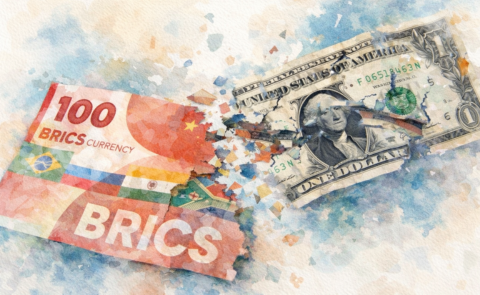
BRICS CBDCs can lead to financial multipolarity

India’s proposal to link the digital currencies of the BRICS nations could alter how emerging economies settle trade deals. It is necessary to examine the reasoning behind such a move, its effort to reducing dollar dependence, and the benefits that accrue to India.
Website articles  (44) Courtesy: Indian Navy
26 February 2026

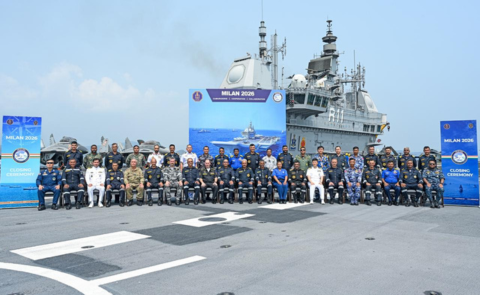
Indian Navy advances ambitions, enhances diplomacy

Over the last two decades, the Indian Navy has taken a quantum leap in modernising its fleet with stealth frigates, warships, submarines, and fighter planes. Its goal is to be the net security provider and first responder securing Sea Lines of Communication in the region. But it is still lagging behind its Indo-pacific naval partners and most important, its regional rival, China.

US Embassy and Consulates in Italy Courtesy: US Embassy & Consulates in Italy
18 December 2025

U.S.’ National Security Strategy 2025

It is customary for every U.S. president to release a National Security Strategy (NSS) early in their tenure. President Trump published the NSS for his second term in November 2025. It’s a contrast from his 2017 NSS, which addressed broad threats. The 2025 version is narrower, emphasising trade over security, with the Western Hemisphere being the primary area of focus. Is the U.S.’s global role shrinking?

AFP (1) Courtesy: ANI
16 October 2025

Uncertainty around the Quad

The Quad summit is expected to be hosted by India in the second half of 2025, possibly in November. However, the grouping faces turbulence that transcends the current flow of India-U.S. relations. The relevance of Australia and Japan, too, needs to be factored in. Beijing considers the Quad as “the Asian NATO” that aims to contain China. Since the commencement of Trump 2.0, the grouping has been struggling to redefine its role and mandate.

X  @Narendra Modi Courtesy: X / @narendramodi
4 September 2025

Modi in Japan: a larger Asia mission

Prime Minister Narendra Modi’s visit to Japan is significant for India domestically and its extended Asian influence. His visit, just prior to the SCO Summit in China, represents a shrewd endeavour at balancing the several priorities of Indian foreign policy

Damon Coulter  SOPA Images  Alamy Courtesy: Damon Coulter / Alamy
21 August 2025

Rise of the Japanese Right

The recent election for Japan’s Upper House of Councillors is a pivotal moment for Japanese politics, revealing fractures within the ruling coalition and a simultaneous rise of the political right. Economic discontent, cultural anxieties, and effective digital mobilisation are converging. Is this a fleeting moment for Japan, or the start of a deeper, more profound change in its political landscape?

ANI Courtesy: ANI
14 August 2025

Is Russia a Red Line for India?

U.S. President Trump will meet Russian President Putin on August 15. A positive outcome may mean removal of punitive U.S. tariffs on India for buying Russian oil and resolving its dilemma of placating a partner country with growing commercial, geopolitical and defence ties, or pursuing strategic autonomy, keeping its old friends and take an economic hit? Is Russia the red line for India?

Website articles  (22) Courtesy: Getty Images
3 July 2025

Diversifying supply chains for critical minerals

The Quad Foreign Ministers’ Meeting in Washington on 1 July, 2025, underscored the importance of diversified and reliable global supply chains, especially for critical minerals. A Gateway House report shows how to strengthen supply chains for rare earths by creating deep financial markets similar to those that exist for bullion and oil.

Gateway House Courtesy: Gateway House
3 July 2025

China Plus One and global supply chains

A slowdown of the Chinese economy, and the shift, particularly by MNCs, from China to other more competitive locations has opened up business opportunities for latecomers to supply chains in the developing world. Evidence suggests that Southeast Asia and some South Asian countries like India, Sri Lanka, Bangladesh, could be beneficiaries of the supply chain shift, particularly in labour-intensive segments.

East Asia Forum Courtesy: East Asia Forum
26 June 2025

Canada, India and the G7 Summit

Most multilateral and plurilateral institutions have lost their significance and ability to shape the trajectory of international relations today. The G7 is no exception. It is impacted by the shift of power from the Atlantic to the Pacific, and an intra-Atlantic rift. The G7 discussions reflected this. More positive were the sideline discussions on repairing the India-Canada bilateral.