Website articles  (5) Courtesy: Körber-Stiftung
6 July 2026

Tested, Trusted, Torn? Emerging Middle Powers Report 2026

The third Emerging Middle Powers Report reveals interesting trends. In every recent year, the five countries surveyed – India, Germany, South Africa, Brazil, and Indonesia – have been tested by events to prove they can prevail over the contested terrain of global politics. A pattern has emerged linking them together: non-alignment is their preferred response to a fragmenting order.
Gateway House Courtesy: Gateway House
4 June 2026

A BRICS Energy Stability Framework

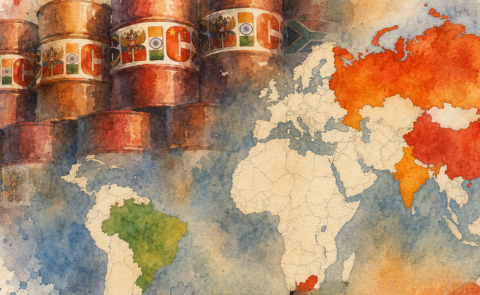
The 2026 Persian Gulf conflict has pushed energy security to the forefront of the BRICS agenda. Divergent national interests prevent the grouping from acting as a unified geopolitical bloc, the growing energy crisis highlights the need for stronger economic cooperation. Proposals such as a BRICS energy reserve, an Energy Stability Fund, and cross-border investments could enhance resilience and be essential if BRICS wants to emerge as a serious economic grouping.

DD India Courtesy: DD India
4 June 2026

BRICS at a Pivotal Moment

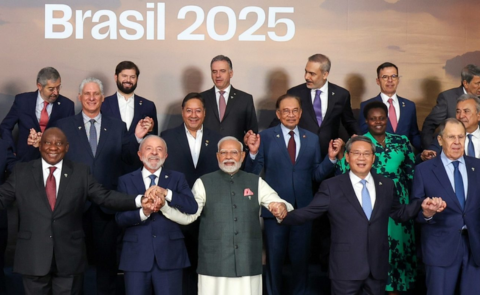
BRICS is too significant to ignore but too fragmented to drive meaningful change for the developing world. The West Asia conflict, U.S. tariff threats over de-dollarisation, UNSC reform divisions, and the presence of regional rivals has exposed its internal strains. Will India’s ongoing 2026 chairship rise above the contradictions, and manage to turn BRICS from a reactive forum into a more assertive and credible global force?

Screenshot 2025-10-13 103335 Courtesy: Körber-Stiftung
13 October 2025

Bandung at 70: Multilateralism in a New Era of Multi-Alignment

The world is facing multiple crises which are shaking the foundations of multilateralism. The West’s structures are faltering, and the need for effective and equitable cooperation is greater than ever. Seventy years after the 1955 Bandung Conference, its principles of sovereignty, territorial integrity, cooperation and solidarity remain vital. This report revisits Bandung’s relevance for today’s reform efforts, urging renewed Global South–Europe collaboration for a sustainable global future.

Getty (1) Courtesy: Gateway House
15 May 2025

The New Geopolitics and South Asia’s Trade Architecture – What Next?

Geopolitics is increasingly intertwined with the economic destiny of South Asia. Even before the U.S. tariffs were rolled out, growing polycrises had hit the global economy, which has been struggling since the pandemic. South Asia seems a relatively bright spark of regional trade and growth. This paper analyses South Asia’s trade architecture in the backdrop of a sluggish world economy in the 2020s, and makes recommendations for closer regional economic integration.

Report Courtesy: Körber-Stiftung
17 April 2025

Momentum for Middle Powers: Emerging Middle Powers Report

The world is undergoing profound transformations that are not being driven only by the United States, China or Russia. Small and medium-sized States are carving out a legitimate place for themselves in the emerging new order. This second edition of our annual Emerging Middle Powers Report is a reminder that the signs of the times are showing a new momentum for middle powers.

15-Patel-Prakash Courtesy:
5 December 2024

Applying a multi-sector analysis to financing forced displacement response

Conversations on forced displacement in many cases still centre on the climate versus conflict dichotomy, but multiple factors including social inequality, poor infrastructure and weak governance, often combine as triggers for displacement. A more analytical approach to financing forced displacement response is necessary to enable humanitarian actors to work more effectively in the allocation of resource and disaster preparedness.

Screenshot 2024-11-06 at 3.04.26 PM Courtesy: Gateway House
7 November 2024

India-Indonesia: Companion Souls in a New Era

India and Indonesia have a comprehensive strategic relationship built on their ancient and modern histories, and a flourishing relationship sustained by trade, economic exchange and people-to-people contact. The India-Indonesia Track 1.5 Dialogue, hosted by Gateway House and the Centre for Strategic and International Studies, Indonesia, aims to provide policy recommendations to promote innovation and navigate evolving governance issues through bilateral and multilateral cooperation.

Screenshot 2024-08-01 125830 Courtesy:
1 August 2024

China in South Asia

China and India both give great importance to their neighbours – the former through its Friendly Neighbourhood policy, the latter through Neighbourhood First. Although China has been increasing its influence in the region, narratives that say that India is losing out to China lack in-depth analysis. To deduce the future trajectory of China in South Asia, it is important to study both China’s and India’s relations with each of these countries, as also with each other.

SriLankaCrisis Courtesy: Business Standard
9 May 2024

Sovereign default and economic crisis in Sri Lanka

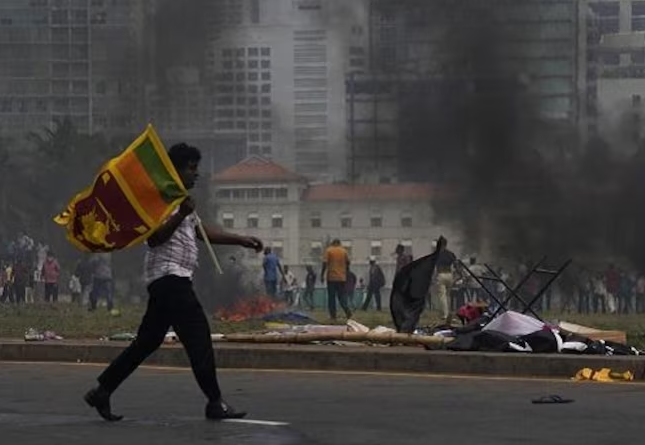
In April 2022, Sri Lanka defaulted on its foreign debts kicking off its worst economic downturn in over 70 years. In a paper for the Institute of South Asian Studies, Ganeshan Wignaraja examines key policy, the benefits of IMF support, and the role that Indian aid has played in Sri Lanka’s recovery while emphasising potential risks of its upcoming presidential and parliamentary elections.