


In every recent year, the emerging middle powers have been tested by events to prove they can prevail over the contested terrain of global politics. In 2026, it is the U.S.-Israel war against Iran, which has compounded pressures on the global fuel, fertiliser and food markets, leaving middle powers to absorb significant costs while finding little traction in efforts to halt the fighting. In 2025, it was by U.S. tariffs, with India and Brazil being among the hardest hit. In 2024, it was by the Israel-Gaza war, now confined but looming darkly. In 2023, the war in Ukraine raised pressing questions about whether emerging middle powers can work together to promote peace and alleviate economic strain, especially in the developing world.
Beneath this rhythm of annual crises, a pattern has emerged. What links the five countries surveyed here is a shared posture: non-alignment as the preferred response to a fragmenting order. Non-alignment here is more the seeking of autonomy and less a position of neutrality. From Brasília to Pretoria, Jakarta and New Delhi, and more quietly Berlin, experts say their country increasingly resists having to choose sides. This is a pragmatic recalibration to a global order marked by an unpredictable U.S., an assertive China and institutions built for an earlier world. The practice of non-alignment still varies (read more on page 45) – Germany’s version is not India’s, and Indonesia’s is not Brazil’s – but the underlying drive is similar. This posture is no longer confined to the Global South.
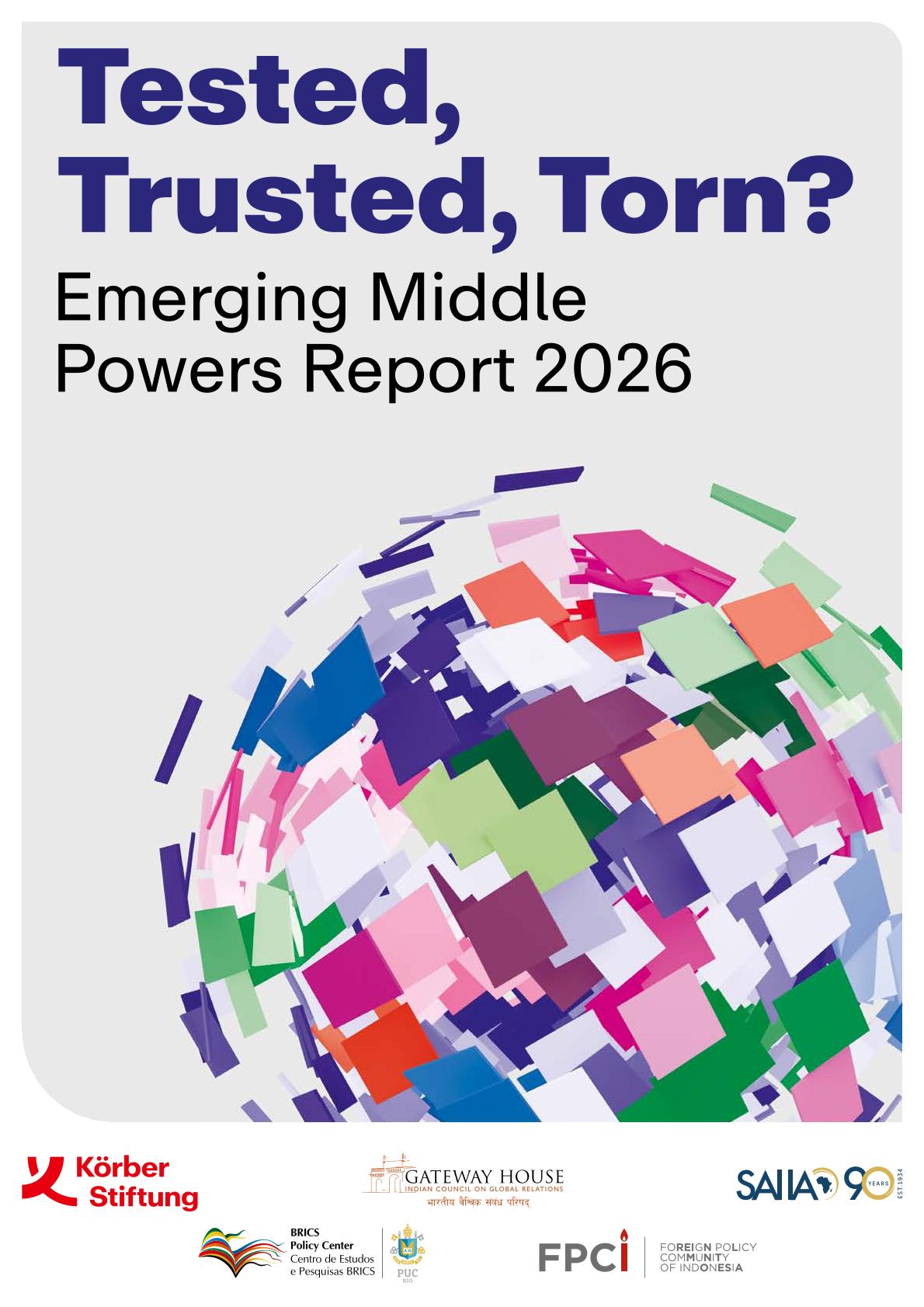
You can download the 2026 Emerging Middle Powers Report here.
Manjeet Kripalani is the Executive Director of Gateway House.
Dr Sarah Pagung is the Executive Director of International Affairs at Körber-Stiftung.
Florian Bigge is the Programme Director of International Affairs at Körber-Stiftung.
Paulo Esteves is a member of the Academic Council, BRICS Policy Center.
Carlos Frederico de Souza Coelho is a researcher at BRICS Policy Center.
Gustavo de Carvalho is the Acting Head, African Governance and Diplomacy Programme, South African Institute for International Affairs (SAIIA), Johannesburg.
Steven Gruzd is the former Head of African Governance and Diplomacy Programme, South African Institute of International Affairs (SAIIA).
Dr Dino Patti Djalal is the Founder and Chairman of Foreign Policy Community of Indonesia (FPCI).
Jenny Sari Winata is the Programme and Research Manager at Foreign Policy Community of Indonesia (FPCI).
Jonathan Lehrer is the Programme Manager, Körber-Stiftung.
Leona Harting is the Programme Manager, Körber-Stiftung.
Lisa Salzwedel is the Programme Manager at Körber-Stiftung.
Raveena Shivashankar is the Digital Media Associate at Gateway House.
Support our work here.
For interview requests or for permission to republish, please contact outreach@gatewayhouse.in.