

Amid the noise surrounding the current tussle at Tata Sons, few have listened carefully to what Noel Tata, a member of the Tata family and one of two Tata Trusts representatives on the Tata Sons board, has been saying. He issued a statement in which he emphasised that listing Tata Sons, the Tata Group’s holding company, would destroy the ‘Tata Model.’[1] He added that the Group was conceived as a national service carried on through business for over a century. If listed, it will destroy “the operating model of this House”, which has stood the test of time for more than 158 years. Effectively, short-term shareholder gains will take precedence over the long-term pioneering research, incubation, and industrial execution that Tata Sons and the Trusts together oversee. This will result from the Trusts’ shareholding being diluted after a public listing.[2]
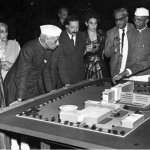
To understand the low-key ‘Tata Model’ of philanthropy through business, a good example is Mumbai’s Tata Institute of Fundamental Research (TIFR, est. 1945), founded during J.R.D. Tata’s stewardship of Tata Sons. The Trust that provided seed capital of Rs 4,00,000 for building its Colaba campus, and funds for the first nine years since its founding, was the Sir Dorabji Tata Trust (SDTT).[3] The erstwhile Bombay government contributed Rs 2,00,000The erstwhile Bombay government contributed Rs 2,00,000; through the personal intervention of PM Nehru, India’s Ministry of Defence parted with 130 acres in Colaba’s Navy Nagar for the campus, and the central government put up additional via the Council for Scientific and Industrial Research.[4]

Source: TATA. Year 1954.
Although TIFR was the brainchild of Dr Homi H. Bhabha, a young accomplished theoretical physicist from Cambridge University, it never would have been built without the Tata Trusts’ initial majority contribution. Bhabha’s vision remains intact today because, under a 1955 trilateral agreement, the head of SDTT serves as chair of the TIFR Council and continues to provide vision, guidance, and commitment to date.[5][6]This unique governance structure and partnership between private capital and government is the Tata Model, and it has evolved over time, as TIFR’s history shows.
The early 1940s, when TIFR was established, were tumultuous years. The Second World War (1939-45) was ongoing, and it kept the brilliant physicist Dr Homi Jehangir Bhabha from returning to England after travelling home to India in 1939 to visit family. This was also the time when India was on the cusp of Independence, and plans were already underway for rapid economic development after independence. One problem remained: an energy gap. It was clear that India would be partitioned and, in addition to losing its oilfields in Burma, which had been overrun by Japan in 1942, India would likely lose its oilfields in Kaur, Attock, in Northwest Punjab. The popularity of the internal combustion engine meant the country would remain a net importer of petroleum. To make post-Independence India energy self-sufficient, the country’s scientific community and its soon-to-be first prime minister, Jawaharlal Nehru, were convinced that nuclear energy was the answer.[7]
Against this geopolitical and economic backdrop, Dr Bhabha proposed an institute for blue-sky research in the physical sciences. He ran this idea by JRD Tata, who suggested he work on detailed plans to present to the Trustees of SDTT. The Sir Dorabji Tata Trust was recommended because one of its objects was ‘the advancement of learning in all its branches especially research work in connection with medical and industrial problems.’[8] Bhabha did not immediately convince the Board about the need for an institute of fundamental research for India on the lines of those he had worked in abroad. It was only after JRD Tata put his weight behind the project that it took off. Thanks to his backing, TIFR (est. 1945) joined the ranks of two other pioneering institutions established by SDTT within a span of a decade: the Tata Institute of Social Sciences (est. 1936) and the Tata Memorial Hospital (est. 1941).
Source: Captain Haseler (via Past-India)
TIFR, established on 1 June 1945, originally operated out of the cosmic ray unit at another Tata-established institute, the Indian Institute of Science (IISc) in Bangalore.[9] Space soon ran out, and in October that year it shifted to new premises in Bombay: Bhabha’s birthplace, the Kenilworth bungalow on Peddar Road.[10] Sir John Colville, governor of Bombay, inaugurated the new premises on December 19, 1945.
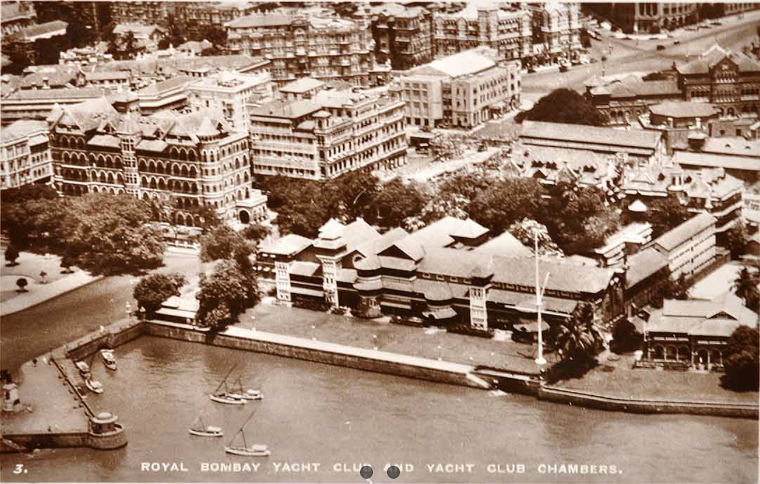
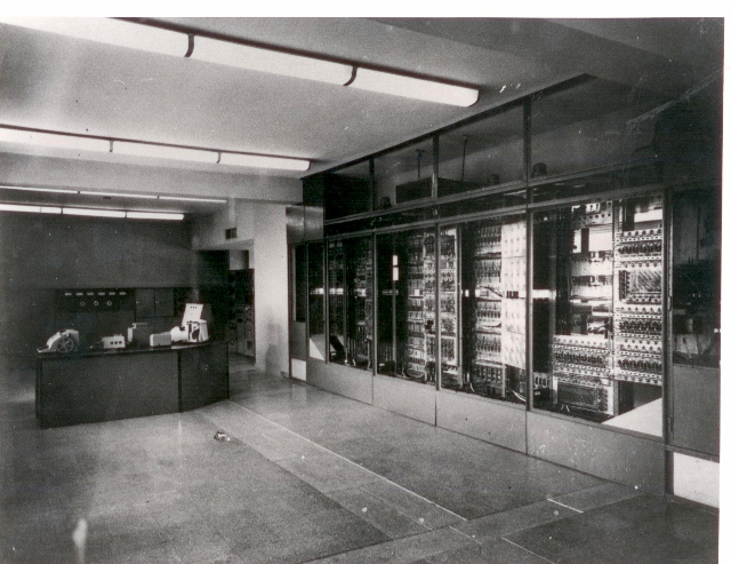
TIFR grew fast. The Nuclear Emulsion and the Electron Magnetism Group started in 1953. Work in Computer Science and Technology began in 1954.[11] This necessitated more space, and the institute’s shift to the southern tip of Bombay city began when the sea-facing premises of the Old Royal Bombay Yacht Club at Apollo Bunder were acquired in 1949 to house TIFR’s fast-expanding work.
Source: TIFR Archives
Despite the whirlwind of setting up different specialised groups, the focus on nuclear energy was never lost. Almost simultaneously with establishing TIFR, the Atomic Energy Commission (1946) was set up in Bombay, with Bhabha as chairman. From TIFR also grew the Department of Atomic Energy (1954), which in the early years (but no longer) was considered part of TIFR and is today based in its old premises at the Old Yacht Club at Apollo Bunder.
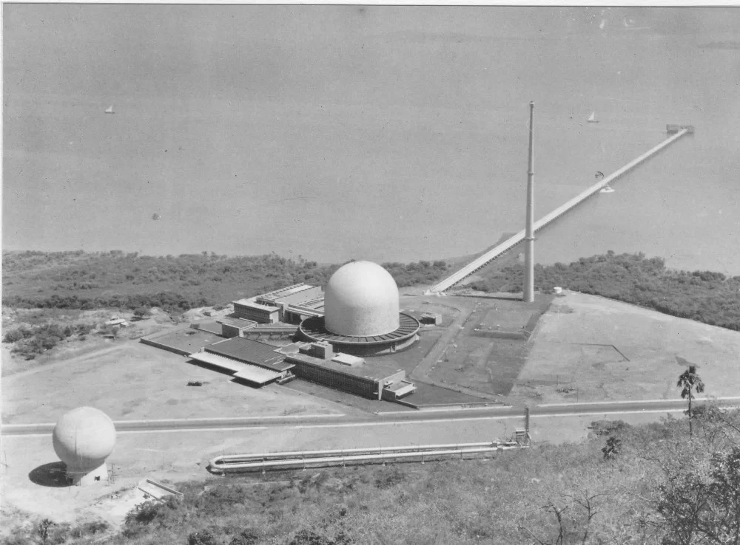
India joined the nuclear club after its first indigenously built experimental nuclear reactor, Apsara, went critical in 1954 at the Atomic Energy Establishment at Trombay (AEET). To consolidate TIFR’s expertise in reactor design, instrumentation, metallurgy, and materials science, the government spun off a separate institution on January 3, 1954—the Atomic Energy Establishment Trombay (AEET), later renamed the Bhabha Atomic Research Centre after Bhabha’s death in 1966.
A critical pivot in TIFR’s evolution was the Tripartite Agreement of 1955-56.[12] The funding contribution and involvement of the Government of India, the Government of Bombay and the Sir Dorabji Tata Trust were restructured. The new setup envisaged extensive financial support from the Government of India and, correspondingly, a greater and more permanent representative on TIFR’s Council of Management. But with a key provision: the SDTT chairman would always chair the Council.[13]
Source: The Society for the Preservation of Canada’s Nuclear Heritage
India built its first nuclear reactor, the Canada India Reactor Utility Services (CIRUS), at AEET’s Trombay campus in 1956, the same year TIFR restructured its funding and governance.[14] This nuclear reactor, which used Canadian natural uranium and US heavy water, went critical in July 1960.[15] This was soon followed by a 1963 bilateral agreement between India’s Department of Atomic Energy (DAE), when Dr Homi Bhabha was secretary, and the International Atomic Energy Agency, which resulted in the establishment of units one and two of the Tarapur Atomic Power Station, just north of Bombay, which still supplies electricity to the states of Maharashtra and Gujarat.[16] It made TIFR the cradle of India’s nuclear research, and along with AEET (Trombay), AEC and DAE, it gave the country atomic energy and its nuclear program.
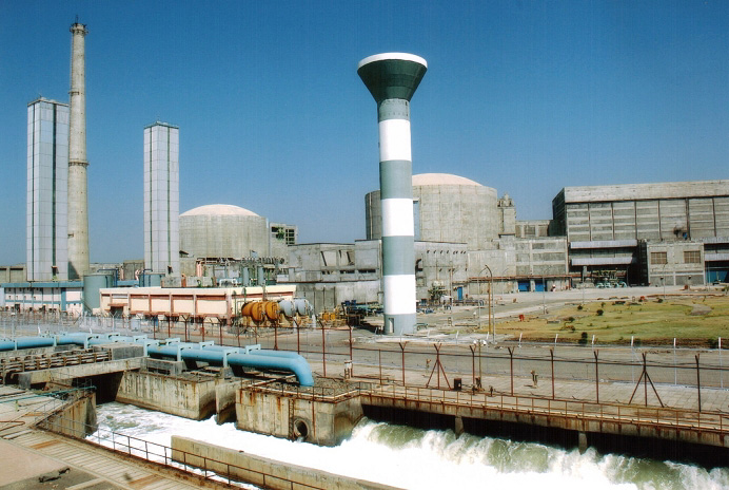
Source: Department of Atomic Energy.
This public-private partnership model between the government and the Tatas has been time-tested not only by TIFR’s high-quality research and the institutional ecosystem it has spawned, but also by two enduring facts.
First, having the chair of SDTT heading the TIFR Council, like Ratan Tata most recently did, has ensured that fundamental research feeds into medical institutes and industry. Ratan Tata’s abiding interest was nuclear medicine and genetics. He ensured that the research carried out at TIFR and its sister institutes, the National Centre for Biological Sciences, the Tata Institute of Genetics and Society (TIGS), BRIC-inStem, and C-CAMP (a vibrant incubator), all in the Bangalore Life Sciences campus, feeds into India’s cancer research centres and hospitals, like Tata Memorial Centre.
Second, the SDTT’s continued presence on the Council has ensured project-wise endowments to TIFR, such as the Rs. 1 crore it donated on TIFR’s Golden Anniversary (1995) to establish its archives and chair professorships.[17]
This public-private partnership in institution-building is a critical part of the Tata Model that Noel Tata refers to. This makes the Trusts a vital bridge between the philanthropy it practices and industry-scale incubation.
Sifra Lentin is Bombay History Fellow at Gateway House.
This article was exclusively written for Gateway House: Indian Council on Global Relations. You can read more exclusive content here.
Support our work here.
For permission to republish, please contact outreach@gatewayhouse.in
©Copyright 2026 Gateway House: Indian Council on Global Relations. All rights reserved. Any unauthorised copying or reproduction is strictly prohibited.
References:
[1] Mitra, Chandrajit. “Tata Sons IPO Could Destroy Group’s National Service Character: Tata Trusts’ Noel Tata,” NDTV, September 18, 2026, https://www.ndtv.com/india-news/tata-sons-ipo-could-destroy-groups-national-service-character-tata-trusts-noel-tata-12061056.
[2] Under the RBI’s NBFC regulations, Tata Sons is designated as a Core Investment Company and Non-Banking Financial Company – Upper Layer. This requires that it be a publicly listed company.
[3] The Sir Dorabji Tata Trust was then chaired by Sir Sohrab D. Saklatwala.
[4] The term Bombay Government is a reference to erstwhile Bombay State, which was partitioned on 1st May 1960 to form the states of Maharashtra and Gujarat.
[5] Dr Homi Bhabha was related to the Tata family through Lady Meherbai Dorabji Tata. He was her nephew.
[7] In the 1940s, the thorium-rich sands of the Kerala Coast were identified as the fuel to power this growth.
[8] Lala, R.M., The Creation of Wealth (Bombay, IBH Publishers Pvt. Ltd., 3rd Edition, 1992), p. 154
[9] The IISc was set up by the founder of the Group, Jamsetji Nusserwanji Tata, in collaboration with the government of the princely state of Mysore and the colonial government. J.N. Tata viewed establishing IISc as a national need and priority. This Institute was completed after J.N. Tata death in 1904. The annual income of the Institute (Rs. 2,62,500/-) was thus made up of Rs. 1,25,000 /- from Mr Tata’s two sons (Dorab and Ratan), Rs. 50,000 /from the Mysore Durbar, and Rs. 87,500/- from the Government of India. The Mysore Durbar contributed a further Rs. 5 lacs towards capital expenditure, and the Government of India added Rs. 2.5 lacs in accordance with its promise of a grant-in-aid.
Harris, F.R., Jamsetji Nusserwanji Tata: A Chronicle Of His Life
[10] The Kenilworth bungalow no longer stands, and in its place are buildings for the staff of the Department of Atomic Energy and Bhabha Atomic Research Centre. There is a plaque on the boundary wall facing the main Peddar Road commemorating Kenilworth Bungalow as the birthplace of Dr Homi Bhabha and TIFR’s first home in Bombay.
[11] The first pilot machine became operational in 1956, and TIFRAC (Tata Institute of Fundamental Research Automatic Calculator) was commissioned in February 1960.
[12]“History,” Tata Institute of Fundamental Research, https://www.tifr.res.in/maincampus/history.php.
[13] Today, more than 99% of the expenditure of the Institute is borne by the Government of India. The Institute comes under the purview of the Department of Atomic Energy through which all grants are channelled.
[14] It was built under a bilateral treaty with Canada, which supplied the natural uranium used in this reactor, and a contract with the United States, which supplied heavy water used as a moderator for this reactor. CIRUS was modelled on the Canadian Chalk River National Research X-perimental (NRX) reactor. Similar to the one signed much later with the U.S. and the International Atomic Energy Agency (IAEA), called the ‘123 Agreement’ (1963). India’s next two reactors were 160 MWe Boiling Water Reactors at the Tarapur Atomic Power Station (TAPS), just north of Bombay.
[15] The CIRUS reactor was decommissioned in 2010.
[16] “Tarapur Atomic Power Station – Units 1 and 2,” Tata Consulting Engineers, https://www.tataconsultingengineers.com/project/tarapur-atomic-power-station-units-1-2/.
[17] “[Endowment],” Tata Institute of Fundamental Research, https://www.tifr.res.in/endowment/.