Gateway House Courtesy: Gateway House
4 June 2026

A BRICS Energy Stability Framework

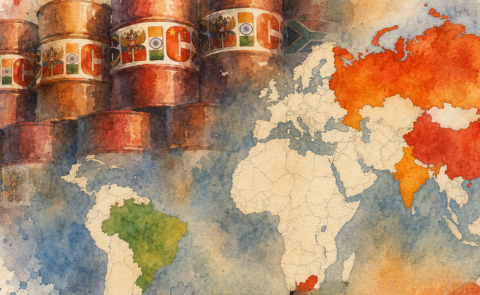
The 2026 Persian Gulf conflict has pushed energy security to the forefront of the BRICS agenda. Divergent national interests prevent the grouping from acting as a unified geopolitical bloc, the growing energy crisis highlights the need for stronger economic cooperation. Proposals such as a BRICS energy reserve, an Energy Stability Fund, and cross-border investments could enhance resilience and be essential if BRICS wants to emerge as a serious economic grouping.

DD India Courtesy: DD India
4 June 2026

BRICS at a Pivotal Moment

BRICS is too significant to ignore but too fragmented to drive meaningful change for the developing world. The West Asia conflict, U.S. tariff threats over de-dollarisation, UNSC reform divisions, and the presence of regional rivals has exposed its internal strains. Will India’s ongoing 2026 chairship rise above the contradictions, and manage to turn BRICS from a reactive forum into a more assertive and credible global force?

Getty (1) Courtesy: Gateway House
15 May 2025

The New Geopolitics and South Asia’s Trade Architecture – What Next?

Geopolitics is increasingly intertwined with the economic destiny of South Asia. Even before the U.S. tariffs were rolled out, growing polycrises had hit the global economy, which has been struggling since the pandemic. South Asia seems a relatively bright spark of regional trade and growth. This paper analyses South Asia’s trade architecture in the backdrop of a sluggish world economy in the 2020s, and makes recommendations for closer regional economic integration.

Screenshot 2024-08-01 125830 Courtesy:
1 August 2024

China in South Asia

China and India both give great importance to their neighbours – the former through its Friendly Neighbourhood policy, the latter through Neighbourhood First. Although China has been increasing its influence in the region, narratives that say that India is losing out to China lack in-depth analysis. To deduce the future trajectory of China in South Asia, it is important to study both China’s and India’s relations with each of these countries, as also with each other.

SriLankaCrisis Courtesy: Business Standard
9 May 2024

Sovereign default and economic crisis in Sri Lanka

In April 2022, Sri Lanka defaulted on its foreign debts kicking off its worst economic downturn in over 70 years. In a paper for the Institute of South Asian Studies, Ganeshan Wignaraja examines key policy, the benefits of IMF support, and the role that Indian aid has played in Sri Lanka’s recovery while emphasising potential risks of its upcoming presidential and parliamentary elections.

Supply-chains-cover Courtesy: Gateway House
5 July 2023

The Great Supply Chain Shift from China to South Asia?

Supply chains are central to the new chapter of India-U.S. relations. Simultaneously, China-centric global supply chains, which underpinned East Asia’s prosperity, are changing as multinationals re-assess risks in the post-Covid era. Is the shift to India and the rest of South Asia occurring? This paper finds that South Asia supply chain pessimism could be changing, and India can spread gains through regionalising supply chains in its neighbourhood.

BoB3 Courtesy: The Strategist
1 June 2023

Food, Energy & Finance Connectivity in the Bay of Bengal

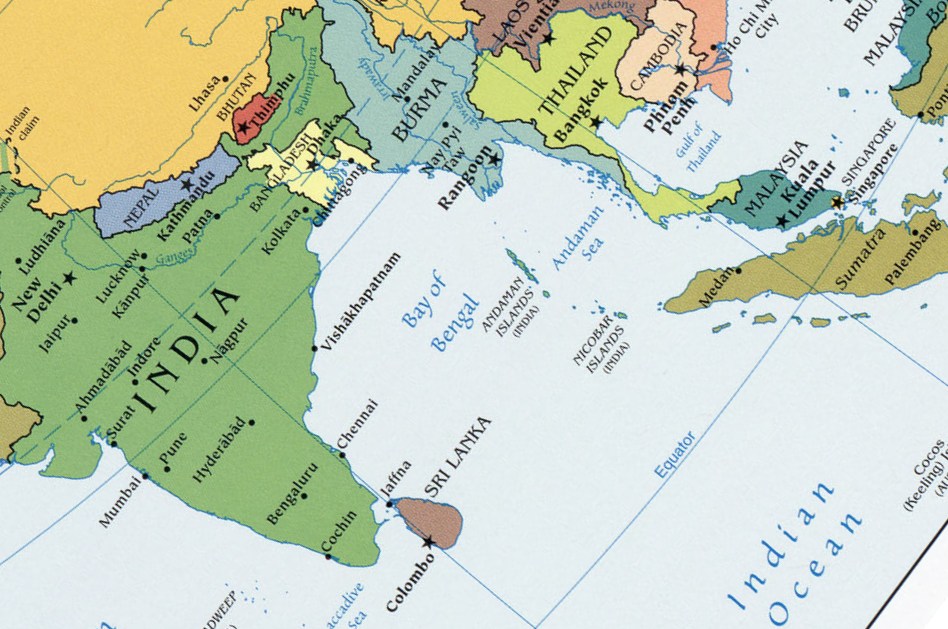
Despite its natural advantages, the Bay of Bengal region lags economically, in part due to insufficient connectivity between the member nations. Improving financial connectivity between them is the first step to easing movement of goods, services and people. Greater financial collaboration also can help the region mitigate the impact of ongoing geopolitical upheavals that have caused food and energy prices to rise.

AI-agriculture v1 Courtesy: Billionphotos.com
11 August 2022

Artificial Intelligence for India’s Agriculture Security

Agriculture has been integral to India’s food security and employment. While salient policies are in place, India has yet to achieve its food security and farmer-income goals. Artificial Intelligence (AI) offers innovative solutions for the agriculture sector. AI technologies will help India take the necessary leap forward to enhance agriculture productivity, farmer income and food security.

GIGA_map_of_Indo-Pacific_Kontur_resize Courtesy: Science Po
28 July 2022

India’s blue economy and the Indo-Pacific’s future

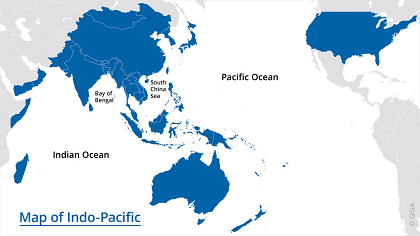
The Indo-Pacific region envisages the Indian and Pacific Oceans as a continuum and stands on two central pillars – maritime security and economic development. The public discussions, however, are focused on maritime security, strategy and geopolitics, while economic development has received less attention. This imbalance can be corrected by creating an awareness on how to harness the potential of the region's Blue Economy and its vast resources and opportunities.

Untitled Courtesy: Gateway House
23 June 2022

Analysing India’s Economic Security Challenges

Low global commodity prices, strong FDI inflows, and sustained growth have boosted the Indian economy in the preceding decade. This favourable economic climate, however, was disrupted by the pandemic and the crisis in Ukraine, exposing vulnerabilities in the global economic system. This paper focuses on India’s economic security challenges, particularly in six sectors - Food, Energy, Finance, Data, Space & Undersea Cables and Critical Minerals - and suggests possible courses of action.