

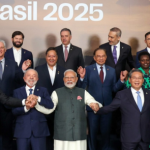
With more than two decades after its founding, BRICS occupies a unique position in global affairs. It is too significant in its representational strength to be dismissed, but quite fragmented internally to lead a meaningful change on behalf of developing nations. This issue paper assesses the grouping at a moment of acute stress. It establishes the genesis of BRICS in its present form and argues that the gap between its declaratory ambitions and operational capacity has become ever-expanding. Lastly, it identifies what India’s 2026 chairship must do to begin bridging this gap.
The paper’s assessment of the grouping’s record is mixed, as it points to a grouping with genuine but restricted achievements. Its institutional innovations such as the New Development Bank (NDB) and the Contingency Reserve Arrangement demonstrated that BRICS could undertake concrete reforms. The Rio Summit 2025 produced four substantive documents and reaffirmed the grouping’s foundational principles. However, the Cross-Border Payments initiative has not been implemented, the NDB remains a fraction of the World Bank’s size, and summit declarations have consistently overrun what the grouping can and has delivered.
Several pertinent challenges have placed the grouping under scrutiny. First, the West Asia conflict, in which members Iran, the UAE and Saudi Arabia, find themselves on opposing sides, has made collective statements impossible and exposed the limits of consensus-driven governance in a structurally divided grouping. Second, the U.S. administration’s tariff imposition threats against any BRICS move on the dollar have had a restraining effect on the grouping’s ambitions and deterred member engagement. The Western media’s amplification of de-dollarisation fears has compounded the problem by attributing to BRICS an agenda of replacing the U.S. dollar, an objective that the grouping has shown no immediate appetite to pursue. Third, China and Russia continue to withhold unambiguous support for India, Brazil, and South Africa at the UN Security Council, forming an internal structural challenge. It is a contradiction that has persisted throughout the grouping’s existence despite its commitment to multilateral reform. Further, as C. Raja Mohan (2026) has argued that with the coexistence of ‘regional rivals’, the efficacy of BRICS has also taken a hit.
India’s 2026 chairship presents a timely opportunity to redefine BRICS’ trajectory from mere aspiration towards meaningful action. This paper recommends four key priorities: first, resolving the identity question of whether BRICS speaks for middle powers or the broader Global South, while also bringing greater clarity on the de-dollarisation narrative propounded by the Western media. Second, intensifying intra-BRICS cooperation in trade, technology and supply chains; third, leveraging India’s constructive G7 standing to establish a formal inter grouping dialogue and fourth, bidding to host a permanent BRICS Secretariat in India itself. Whether India can lead the shift in BRICS from occupying a defensive posture to an assertive and credible leadership will determine whether the grouping fulfils its founding promise and emerges as a formidable force on the global stage.
You can download ‘BRICS at a Pivotal Moment’ here.
Rajiv Bhatia is the Distinguished Fellow for Foreign Policy Studies and a former ambassador.
The issue paper is part of the first edition of the Geopolitical Futures Policy Series on Perspectives on Statecraft and Institution Building by Asia Pacific Consulting and Advisory, a subsidiary of The Asia Foundation.