

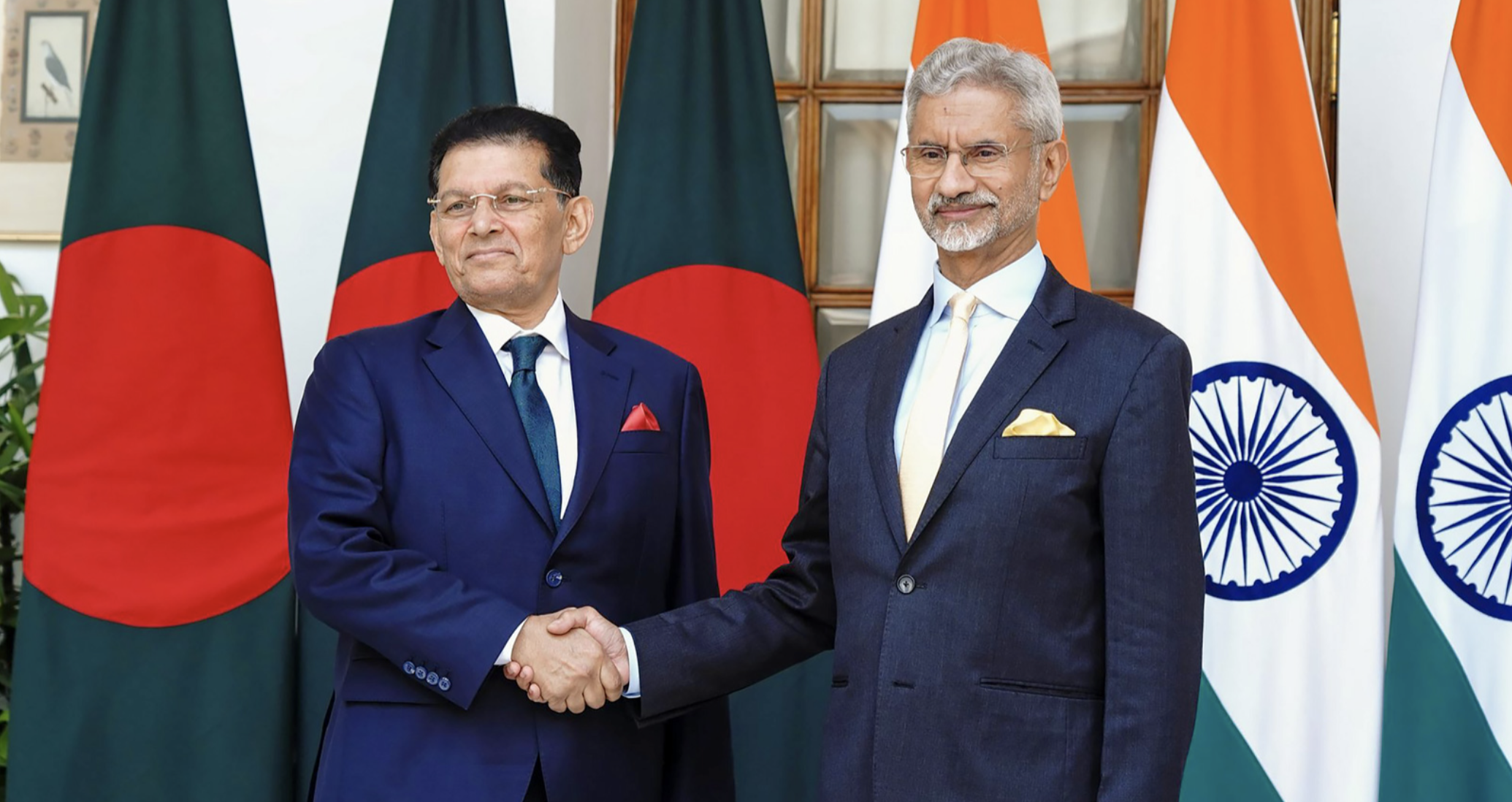
Twelve weeks can change the mood dramatically in bilateral relations. From April 7, when Bangladesh Foreign Minister Khalilur Rahman visited Delhi, driving directly from the airport to National Security Adviser Ajit Doval’s office for a fruitful discussion and dinner, to August 5, when former Bangladesh Prime Minister Sheikh Hasina delivered an audio address to her constituents at home via New Delhi’s Foreign Correspondents’ Club – the innate volatility of India-Bangladesh relations was on full display.
Just four months ago, the two governments seemed determined to move beyond the difficulties faced during the two-year transition led by Chief Adviser Muhammad Yunus in Bangladesh and begin a new chapter. But as Hasina, who was given refuge in India, announced her intention to return to Bangladesh in December 2026 and her son, Sajeeb Wazed Joy, called Bangladesh “another Pakistan”, the relationship plummeted to a low level, requiring an emergency response from the two governments.
The stakes in a healthy and stable equation are high for both Delhi and Dhaka. The compulsions of geography, history, economy, culture, and strategic interests apply to both sides. The 4,096-km-long border creates constraints and opportunities for the two countries. Against this backdrop, building and strengthening a coalition of interests between realists and pragmatists on both sides of the border is essential to prevent instability and deterioration.
There were fears that the April election outcomes in Assam and West Bengal might have repercussions for ties with Bangladesh. The issue of illegal immigration from Bangladesh assumed a new urgency and poignancy. The media played up every incident. The decision made in April to commence sector-wise discussions on major issues through bilateral mechanisms was not followed up. Meanwhile, Bangladesh Prime Minister Tarique Rahman chose to pay his first foreign visits to Malaysia and China in June 2026, giving fresh ammunition to Bangladesh critics on the Indian side, who argued that he had other priorities.
Sheikh Hasina’s press conference lit a fuse. The Bangladesh government made strong démarches, both before and after it. It was one thing for Delhi to go slow and correctly on Bangladesh’s request for Hasina’s extradition, but quite another to allow her to use a platform in Delhi to denounce the government in Dhaka. It was appropriate for the Indian foreign ministry spokesman to say that Delhi did not “endorse” what she said at the press conference, nor was it involved in arranging the event. However, observers wondered whether the Indian side did enough to persuade Hasina to shelve the conference or convince the host to cancel it in view of Dhaka’s objections and its likely adverse impact on relations with India.
Fortunately, political leaders and senior officials on both sides quickly recognised the damage and seemed aware of the need for prompt remedial action. The calls by the Indian high commissioner Dinesh Trivedi on the Bangladeshi PM, foreign minister, and home minister in Dhaka, followed soon thereafter by his hurried visit to Delhi to brief the government, were clearly indicative of the urgency and fragility of the situation.
Two specific issues drew public attention.
First, Dhaka requested that the extradition of Sheikh Hasina (and other fugitives) be expedited. In response, India reiterated that the request was under examination in accordance with established processes. Experts knew that it was bound to take time, and compliance may be difficult due to a combination of legal, political and psychological factors. But was it possible to offer an assurance that the 5 August-type press conference would not be repeated?
Second, India renewed the invitation to PM Tarique Rahman to visit India for a bilateral state visit and also to participate in the BRICS Summit in September as the chair of BIMSTEC. For a while last week, it appeared that officials would find mutually convenient dates, even though the Indian side preferred dates in September and the Bangladesh side wanted dates in August. Somehow, Dhaka’s key suggestion that a more favourable environment might first be created for the visit was missed by the media and others. Was it laying down a precondition for the PM’s visit to India? If so, this approach was certain to complicate matters. An impasse resulted, throwing a blanket of uncertainty on this important visit, which alone can clear the air and unleash the process of holding meetings of all bilateral mechanisms, as agreed earlier.
Beyond these immediate issues are the questions about the kind of relationship Bangladesh desires to develop with the U.S., China and Pakistan. The Trump administration’s approach to South Asia seems to leave considerable scope for better relations between the U.S. and Bangladesh. Delhi will need to be on guard to ensure that this does not adversely affect India’s interests. Pakistan has gained more than a foothold in Bangladesh as radical and fundamentalist forces secured a significant edge during and after the Yunus transition. The front line of defence against them will have to be the moderate and secular forces in Bangladesh itself. Despite the setbacks it has faced, the Awami League remains a pivotal political force, helping the nation define itself as a blend of its Bengali and Islamic identities.
As for China, Bangladesh remains drawn to the advantages it expects to benefit from cooperation with Beijing. But this can be balanced by India’s multipronged approach to economic cooperation and fair river water-sharing. Delhi did it successfully before and is undoubtedly capable of doing it again, so long as Bangladesh is conscious of the need to respect India’s red lines on security and strategic sensitivity.
On regional cooperation, it should be possible to align the two countries’ positions. Reports suggest Dhaka’s interest in efforts to revive SAARC. Such enthusiasm, if it existed, must be diminishing by the day amid the fast-changing military scenarios in West Asia. How the Mecca Accord or ‘Islamic NATO’ might sit with SAARC is a question Dhaka needs to ponder.
On the other hand, there are incipient fears of attempts by certain countries (such as Pakistan) to persuade Dhaka to join the Mecca Joint Defence Agreement. Is Saudi Arabia’s invitation to Tarique Rahman a pointer in that direction?
The compulsions closer to home are enormous. India and Bangladesh have much to gain by cooperating closely to turn BIMSTEC into a truly effective and forward-looking regional grouping. The seductive concept of the Bay of Bengal Community promises to be a major magnet for all BIMSTEC nations, especially Bangladesh.
The pathway to a cordial and cooperative relationship between India and Bangladesh must be anchored in a clear-cut recognition of mutual sensitivities and deep pragmatism. As M. Riaz Hamidullah, Bangladesh’s high commissioner in Delhi, observed recently: “India is one country with which we share an organic relationship.” Dhaka should know well where India’s red lines lie. India will then be willing to go halfway.
Political headwinds will surely make the task difficult. The challenge for diplomacy is to find the sweet spot before it is too late.
Rajiv Bhatia is the Distinguished Fellow for Foreign Policy Studies and a former diplomat who served in Jakarta as DCM and in Yangon as Ambassador.
This article was exclusively written for Gateway House: Indian Council on Global Relations. You can read more exclusive content here.
Support our work here.
For permission to republish, please contact outreach@gatewayhouse.in
© Copyright 2026 Gateway House: Indian Council on Global Relations. All rights reserved. Any unauthorised copying or reproduction is strictly prohibited.