

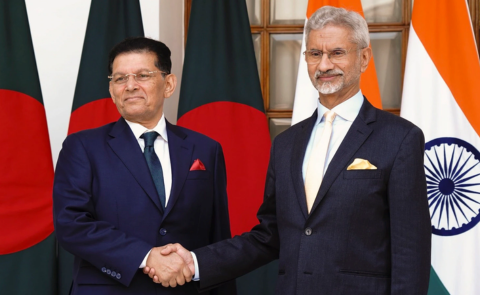
Discussions held in Delhi between the governments of India and Bangladesh during Foreign Minister Khalilur Rahman’s visit (April 7-9) have consolidated the reset of the bilateral relationship.
After over 15 years of bilateral warmth, often termed ‘the golden chapter’ during Prime Minister Sheikh Hasina’s long tenure in power, relations quickly turned southward following her ouster in August 2024. The February 2026 election results brought an end to the Muhammad Yunus-led regime, alleviating strained relations and offering fresh opportunities for the two nations to mend ties. Both sides worked on it: Rahman’s visit was preceded by the December 2025 visit of External Affairs Minister S. Jaishankar to Dhaka for the funeral of former prime minister Khaleda Zia, followed by the presence of Lok Sabha Speaker Om Birla and Foreign Secretary Vikram Misri at the inauguration of Prime Minister Tarique Rahman in February 2026. Khalilur Rahman reciprocated these meaningful gestures with his visit.
Was it a mere ‘stopover’ in the Indian capital for him as he later proceeded to Mauritius to participate in a conference on the Indian Ocean, jointly hosted by the Indian Ministry of External Affairs (MEA) and India Foundation, or a full-fledged ‘official visit’? A revealing clue lies in the list of dignitaries Rahman met and those he did not. He held discussions with the external affairs minister, the minister for petroleum and natural gas, and the national security adviser, but he did not meet the minister for commerce and industry, the home minister, or the minister for water resources, and more importantly, he was not given an opportunity to pay a courtesy call on the prime minister.
Hence, Rahman’s visit was an intermediate stage in the journey towards a full India-Bangladesh reset. He will probably continue his conversations with his counterpart Jaishankar in Mauritius, and they may reflect together on operationalising the key decision taken at their official dialogue in Delhi: “to explore proposals for deepening the partnership through the relevant bilateral mechanisms”, as announced by the MEA[1] India’s desire to engage constructively with the new Bangladesh government was conveyed, and plans were made for follow-up meetings, presumably at senior official levels.
Given the twin factors of geography and history, India-Bangladesh relations span multiple domains, making it inevitable that developments in one sphere, such as internal politics, affect another, such as the economy. Rahman’s first port of call was Ajit Doval, the national security adviser, on April 7, the very official he had met in November 2025, when Rahman served as Bangladesh’s national security adviser under Mohammad Yunus. This is a positive sign, perhaps indicating that the new Bangladesh government is conscious of India’s essential red line: New Delhi will be optimally cooperative with a friendly neighbour that is willing to respect its needs and sensitivities on security issues.
From the Bangladesh side, Rahman seems to have carried an extensive list of requests. They are grateful for India supplementing their diesel supplies due to the Gulf War but want more. Restrictions on visas, imposed by India due to previous unfriendly acts, are hurting Bangladesh; these will soon be eased, especially for business and medical visas. There have been concerns about the fast-approaching end-2026 deadline to renew the 1996 River Water Sharing Treaty. Technical and official-level talks need to commence soon, and they will.
Bangladesh also made a request for Sheikh Hasina’s extradition, if only for form’s sake. It was more emphatic about the extradition of two alleged Bangladeshi killers of a radical leader, Sharif Osman Hadi, who were arrested by the Kolkata police. This could be agreed to, subject to normal judicial procedures.
On illegal immigration from Bangladesh, Dhaka continues to reiterate its traditional position: neither the state nor the society causes it, but both remain deeply concerned over what they describe as tough measures by India, including ‘border killings’. Riaz Hamidullah, Bangladesh’s High Commissioner in Delhi, suggested that killing a cattle smuggler is excessive, advocating for an approach that benefits the common people.
The impact of developments in Bangladesh on the polls in Assam and Bengal is natural and inevitable. Likewise, electoral results may influence Dhaka’s future approach towards India.
What India expects from Bangladesh has not been adequately disclosed, but deepening connectivity and continuing relevant projects remain top priorities.
The two capitals also need to align more closely on regional cooperation and integration. India has lost interest in the South Asian Association for Regional Cooperation (SAARC) for good reason. Instead, it has committed to strengthening and bolstering BIMSTEC, or the Bay of Bengal Initiative for Multi-Sectoral Technical and Economic Cooperation, in whose development Bangladesh played a vital role and even hosts the BIMSTEC secretariat. Instead, some voices from Dhaka are calling for the revival of SAARC. Delhi needs to convince its Bangladeshi interlocutors to resume the effort to turn BIMSTEC into an effective instrument for the mutual benefit of all its members.
Before the Rahman visit began, there was some speculation that it was a preparatory trip for a visit to India by Prime Minister Tarique Rahman. That seems premature. Officials and ministers need to work harder in the coming weeks before a head-of-government-level interaction, paving the way for tangible outcomes.
The two countries have much to gain through deeper cooperation and more to lose if they drift. As during Covid, the Gulf War has brought India’s neighbours in the north, south and east closer together, with aid provided by New Delhi for daily energy essentials. This is the time to focus on a common future by initiating bold trade and economic policies and linkages to counter the vested interests in the region and beyond that work overtime to create a rift between India and Bangladesh.
Rahman indicated that the Bangladesh government follows a foreign policy based on the principle of ‘Bangladesh First’. India is still committed to its ‘Neighbourhood First’ policy. The two neighbours must commit to staying on the same page and upholding the values of mutual resilience, respect, and reciprocity.
Rajiv Bhatia is the Distinguished Fellow for Foreign Policy Studies and a former ambassador.
This article was exclusively written for Gateway House: Indian Council on Global Relations. You can read more exclusive content here.
For permission to republish, please contact outreach@gatewayhouse.in.
Support our work here.
©Copyright 2026 Gateway House: Indian Council on Global Relations. All rights reserved. Any unauthorised copying or reproduction is strictly prohibited.
References:
[1] ‘Meeting of the External Affairs Minister with the Foreign Minister of Bangladesh’, Ministry of External Affairs, 8 April 2026, https://www.mea.gov.in/press-releases.htm?dtl/41031/Meeting_of_the_External_Affairs_Minister_with_the_Foreign_Minister_of_Bangladesh_April_08_2026