Distinguished Fellow, National Security and China Studies
Lt Gen S L Narasimhan, PVSM, AVSM*, VSM is an Infantry Officer who served in the Indian Army for 40 years and worked extensively on the India-China border. He served as the Defence Attaché in the Embassy of India in China for three years. Before going to China, he qualified in the Chinese language with distinction. His expertise on China spans its international relations, internal issues, economy, defence and science & technology developments in China. Narasimhan is a former Member of the National Security Advisory Board. And, during his three tenures on the board, he worked on China and India’s national security issues pertaining to defence. Narasimhan was the first Director General of the Centre for Contemporary China Studies, a policy-oriented inter-ministerial think tank of the Government of India for five years. He is presently a Distinguished Fellow with the Centre for Air Power Studies, India and Emeritus Resource Faculty with Rashtriya Raksha University, India. He has graduated in Mathematics, is a post-graduate in Defence Studies and has a PhD in India-China Relations.
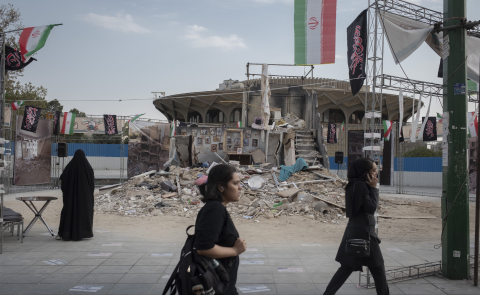
The ongoing conflict in the Gulf has created tremendous change. Israel is deeply scarred by the October 7 attacks. Iran retains the ability to go nuclear despite U.S.-Israel attacks. China’s assistance to Iran through intelligence and the supply of parts and chemicals for missiles has been noticed. New formations of countries - either interlocutors, participants or victims of the war – are generating an alphabet soup of influencers.
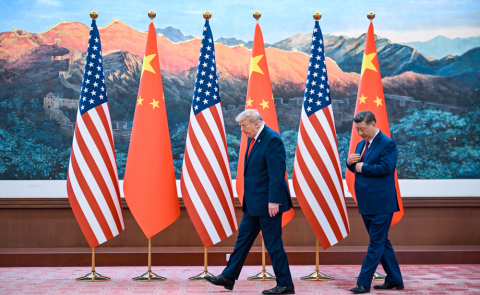
President Donald Trump’s May 13-15 visit to China was set against the backdrop of the ongoing U.S.-Israel-Iran conflict. Though the agenda was an economic one, Beijing used the occasion to project itself as a stabilising power, urging dialogue between Washington and Tehran. The visit did produce agreements on trade and investment, but the absence of a joint statement and differing priorities exposed persistent tensions. In this tale of two visits, China seems to have trumped the U.S.
The West Asian conflict is raising questions about Iran’s performance. Tehran appeared well-prepared, having expanded its low-cost drone and missile capabilities. It also widened the conflict by targeting U.S. bases in the Gulf. The key lesson is that eliminating leadership does not guarantee regime change. The conflict underscores that modern warfare depends not just on battlefield gains, but also on economic resilience, trade leverage, and technological strength.
The U.S. and Israel launched precise airstrikes on Iran, targeting nuclear facilities and senior leadership. Their aim is to weaken Iran’s nuclear programme and potentially induce regime change, while Tehran’s priority remains regime survival. The conflict’s duration will depend on whether it remains limited to missile exchanges or escalates into asymmetric warfare.
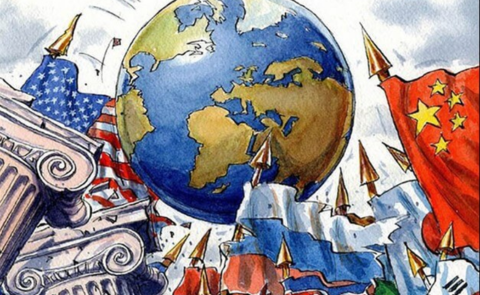
Multipolarity indicates who holds power, while multilateralism is about how states choose to cooperate. In today’s world, power is diffusing and interdependence is deepening simultaneously. A multipolar world creates fluid alignments and strategic competition, but multilateralism manages interdependence through rules and institutions. The world is becoming both, simultaneously, requiring states to manage competition, preserve cooperation, and stabilise an increasingly complex global landscape. That is easier said.
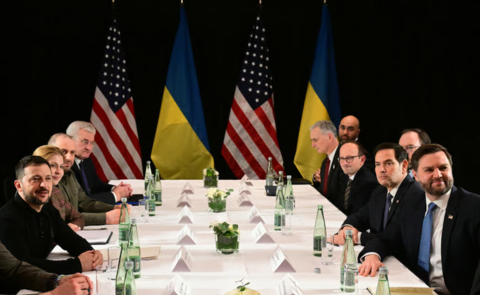
The U.S. demand for Greenland for security purposes, has alarmed Europe enough for talk of Article 5 of NATO’s collective defence agreement to be put on the discussion table. But can NATO survive without Article 5? And can Article 5 survive without the U.S. defence cover for Europe?
It is customary for every U.S. president to release a National Security Strategy (NSS) early in their tenure. President Trump published the NSS for his second term in November 2025. It’s a contrast from his 2017 NSS, which addressed broad threats. The 2025 version is narrower, emphasising trade over security, with the Western Hemisphere being the primary area of focus. Is the U.S.’s global role shrinking?
India-China relations move in waves of hostility and stability. The bilateral may be re-entering a period of stability, last seen in 2018. If the caveats of security, mutual sensitivity and a level playing field are respected, then much can be achieved by reviving the initiatives begun after PM Modi’s visit to China in 2015 and two informal summits in Wuhan in 2018, and Mahabalipuram in 2019.
Chinese President Xi Jinping set two centennial goals and a 2027 target for the People’s Liberation Army’s (PLA) modernisation. This is in line since its founding in 1927, when the PLA has undergone continuous technological, doctrinal, and manpower transformation. Guided by Xi’s goals, it is adapting to evolving warfare trends drawn from experience and observation. For India, the implications arise not only from the PLA’s modernisation but also from emerging military and geopolitical dynamics.
In China’s White Paper on national security, the country congratulates itself for maintaining peace and development and bringing “stability in a tempestuous world.” It also pats itself on the back for “creating unity and self-reliance in the Global South” thus leading to an adjustment of the international balance of power. Worth studying are its global initiatives – a new governance order.