Bernama Courtesy: Bernama
9 July 2025

Malaysia’s ASEAN Chairmanship disappoints

The 46th ASEAN Summit led by Malaysia in the chair, concluded in May. Malaysia is one of the founding members of the ASEAN, and is fully cognisant of its prolonged challenges, but as chair it has not addressed the issues. It raises questions on whether the stated deliverable of “inclusivity and sustainability” is merely a diversion from the country’s weakening leadership in the region.

Gateway House Courtesy: Gateway House
3 July 2025

China Plus One and global supply chains

A slowdown of the Chinese economy, and the shift, particularly by MNCs, from China to other more competitive locations has opened up business opportunities for latecomers to supply chains in the developing world. Evidence suggests that Southeast Asia and some South Asian countries like India, Sri Lanka, Bangladesh, could be beneficiaries of the supply chain shift, particularly in labour-intensive segments.
Getty (1) Courtesy: Gateway House
15 May 2025

The New Geopolitics and South Asia’s Trade Architecture – What Next?

Geopolitics is increasingly intertwined with the economic destiny of South Asia. Even before the U.S. tariffs were rolled out, growing polycrises had hit the global economy, which has been struggling since the pandemic. South Asia seems a relatively bright spark of regional trade and growth. This paper analyses South Asia’s trade architecture in the backdrop of a sluggish world economy in the 2020s, and makes recommendations for closer regional economic integration.

myanmar coup financial times Courtesy: Financial Times
3 February 2022

Myanmar’s ‘annus horribilis’

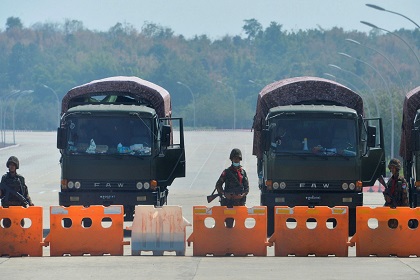
It has been a year since the democratically elected Myanmar government was overthrown in a military coup. Since then, economic instability and the pandemic have taken a toll on the nation. ASEAN's mediatory endeavours and Western sanctions have shown limited results. New Delhi's diplomacy must support ASEAN, while remaining pragmatic and protecting its interests in the country.

Countering China's Maritime Greyzone activities Courtesy:
22 July 2021

Countering China’s Maritime Grey Zone Activities

On 15 July, Gateway House co-hosted a webcast with Konrad-Adenauer-Stiftung (KAS) on 'Countering China’s Maritime Grey Zone Activities'. The panel discussed the potential strategies that smaller nations in the region can adopt to overcome the challenges of Chinese maritime grey zone activities, and the role of regional maritime powers in capability-building of maritime law enforcement agencies.

regan Courtesy: Pacom
11 April 2019

Canada in the Indo-Pacific

Canada, which has been slow to respond to a changing trans-Pacific neighbourhood, can join India and the ASEAN member states to embark on a trilateral dialogue on the Indo-Pacific’s importance in terms of political, strategic and other domains. An alignment in outlook can strengthen the security and prosperity of a region, currently mired in U.S.-China rivalries

https---s3-ap-northeast-1.amazonaws.com-psh-ex-ftnikkei-3937bb4-images-2-2-2-1-13871222-5-eng-GB-20180510_former-PM-Mahathir-01 Courtesy: Nikkei Asia
6 December 2018

Malaysia in transition, and recalibrating

Six months after Malaysia’s parliamentary elections, its domestic affairs are still untidy. The government is combating corruption, but not bringing in constitutional reform. A successor’s name is not emerging clearly either. But Prime Minister Mahathir Mohammad’s foreign relations priorities – principally, Japan and China – are in order

IMG_6681 - Copy Courtesy: Gateway House
12 July 2018

China’s focus on stability

Yuan Peng, Vice President, and Dr. HU Shisheng, director, respectively of the Institute of South & Southeast Asian and Oceanian Studies, China Institute of Contemporary International Relations, Beijing, spoke to Gateway House about working towards ‘the final goal of denuclearisation’, India-China relations since the Doklam stand-off and addressing security concerns raised by the Belt and Road Initiative

Cdw68MOUIAAlO_l Courtesy: Narendra Modi/ Twitter
28 June 2018

Islam in India’s soft power

Religion is an important component of the soft power countries use in their foreign policy. Yet, no Indian government has given Islam adequate prominence, especially in its interactions with South-East Asia, where the majority of people are Muslim

Modi Asean Courtesy:
12 May 2016

India’s Act East Policy so far and beyond

In two years, the Modi government’s Act East Policy has gone well beyond the focus on economic ties of its predecessor, the Look East Policy. It has made progress on many wider fronts, including connectivity and defence collaboration. India must now build on this success and further consolidate relations and trade links with ASEAN and beyond