AFP (1) Courtesy: ANI
16 October 2025

Uncertainty around the Quad

The Quad summit is expected to be hosted by India in the second half of 2025, possibly in November. However, the grouping faces turbulence that transcends the current flow of India-U.S. relations. The relevance of Australia and Japan, too, needs to be factored in. Beijing considers the Quad as “the Asian NATO” that aims to contain China. Since the commencement of Trump 2.0, the grouping has been struggling to redefine its role and mandate.

Ivan Courtesy: Gateway House
8 October 2025

Unfolding Geopolitics Episode 23 | India renews engagement with Afghanistan

Afghanistan’s Foreign Minister Amir Khan Muttaqi will visit India on October 10, marking the first high-level Taliban visit since the group took over Kabul in 2021. Nayanima Basu discusses the purpose of this visit and the importance of engagement with Afghanistan. She explains the roles of China, which seeks business; Pakistan, which pursues political interests; and the U.S., which has a renewed interest in Bagram Air Base and its return to the country it abandoned.

X  @Narendra Modi Courtesy: X / @narendramodi
4 September 2025

Modi in Japan: a larger Asia mission

Prime Minister Narendra Modi’s visit to Japan is significant for India domestically and its extended Asian influence. His visit, just prior to the SCO Summit in China, represents a shrewd endeavour at balancing the several priorities of Indian foreign policy

G20.Org Courtesy: G20.org
28 August 2025

Appraising Brazil’s G20 Presidency

The G20’s current cycle is unique, with four Global South nations presiding consecutively: Indonesia, India, Brazil, and now South Africa. Brazil’s 2023-24 presidency exhibited both achievements and struggles, prioritising social inclusion, hunger, energy transition, and governance reform. The handover to South Africa marks a significant milestone in G20 history. Will the momentum be followed by the U.S., the next G20 president but also a G20 sceptic?

AFP Courtesy: AFP
14 August 2025

India-U.S. trade: geopolitics or geoeconomics?

India-U.S. trade negotiations have faltered. India stepped outside its comfort zone to offer zero tariffs on industrial goods that form 40% of U.S. exports to India, but the additional 25% tariffs have rendered most Indian exports noncompetitive. Only a carefully balanced, incremental negotiating framework blending economic pragmatism with protection of core domestic interests backed by political will, stands a realistic chance of bridging the current impasse.

IMEC map with source Courtesy: Gateway House
11 June 2025

IMEC: more than just a corridor

The proposed IMEC corridor connecting India to Europe through the Gulf can be transformative, helping to reduce risks to the global movement of goods and data. It’s early days yet, and there are gaps to be filled in terms of missing infrastructure and overcoming a diplomatic rift.

27010605639_d03ddf44a5_o Courtesy: The Dahrendorf Forum
17 July 2023

Central Asia, the new corridor

The Russia-Ukraine conflict has led to the resurgence of interest in Central Asian as an alternate trade corridor between Europe and Asia. Timely investment in connectivity projects like the Middle Corridor and the INSTC by regional stakeholders, as well as by the EU, China and India, must now build on this interest to create new regional, international, and cross-continental transport corridors.

website SCO Courtesy: India Today
11 July 2023

SCO Summit: Same old, some new

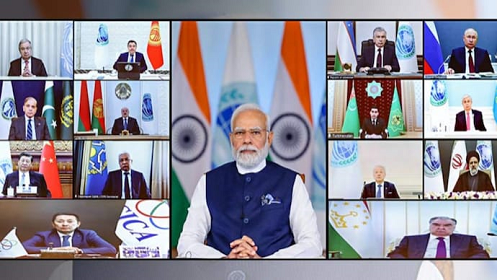
The Shanghai Cooperation Organisation's growing importance is seen in the numerous new applicants waiting in line for membership. The 23rd SCO Summit hosted by India on July 4 saw progress in areas like digital transformation and economic cooperation. However, timidity in acting on foundational issues like anti-terrorism reflects the internal contradictions and tensions within member states - a continuing challenge for SCO.

swarajya sco Courtesy: Swarajya
10 May 2023

Steering the SCO

India, as chair of the Shanghai Cooperation Organisation, hosted the foreign ministers’ meet in Goa last week. What would have been an important and expanding regional grouping has been complicated by the Russia-Ukraine crisis, the increased influence of China and an obstructionist Pakistan. Still, India has played its role with an eye on the long term.

mappr Courtesy: Mappr
20 April 2023

Uzbekistan balances the geopolitical quartet

India is rapidly increasing its economic engagement with Russia, and other former Soviet countries. This means it must look at old friends in Central Asia with new eyes. Uzbekistan is one of them. India is one of a quartet of geopolitical powers playing to the strategic interests of this nation which sits at the crossroads of South, East, West and Central Asia and Russia.