GIGA_map_of_Indo-Pacific_Kontur_resize Courtesy: Science Po
28 July 2022

India’s blue economy and the Indo-Pacific’s future

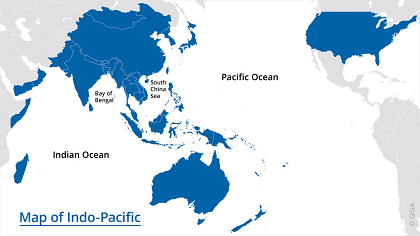
The Indo-Pacific region envisages the Indian and Pacific Oceans as a continuum and stands on two central pillars – maritime security and economic development. The public discussions, however, are focused on maritime security, strategy and geopolitics, while economic development has received less attention. This imbalance can be corrected by creating an awareness on how to harness the potential of the region's Blue Economy and its vast resources and opportunities.
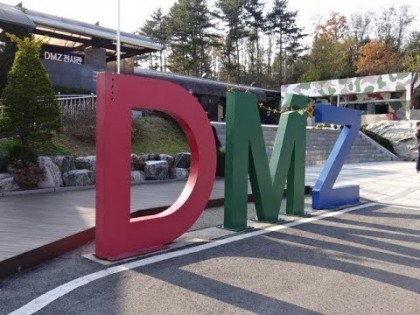
image002 (1) Courtesy: Shutterstock
14 August 2019

The DMZ, between peace and hostility

The Demilitarised Zone (DMZ) is a 250-km-long militarised border that divides the Korean peninsula roughly into half. It is one of the most heavily guarded borders in the world. The author, who had a unique opportunity to visit the DMZ, narrates her experience

IMG_6681 - Copy Courtesy: Gateway House
12 July 2018

China’s focus on stability

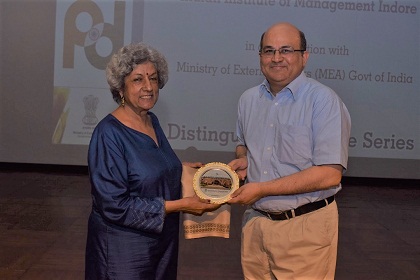
Yuan Peng, Vice President, and Dr. HU Shisheng, director, respectively of the Institute of South & Southeast Asian and Oceanian Studies, China Institute of Contemporary International Relations, Beijing, spoke to Gateway House about working towards ‘the final goal of denuclearisation’, India-China relations since the Doklam stand-off and addressing security concerns raised by the Belt and Road Initiative

4 - Copy Courtesy: IIM, Indore
12 July 2018

India in a changing global order

The world order that came about in the aftermath of World War II was a western-oriented construct that has become obsolete in many ways. The changes underway offer India an opportunity to participate in the crafting of political and economic institutions that are more pertinent to the emerging geopolitical equations

trump kim Courtesy: Wikimedia
14 June 2018

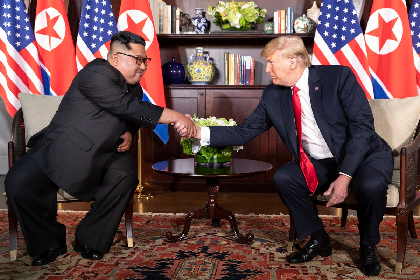
Trump-Kim summit is a realistic trade-off

The June 12 summit was characterised by give-and-take as opposed to the one-way approach practised by earlier U.S. administrations. All countries welcomed the agreement and there is hope that this realism will enable the United States to address other contentious issues too

abe kim Courtesy: View.mn
10 April 2018

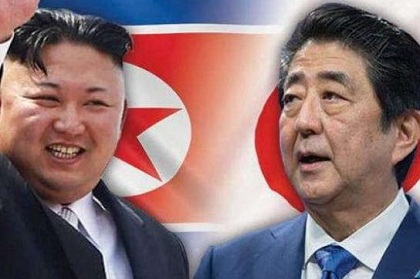
Tokyo’s gameplan for Pyongyang

North Korea's overtures to its immediate strategic neighbours through a series of summits have excluded Japan, which has long regarded Pyongyang's nuclear weapons and missile development programmes a direct threat. It is reacting by reaching out to the U.S., North Korea and China

Modi Asean Courtesy:
12 May 2016

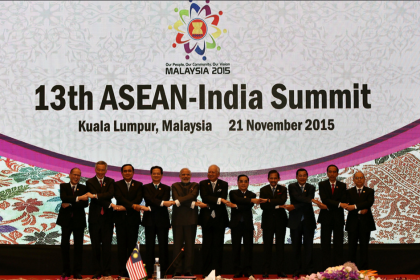
India’s Act East Policy so far and beyond

In two years, the Modi government’s Act East Policy has gone well beyond the focus on economic ties of its predecessor, the Look East Policy. It has made progress on many wider fronts, including connectivity and defence collaboration. India must now build on this success and further consolidate relations and trade links with ASEAN and beyond

obama Courtesy: Pete Souza/The White House
22 February 2013

The pacific pivot: A decade late and five years too soon

The announcement of the Pacific pivot by the U.S. in 2001 has led to several nations making bold political moves. However, the U.S. isn’t yet ready to be a regional protector against China. What does Washington have to do to prepare itself for the Pivot?