

The August 31 meeting of the Shanghai Cooperation Council in Tianjin, China, caught world attention, with the dramatic photos of Indian Prime Minister Narendra Modi, Russian President Vladimir Putin and Chinese President Xi Jinping walking and talking in step.
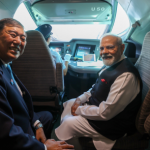
But more significant for India domestically and in Asia, is Prime Minister Modi‘s official visit to Japan on 29-30 August. His meeting with Japanese Prime Minister Shigeru Ishiba and two former Prime Ministers, Yoshihide Suga and Fumio Kishida, brought both warmth and new investments. This stand-alone Modi visit for the 15th annual summit with Japan is his eighth since 2014, but the first bilateral undertaken since 2018. The visit to Japan and then to China, represented a shrewd endeavour at balancing several priorities of Indian foreign policy.
Japan enjoys a position of exceptional consequence for India. A fellow Asian democracy, a valued source of trade, technology and investment, and a nation with a long memory of positive links with India, Japan has acquired even greater weight as an Indo-Pacific power working closely with its other partners, the U.S., Australia, and India.
In his statement upon departure from Delhi and in the speeches and remarks he delivered while in Japan, PM Modi emphasised the importance of the India-Japan partnership for the two countries and beyond. “As two of the largest economies and vibrant democracies of the world, their partnership is extremely important, not just for the two countries but for global peace and stability as well,” he observed. He called Japan “a tech powerhouse” and India “a talent powerhouse,” suggesting that constructive collaboration between the two would help them lead the revolution in green energy, mobility, and logistics infrastructure. Ishiba agreed, adding, “We need to take advantage of each other’s strengths, to bring solutions to our challenges and to help each other.”
The success of Modi’s visit to Japan should be measured by analysing its tangible outcomes. India’s Ministry of External Affairs (MEA) highlighted over a dozen of them by listing the important documents signed, in addition to the joint statement. This list includes the following: India-Japan Joint Vision for the Next Decade; Joint Declaration on Security Cooperation, which presents a comprehensive framework to evolve defence and security cooperation as a response to contemporary security challenges; Action Plan for India-Japan Human Resource Exchange; MOUs on Mineral Resources and Digital Partnership 2.0; and the Joint Declaration on Clean Hydrogen and Ammonia.
The announcement of other outcomes covered, inter alia, the ambitious target of JPY 10 trillion ($67 billion) as private Japanese investment in India in the next decade, the launch of AI Initiative and the next generation mobility partnership as well as the Forum of Small and Medium Enterprises to strengthen collaboration among SMEs of the countries as “the engines of our respective economies,” and high-level exchanges between Indian states and Japanese prefectures.
The joint statement provides detailed information about the three pillars of partnership: defence and security, economic cooperation, and collaboration in various other domains. It made a polite reference to the Mumbai-Ahmedabad high-speed rail, which has been delayed, emphasising its importance and agreeing to commence operations “at the earliest” while acknowledging the need to introduce the latest Japanese Shinkansen technology in India.
Two other outcomes: First, India and Japan reaffirmed their commitment to the development of India’s North Eastern Region (NER) by enhancing “hard, soft, and people-to-people connectivity” and continuing their work through the Act East Forum. Second, they welcomed more bilateral cooperation for Africa’s sustainable economic development by establishing “an industrial hub” for trade and investment with Africa. The Indian side showed much interest in PM Ishiba‘s announcement of ‘the economic region initiative’ for the Indian Ocean – Africa region made at TICAD-9.
Scholars observing the evolution of India-Japan relations in recent years have been in broad agreement that ties continue to make progress, despite the frequent change of prime ministers in Japan. PM Modi has had to deal with four PMs since 2014, namely Shinzo Abe, Yoshihide Suga, Fumio Kishida, and Shigeru Ishiba. This results from a deep convergence of interests, as Sanjay Kumar Verma, a former Indian ambassador to Japan, pointed out. The two sides have also been conscious of the challenges facing the relationship. These include Japanese frustration over “India’s regulatory complexity” and India’s concerns about “Japan’s slowing economy.”
Nevertheless, the Indian side has judged this Modi visit as a notable success, given that significant decisions of far-reaching importance have been taken. Despite India’s current difficulties with the U.S., Japan remains bullish and seriously interested in taking forward the relationship in bilateral, regional, and global domains. This sent out a meaningful signal of its own to China, Modi’s next stop.
At a time when U.S.-India ties are under exceptional strain due to the tariff and other issues, legitimate doubts have been raised about the immediate future of the Quad. In his pre-PM visit media briefing on 26 August. Foreign Secretary Vikram Misri sought to dispel these doubts by stressing that further development of the Quad cooperation would figure in the talks in Tokyo. “Both our countries attach high value to this forum and this partnership,” he said.
The continuing faith in the in the relevance of the Quad was reinforced from the other end of the Indian Ocean by Penny Wong, the Australian foreign minister, who told a group of visiting Indian journalists on 27 August that India and her country were “strong partners of the Quad” because “we have those shared strategic objectives,” The Japanese government too has been on the same page.
Both India and Japan expressed their continuing interest in strengthening cooperation within the Quad, despite the on-going uncertainty about the U.S. President Donald Trump’s plan to attend the summit to be hosted by India in 2025. Modi extended an invitation to his Japanese host to visit India for the summit, which was accepted. It was not revealed if they considered a Plan B in the event the U.S. President fails to attend the summit. By extension, both welcomed close cooperation between the Free and Open Indo-Pacific (FOIP) and the Indo-Pacific Oceans’ Initiative (IPOI) and found notable convergence on the way forward for Myanmar, important to both Japan and India.
SCO may have stolen the global limelight, but the 15th India-Japan Summit has strengthened not only the India-Japan partnership but also India’s position in Asia and on the global stage.
Rajiv Bhatia is the Distinguished Fellow for Foreign Policy Studies, and a former ambassador.
This article was first published in WION.