

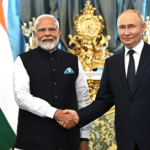
India’s National Security Advisor Ajit Doval arrived in Moscow on August 5, to discuss regional stability, counter-terrorism, energy security and defence purchases. He will be meeting his counterpart but also Russian Foreign Minister Sergei Lavrov. There is an expectation that he will get an audience with Russian President Vladimir Putin, to invite him to the India-Russia Summit to be held later this year. This will be Putin’s first trip to India in four years.
The high-level activity in the Russia-India corridor is not matched by a similar engagement in the India-U.S. space. On August 1, U.S. President Donald Trump threatened India with 25% tariffs on its exports to the U.S. plus additional penalties of up to 500% if New Delhi didn’t stop its purchases of Russian oil by August 7; on August 6, he doubled the tariff threat to 50 per cent. Trump demanded a response to his social media message from Prime Minister Narendra Modi, and still awaits it. Apart from Indian trade negotiators working the hallways in Washington, and U.S. trade negotiators doing similarly in New Delhi, there has been surprisingly little U.S.-India activity.
Is Russia the red line for India?
It may well be. The U.S. tariff impositions come at a time when India is re-entering the global commercial arena as an equal player. The country is currently negotiating free trade agreements (FTAs) with six[1] countries – including the U.S. – having successfully closed 16 similar regional and bilateral trade agreements over the last five years. The ASEAN-India FTA is being considered for review; more than two dozen countries are in line to meaningfully develop trade links with India. At home, India is building its industrial capacity and developing new markets and supply chains, eyeing the China+1 space that has opened up for occupation by the ambitious.
Russia has been a contributor to India’s efforts. Discounted oil purchases from Russia have kept India’s economy running, and prices stable. And Russia has been a reliable security partner. The S-400 air defence system performed admirably during India’s Operation Sindoor against Pakistan. Upgraded Russian equipment is still desirable in New Delhi, especially as it comes with technology transfers and possible co-production, unlike the U.S. with its many restrictions. Doval is likely to ask for more. India has already contracted[2] with Russia for $50 billion worth of military purchases over the last 20 years.
In contrast, India has bought $24 billion[3] in U.S. defence equipment since 2008, and at the Modi-Trump meeting in Washington in February, a promise to buy more was made. India’s own domestic defence industry is catching up; it has tripled in value to $14 billion over the past decade, and is rapidly ramping up. Already 65% of defence equipment is made domestically, compared with a 65% import dependence from 10 years ago.[4]
The allure of Russia for India has increased since Trump made nice with Pakistan immediately after Operation Sindoor, and the tariff threats have intensified public opinion in Moscow’s favour. This is a good time then, for India and Russia to accommodate each other, for geopolitical, regional and domestic reasons.
Putin the strategist sees India cornered by Washington, and will play to it. Russia has some frustrations with India which will be conveyed to NSA Doval: first, though bilateral trade has reached a record $68.7 billion, over 90% of it is oil, and India runs a massive deficit with Moscow. Second, U.S. and EU sanctions against Russia have forced the rupee-rouble trade practice back into the bilateral, and now 90% of all India-Russia trade is in local currencies. Russians are unable to invest much in India, as Moscow needs funds to run its own war-time economy. Third, on Ukraine, Russia has been less than happy with India’s make-peace-not-war statements.
Regionally, though Russia has managed to separate its historical proximity with India from its new and deep friendship with China, at the SCO, there are clear sides: Russia-China-Central Asia on one side, with India being the outlier.
Bilaterally, India has specific needs from Russia, viz. defence equipment. India would like to buy more, but Moscow is using large quantities of its production for the Ukraine war.
It doesn’t compare with India’s current unhappiness with Washington. Sanctions on traditional oil suppliers Iran and Venezuela have cut off those supplies for India, and now penalties on Russian oil threaten to do the same, destabilising India’s growing economy. It has been a particularly unkind cut, as the Biden administration had appealed to India to buy Russian discounted oil to keep energy markets steady.
Trump has been cavalier about the QUAD, which was meant to keep China in check in the Indo-Pacific. The next QUAD meeting, due to be held in India in October, may be a damp squib without the presence of the U.S. President – or may get postponed. Meanwhile Trump’s irritation with BRICS, which he sees colluding to displace the dollar’s dominance, will only increase as India takes the chair of the plurilateral in 2026. India has been holding off a reconvening of the Russia-India-China Trilateral, but if it does so, Trump will have one more grouse against India.
New Delhi will have to take a hard geopolitical call, and take the bargain available on the table: economy-greasing oil from Russia for now, and plan carefully for future diversification. On Ukraine, India could take a stronger position, emphasising that the West acknowledge the fundamental reason for Russia’s war with its neighbour. India could project a harmonious partnership with Russia, with Putin visiting New Delhi in the next few months – a sure way to infuriate Trump. That may compel India to be a grown up and take the 50% tariffs hit, till a renegotiation takes place or a trade agreement to mutual U.S.-India satisfaction comes about. It will also force Indian companies to diversify into new, non-G7 markets, and invest more in research and development at home.
An all-important domestic benefit to going the Moscow way: Standing up to Trump will give Prime Minister Modi a boost just before the Bihar election, leaving opposition leader Rahul Gandhi fuming alongside Trump.
Manjeet Kripalani is the Executive Director, Gateway House.
This article was first published in The Indian Express.
References:
[1] U.S., EU, New Zealand, Oman, Chile, Peru
[2] Russia Signed Contracts With India for $50 Billion Over Past 20 Years.” Sputnik India, 7 February 2025. https://sputniknews.in/20250207/russia-signed-contracts-with-india-for-50bln-over-past-20-years-8748413.html#:~:text=The%20latest%20engine%20for%20fifth,Air%20Force%
[3] India-U.S.: Major Arms Transfers and Military Exercises. Congressional Research Service (CRS) Report, Congress.gov, updated 2025. https://www.congress.gov/crs-product/IF12438#:~:text=Prior%20to%202008%2C%20U.S.%2DIndia,submarine%
20warfare%20(ASW)%20capabilities
[4] Press Information Bureau, Government of India. “Make in India Powers Defence Growth: Production hit ₹1.27 lakh crore in FY 2023-24, Exports cross ₹21,000 crore.” 24 March 2025. https://www.pib.gov.in/PressReleaseIframePage.aspx?PRID=2114546