Most popular Indian actors worldwide Courtesy: Gateway House
1 October 2025

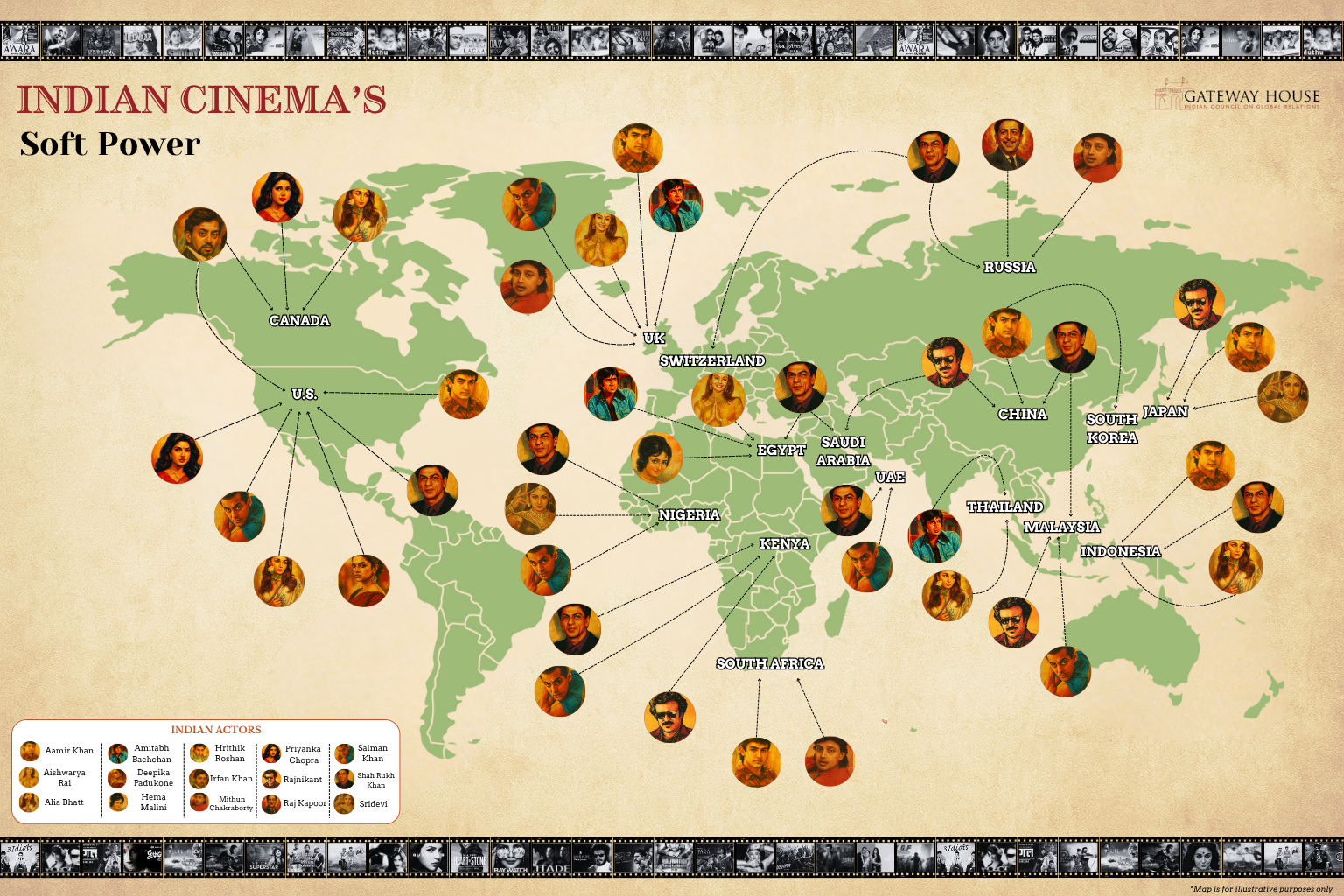
Indian Cinema as Economic Catalyst

As India seeks leadership in a multipolar world, cultural credibility is as vital as economic clout. Cinema gives India an edge with vivid storytelling, music, and empowering narratives, fostering understanding in a polarised world. Its popularity correlates with trade, as seen in the U.S., Russia, and Middle East. The more popular the cinema, the bigger the boost to trade.

U.S. Tariffs on Brics+ countries Courtesy: Gateway House
25 September 2025

U.S. Reciprocal Tariffs on BRICS+ countries

Under U.S. President Donald Trump’s reciprocal trade policy, the original five BRICS member countries account for the highest U.S. tariffs globally. India and Brazil are facing the highest tariffs of 50%, while China follows with a tariff of 34%, down from 145% earlier in the year. This infographic details the U.S. reciprocal tariff rates for each BRICS+ member and the sectors that are impacted.

indo pacific  (7) Courtesy: Daily News Egypt
31 July 2025

Egypt positions its foreign policy

Egypt sits at the intersection of three continents and two seas, and its foreign policy is a geographic, historic and strategic consequence. From Tripoli to Kortum, Addis Ababa to Brussels, New Delhi to Moscow, Beijing to Washington, Cairo employs diplomacy as a key national security tool, positioning itself as a cornerstone of geopolitical stability within an increasingly multipolar world.

ADEM ALTANAFP via Getty Images Courtesy: Adem Altan/AFP via Getty Images
3 July 2025

Iran’s second chance to transition

Iranian foreign policy must move toward strategic autonomy and internal concord. As witnessed after the 1988 ceasefire with Iraq, such moments can mark an inflexion point - one that prioritises national reconstruction, resilience, and welfare; strategic recalibration, strengthening of confidence, and finding a geopolitical identity. Iran has been there before, and can apply those experiences again.

IMEC map with source Courtesy: Gateway House
11 June 2025

IMEC: more than just a corridor

The proposed IMEC corridor connecting India to Europe through the Gulf can be transformative, helping to reduce risks to the global movement of goods and data. It’s early days yet, and there are gaps to be filled in terms of missing infrastructure and overcoming a diplomatic rift.

Website articles  (18) Courtesy: Reuters photo
28 May 2025

Strategy meets statecraft: Trump in Riyadh

Presidential visits abroad are high-level instruments of statecraft and, more often than not, signals of geopolitical priorities. The recent visit of U.S. President Donald Trump to the United Arab Emirates, Saudi Arabia, and Qatar, exemplified this, indicating the administration's policy orientation.

National Security Advisors' Meeting Courtesy: Observer Research Foundation
24 August 2023

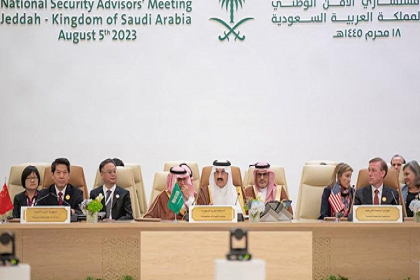
Jeddah is the ‘new’ Vienna

In West Asia, nations such as Saudi Arabia and other Gulf countries are starting to understand their pivotal geopolitical positioning in world affairs – and are making calibrated and strategic moves to preserve or recover global stability. It’s welcome at a time when more than two dozen conflicts are ongoing, when geopolitical rivals have hardened their positions, and diplomacy has failed to de-escalate in the primary contests.

FILE PHOTO: A worker walks past the logo of Reserve Bank of India (RBI) inside its office in New Delhi, India July 8, 2019. REUTERS/Anushree Fadnavis Courtesy: Reuters
14 July 2022

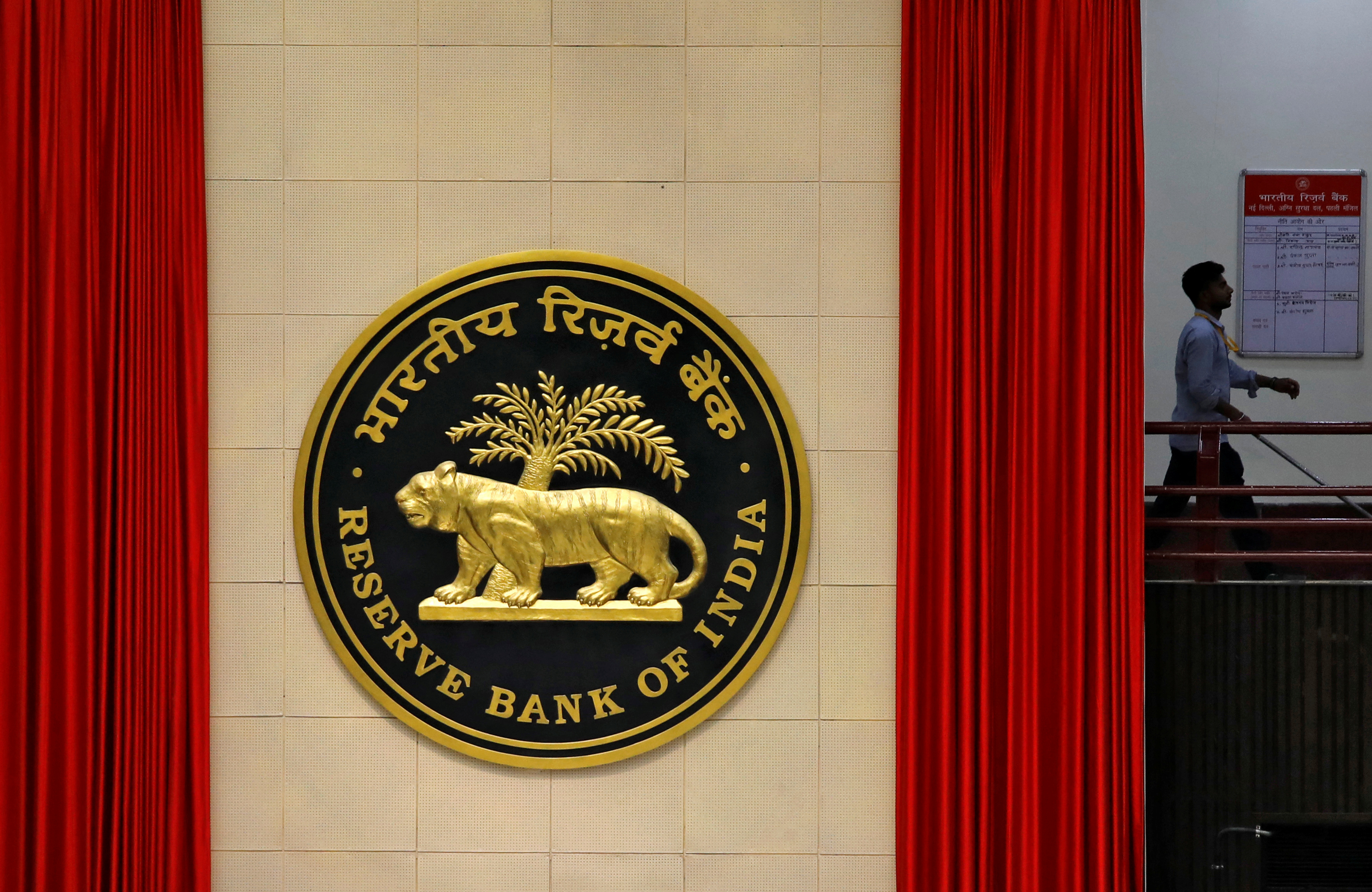
The rupee as regional currency

The Reserve Bank’s move to enable international trade in INR is a step towards regaining Indian primacy in the Indian Ocean region that the Indian Rupee once enjoyed. It is also an essential financial dimension that will add heft to India’s strategic SAGAR policy.

TDB_car_151021 Courtesy: TDB
24 February 2022

Enhancing Regional Financial Intermediation in the Indo-Pacific

Financial intermediaries are critical lubricants for business, growth and development. The Indo-Pacific countries are industrializing, but smaller nations lag behind economically. The Quad countries can aid the advancement of the financial architecture in the Indo-Pacific by helping to develop an ecosystem, modelled on the examples of Japan and India.