AFP Courtesy: AFP
14 August 2025

India-U.S. trade: geopolitics or geoeconomics?

India-U.S. trade negotiations have faltered. India stepped outside its comfort zone to offer zero tariffs on industrial goods that form 40% of U.S. exports to India, but the additional 25% tariffs have rendered most Indian exports noncompetitive. Only a carefully balanced, incremental negotiating framework blending economic pragmatism with protection of core domestic interests backed by political will, stands a realistic chance of bridging the current impasse.
U.S. Implementation of tariffs Explained1 Courtesy: Gateway House
13 August 2025

The path of U.S. tariff policies

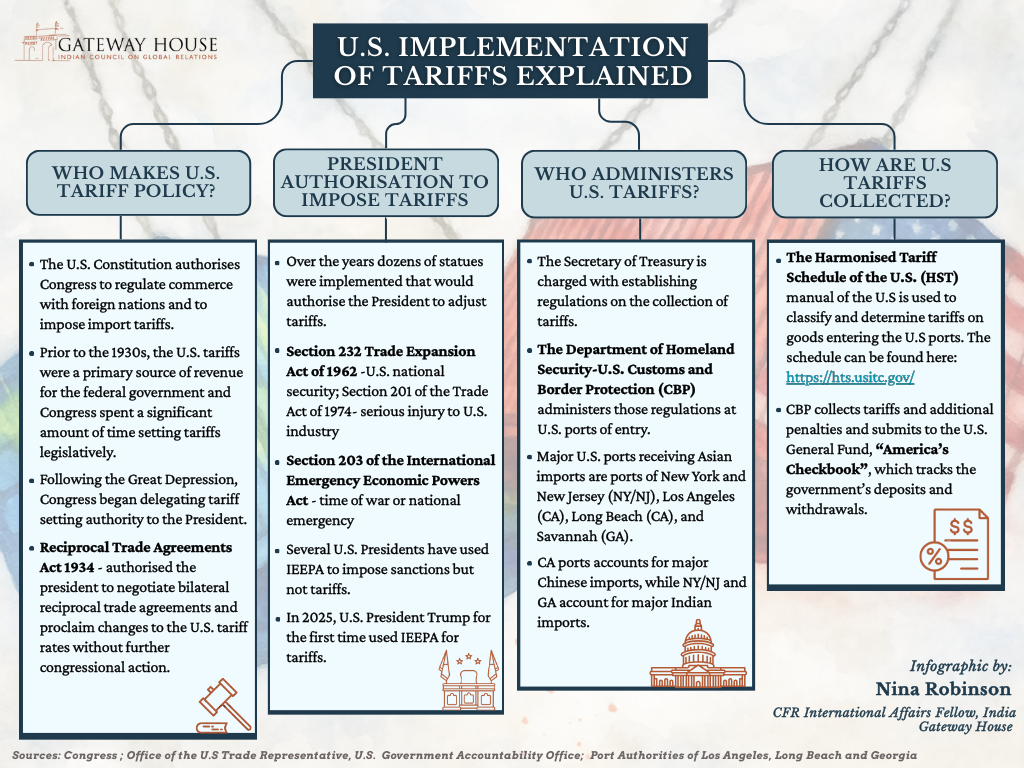
Who makes, imposes, administers and collects U.S. tariffs? The U.S. Congress, but for the last several decades, it has been at the discretion of the U.S. President, who has been given tariff-setting authority. Under the International Emergency Economic Powers Act, 1977, U.S. President Donald Trump has imposed reciprocal and universal tariffs on over 60 countries.

indo pacific  (7) Courtesy: Daily News Egypt
31 July 2025

Egypt positions its foreign policy

Egypt sits at the intersection of three continents and two seas, and its foreign policy is a geographic, historic and strategic consequence. From Tripoli to Kortum, Addis Ababa to Brussels, New Delhi to Moscow, Beijing to Washington, Cairo employs diplomacy as a key national security tool, positioning itself as a cornerstone of geopolitical stability within an increasingly multipolar world.

trump - japan (1) Courtesy: Gateway House
24 July 2025

Unfolding Geopolitics Episode 20 | PM Modi’s Maldives visit

All eyes are on the July 25-26 visit of Prime Minister Modi to Maldives as chief guest for the Maldivian Independence Day celebrations. It’s a remarkable turnaround by Maldivian President Mohamed Muizzu, who won the 2023 election on an “India Out” campaign. What caused the change? Proximity and geopolitics, says Rajiv Bhatia transformed Maldivian view.

indo pacific  (2) Courtesy: Getty Images
24 July 2025

India’s footprint in the Indo-Pacific region

India is strategically expanding its influence across the Indo-Pacific region, positioning itself as a key player in regional affairs. Three elements anchor the effort: development aid, trade and the diaspora. The country now has 20 Free Trade Agreement partners in the Indo-Pacific. The 21.8 million-strong Indian diaspora across the region is a significant source of soft power for India.

trump - japan Courtesy: Kent Nishimura/Reuters
24 July 2025

The Trump effect in Japan

The political setback by the ruling coalition in Japan in the July 20 Upper House elections reflects growing frustration with the mainstream political parties. Young people frustrated with high costs have resulted in a fragmentation of Japan’s political landscape, and the rise of the right. The “Trump effect” has found fertile ground in Japan’s political soil.

Website articles  (22) Courtesy: Getty Images
3 July 2025

Diversifying supply chains for critical minerals

The Quad Foreign Ministers’ Meeting in Washington on 1 July, 2025, underscored the importance of diversified and reliable global supply chains, especially for critical minerals. A Gateway House report shows how to strengthen supply chains for rare earths by creating deep financial markets similar to those that exist for bullion and oil.

Hindustan Times (1) Courtesy: X / PMOIndia
3 July 2025

PM Modi forges ties with G7, Cyprus, Croatia

PM Modi's multi-country visit from 15-19 June to Cyprus, Canada, and Croatia demonstrated India's expertise in nurturing ties with great powers, middle powers and state powers.  The common thread was twofold: to represent India at the still-important summit of the Group of Seven in Alberta, and to push India’s strategic partnership with the EU, by forging closer ties with the countries of eastern and central Europe.

Gateway House Courtesy: Gateway House
3 July 2025

China Plus One and global supply chains

A slowdown of the Chinese economy, and the shift, particularly by MNCs, from China to other more competitive locations has opened up business opportunities for latecomers to supply chains in the developing world. Evidence suggests that Southeast Asia and some South Asian countries like India, Sri Lanka, Bangladesh, could be beneficiaries of the supply chain shift, particularly in labour-intensive segments.

ADEM ALTANAFP via Getty Images Courtesy: Adem Altan/AFP via Getty Images
3 July 2025

Iran’s second chance to transition

Iranian foreign policy must move toward strategic autonomy and internal concord. As witnessed after the 1988 ceasefire with Iraq, such moments can mark an inflexion point - one that prioritises national reconstruction, resilience, and welfare; strategic recalibration, strengthening of confidence, and finding a geopolitical identity. Iran has been there before, and can apply those experiences again.