

India has strategically sought to expand its influence across the Indo-Pacific region in recent decades, positioning itself as a key player in regional and global affairs. This effort is first and foremost reflected in its growing network of strategic partners in the region, ranging from strategic partnerships with Oman and Tanzania to a Comprehensive Global Strategic Partnership with the U.S. This expansion in strategic partnerships can be attributed to three factors: an increasingly assertive China, economic benefits, and India’s desire to play a bigger role on the world stage. Additionally, India has increasingly used official visits, both incoming and outgoing, as a tool to maintain and improve ties with countries in the region.
India has significantly expanded trade relations with its Indo-Pacific partners, entering into a total of ten Free Trade Agreements (FTAs) with countries in the region since 2000, bringing its total FTA partners to 20. Despite these advances, trade deficits, particularly with partners like China, remain a significant concern.
Once a significant benefactor of international development aid, India has now shifted into the role of provider. The vast majority of this aid is distributed amongst countries in India’s immediate neighbourhood, in line with its “neighbourhood first” policy. In total, $7.6 billion of a total of 8.9 billion has been directed towards India’s Indo-Pacific partners.
Beyond the government’s efforts to consolidate its position, India’s Indo-Pacific footprint has been strengthened by the 21.8 million strong Indian diaspora spread across all corners of the region, from South Africa to Tuvalu. These person-to-person ties between India and even the most far-flung parts of the Indo-Pacific act as a significant source of soft power for India. These ties are further strengthened by an ever-increasing network of air connectivity between India and other countries in the region, now totalling 175 direct air routes.
Status of Relationship with Indo-Pacific Partners
India has cultivated a wide range of partnerships with various countries across the Indo-Pacific region. These are classified under numerous statuses: Strategic, Special Strategic, Comprehensive Strategic, and Comprehensive Global Strategic. While these classifications lack specific, agreed upon definitions, they nonetheless denote the level of engagement and cooperation between India and the respective partner.
Strategic Partnerships refer to engagement in a range of areas, though they are typically centered on political, defence and security cooperation.[1][2] Special Strategic Partnerships indicate a further level of engagement, including areas such as investment, energy, infrastructure and healthcare.[3] Even more exhaustive are Comprehensive Strategic Partnerships, covering a gamut of areas such as defence, trade, technology, education, energy, healthcare, culture, tourism, environment, and agriculture.[4][5] Finally, is the level of Comprehensive Global Strategic Partnership, which exists only with the U.S., encompassing all the previously mentioned domains, with a particular emphasis on defence cooperation. This includes co-development and co-production of defence equipment, maritime and space domain information sharing, advanced training, and expanded joint exercises.[6]
India’s partnerships with Indo-Pacific countries
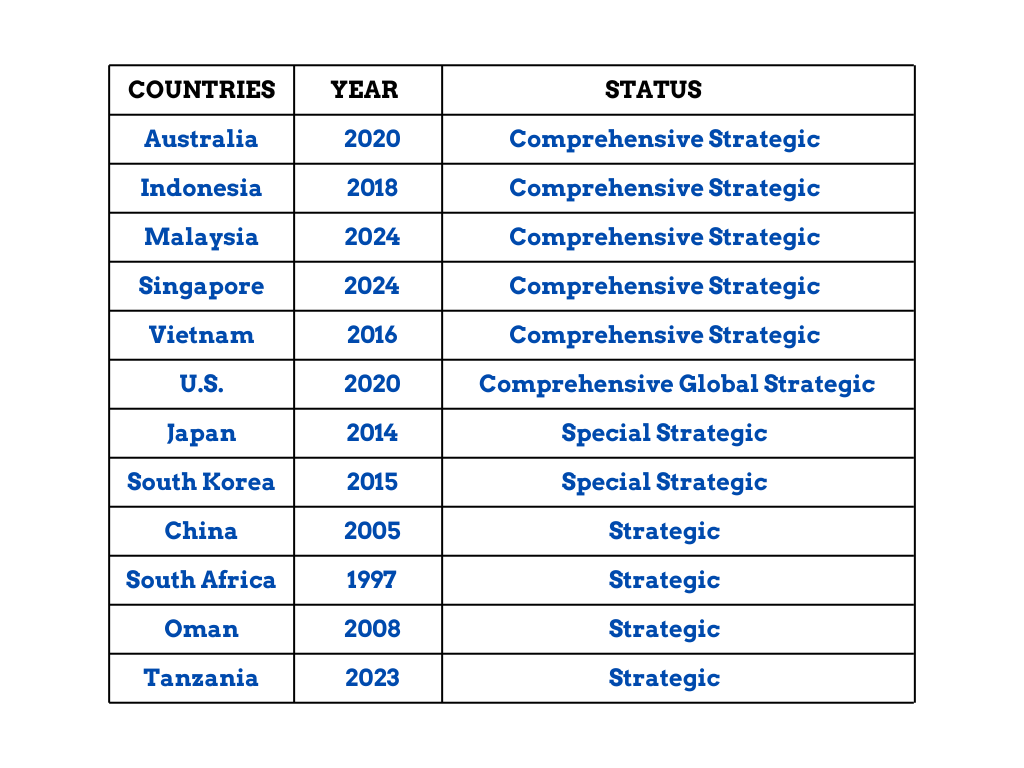
This map shows the various countries in the Indo-Pacific with which India has signed a form of partnership agreement. In total, India has entered into one Comprehensive Global Strategic Partnership, five Comprehensive Strategic Partnerships, two Special Strategic Partnerships, and four Strategic Partnerships across the Indo-Pacific region. Four of these partners are located in Southeast Asia, three in Northeast Asia, two in Africa, and one each in North America, Oceania and the Middle East. In addition to these bilateral partnerships, India has also entered into a Comprehensive Strategic Partnership with the Association of Southeast Asian Nations (ASEAN).
Having fostered such a wide range of partnerships in all corners of the Indo-Pacific region, India has positioned itself as a key-player in a range of areas of regional cooperation. Of the fourteen partnerships that India enjoys with countries in the Indo-Pacific, nine of them were elevated to their current status in the last 10 years since 2015, with six elevated in the last five years since 2020, reflecting the country’s ever-increasing focus on the Indo-Pacific region as an area of priority for its foreign and security policy.
There are three plausible drivers behind the rise in the number of strategic partnerships that India has entered into with countries in the Indo Pacific region.The first is the rapid rise of China as an economic powerhouse, accompanied by its increased militarisation and aggressive behaviour in the region. Such a shift in regional power dynamics has likely encouraged India to seek external balance in the form of strategic partnerships with countries that share similar concerns regarding a more assertive China. Indeed, India’s “Act East” policy, revised in 2014, has sought to deepen ties with Southeast Asian countries in particular, helping strengthen India’s position in the region. Furthermore, the Indo-Pacific Oceans Initiative (IPOI) was devised in 2019 to improve maritime cooperation between like-minded countries to support a resilient, rules-based maritime order in the Indo-Pacific.
The likely economic benefits to be gained by entering into such agreements is the second driver. In recent decades, India has opened itself up to increased trade, with equal now to 46% of GDP (Gross Domestic Product), compared to just 16% in 1990.[7] Given their geographic proximity, Southeast Asian countries in India’s neighbourhood offer an obvious chance for trade development.
Third, and final is India’s aspiration to play a larger and more influential role on the international stage. Commensurate with its position as the world’s largest country and fifth largest economy by nominal GDP (third largest if measured by Purchasing Power Parity), India has increasingly sought to take on not only a leading role regionally but also globally.[8] To do so, it has leveraged its ties with countries in the region, both immediate neighbours and those further afield.[9]
Looking to the future, if India wishes to strengthen its position as one of the leading powers in the Indo-Pacific, it should work on further expanding its network of strategic partners. The South Pacific is one area set to play a crucial role in the future of the Indo Pacific. Although India inaugurated the Forum for India-Pacific Island Cooperation in 2014 to further its presence in the region, it is yet to enter into a strategic partnership with any South Pacific nation, with the exception of Australia.[10]
Indian Diaspora in the Indo-Pacific Region
The Indian diaspora is the largest in the world, totalling just over 35.42 million people residing overseas.[11] This is divided between Non-Resident Indians (NRIs), who retain Indian citizenship but reside outside of India, and Persons of Indian Origin (PIOs), who are foreign citizens with Indian ancestry. The majority of overseas Indians reside in countries in the Indo-Pacific region, totalling 21.83 million, or 61.63% of the total Indian diaspora. This figure includes 6.02 million NRIs and 15.8 million PIOs.
Indian diaspora in the Indo-Pacific region:
Non-Resident Indians and People of Indian Origin
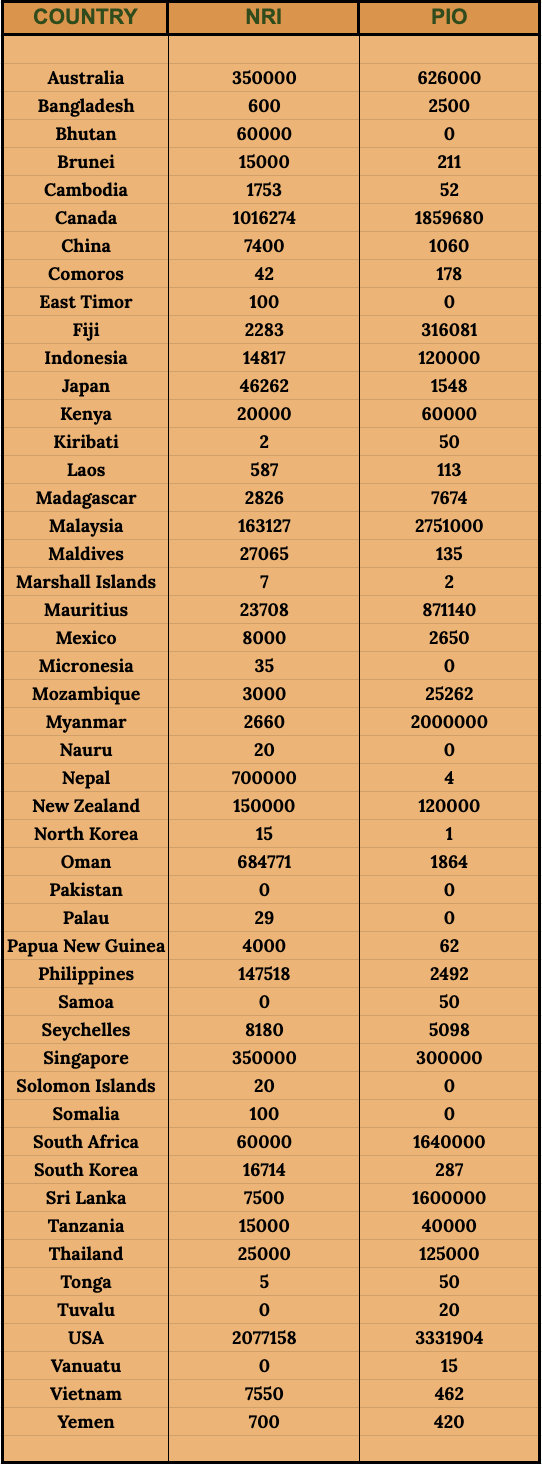
This map shows the number of NRIs and PIOs present in countries across the Indo-Pacific region. There have been numerous drivers of the Indian diaspora throughout history which can help explain the distribution seen here. The first of these drivers of Indian migration is inextricably linked to British colonial rule. Following the abolition of slavery in the United Kingdom in 1833, there was a need for indentured labourers to work in the agricultural sector across the British Empire.[12] This resulted in Indian labourers being sent across the empire throughout the latter half of the 19th century, particularly to the Caribbean, and also throughout the Indo-Pacific.[13] British colonies such as those in South Africa, Mauritius and Fiji received many of these Indian labourers, whose descendants now make up large numbers of PIOs seen in each of these countries.[14]
Contemporary migration from India towards the Indo-Pacific has since shifted away from these destinations and to economically developed countries in the West. Beginning in the 1970s, this has seen highly skilled and educated Indians heading abroad to seek employment.[15] This employment-driven migration can help explain the large number of both NRIs and PIOs who reside in the U.S., Canada, Australia, and New Zealand. Similarly, less-skilled Indian labourers have sought employment opportunities in the Middle East in recent decades, helping explain the large number of NRIs residing in Oman.[16]
Such a large Indian diaspora in the Indo-Pacific provides an important bridge between India and the diverse range of countries in this region of the world. This diaspora plays a crucial role in strengthening economic, cultural and political ties between India and its host countries, acting as a significant source of soft power for India. As a result, the Indian government has actively engaged with its overseas communities through initiatives such as the Overseas Citizenship of India (OCI) program. This program allows for PIOs to obtain a lifelong visa for India and acquire certain rights similar to NRIs, including access to the education system.[17] Such an initiative, among others like Pravasi Bharatiya Divas, help to foster deeper connections across the Indo-Pacific.
Air Connectivity between India and Countries in the Indo-Pacific
When it comes to air connectivity, India currently sees direct air routes to 25 of the 48 countries in the Indo-Pacific region,[18] which provide an important connection between the Indo-Pacific and 28 different Indian cities, from Amritsar in Punjab, all the way to Thiruvananthapuram in Kerala.
Air routes between India and countries in the Indo-Pacific
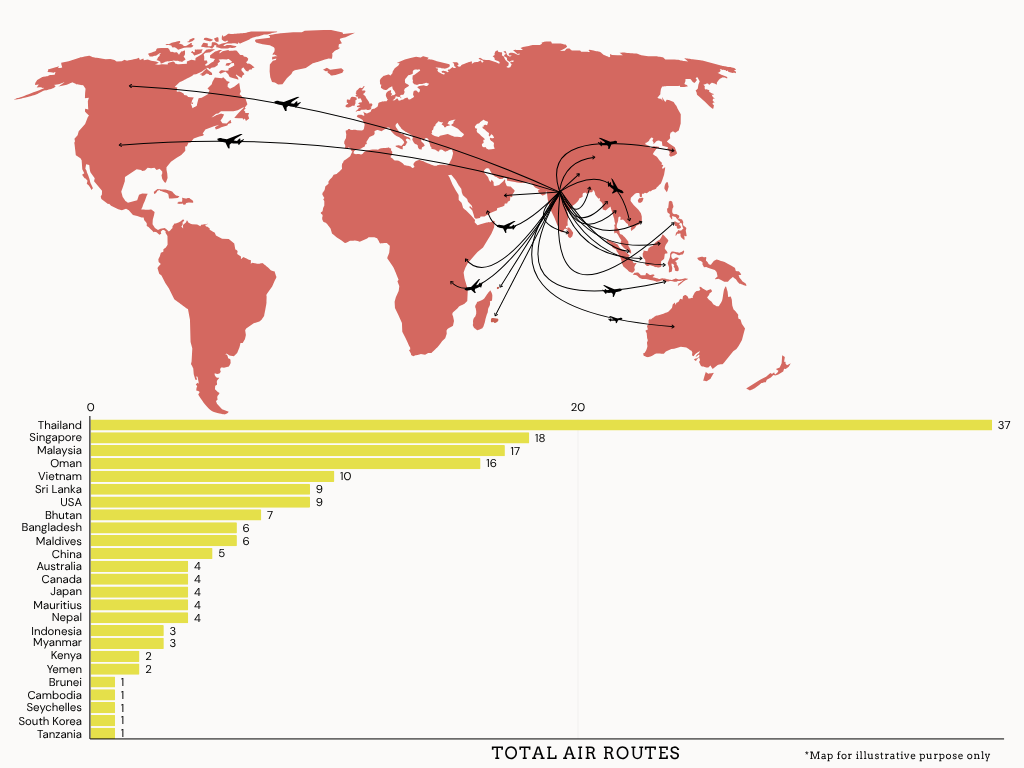
This graph shows the 175 direct air routes between India and countries in the Indo-Pacific region. Four countries are served by significantly more routes than the rest, totalling 90 routes between them. These are Thailand, Malaysia, Singapore and Oman. Both Thailand and Malaysia have seen a considerable increase in air connectivity with India, since they eased visa restrictions for Indian nationals in late 2023.[19][20] While both these countries are both popular destinations for Indian tourists, Bangkok and Kuala Lumpur are also major transit hubs for travellers going further afield, as is Singapore. Oman, on the other hand, is home to a significant population of migrant workers from all over India.[21]
There are no direct flights between India and mainland China, the second largest country in the Indo-Pacific region. While there are five direct connections with Hong Kong, none currently exist between cities in India and in mainland China. These connections were suspended following the outbreak of Covid-19 and failed to resume after border clashes in 2020 led to increased tension in the India-China relationship. Following the visit of External Affairs Minister Jaishankar to Beijing in January 2025, however, both countries agreed in principle to restart these direct connections.[22]
Though India sees air connections to a wide range of Indo-Pacific partners, there are a few notable countries which, despite a large Indian diaspora and warm relations with India, lack direct air connections with Indian cities. South Africa is an example of this. Despite being one of India’s strategic partners in the region and home to 1.7 million Indian diaspora, the BRICS member state is yet to host a direct flight to India. New Zealand, though not in a strategic partnership with India, is another example of a country with a significant Indian diaspora and warm bilateral relations, which is yet to receive direct flights. Direct air connections offer a bridge between India and its partners in the Indo-Pacific, allowing India to boost people-to-people ties and mobility. India should engage with officials in Indo-Pacific countries which do not yet see direct air connection to India in order to facilitate increased connectivity.
India’s Development Assistance Architecture
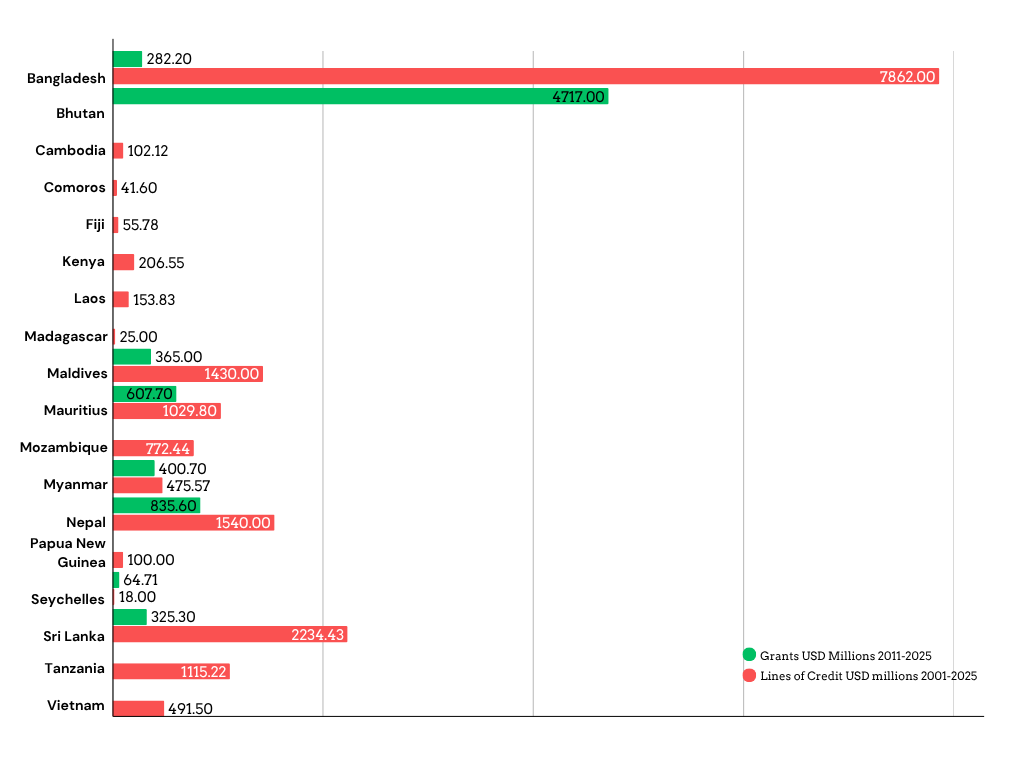
Development assistance has become an increasingly important tool in India’s foreign policy in the last two decades. Once a major beneficiary of international aid, India has recently shifted to the role of provider, supplying significant amounts of development assistance to other countries. Since 2011, this has included over $8.9 billion in grants to a wide range of partners across the globe.[23] The vast majority of this aid has gone to countries in India’s immediate neighbourhood, in line with its “neighbourhood first” policy devised in 2008 to enhance connectivity and bolster trade and commerce with countries such as Afghanistan, Bangladesh, Bhutan, Maldives, Myanmar, Nepal, Pakistan and Sri Lanka. In fact, $7.6 billion of India’s total direct development assistance has gone to its Indo-Pacific partners, the largest recipient of which is Bhutan, receiving a little over $4.7 billion of this sum.[24] Nepal, Mauritius, Myanmar, the Maldives, Sri Lanka, and Bangladesh have been other major recipients of this aid. In addition to its direct development assistance, India has also provided a total of over $560 million over the same period for international training and capacity building programs to both Indo-Pacific partners and others further afield.[25]
Beyond direct development assistance and funding for capacity building, India has also extended hundreds of Lines of Credit (LOCs) to partner countries since 2001, worth over $32 billion.[26] These LOCs have funded a diverse range of projects right across the Indo-Pacific, from restructuring the sugar industry in Fiji to drinking water purification in Mozambique. In total, the LOCs extended to India’s Indo-Pacific partners have been worth a combined value of over $17.7 billion, with the largest recipient being Bangladesh, with $7.9 billion.[27]
Though India has significantly increased its provision of international development assistance, it could do more to diversify the recipients of such assistance, particularly by providing aid to more partners beyond its immediate neighbourhood. Although countries in India’s neighbours must remain an area of priority, it has a unique opportunity given the suspension on all USAID programs to further project its influence through development assistance. The new Trump administration and its critical stance on foreign aid represents a chance for India to step up and step in, particularly in areas where it has thus far provided little assistance, such as the South Pacific and East Africa.
India’s expanding development assistance in the Indo-Pacific region
Trade Relationships
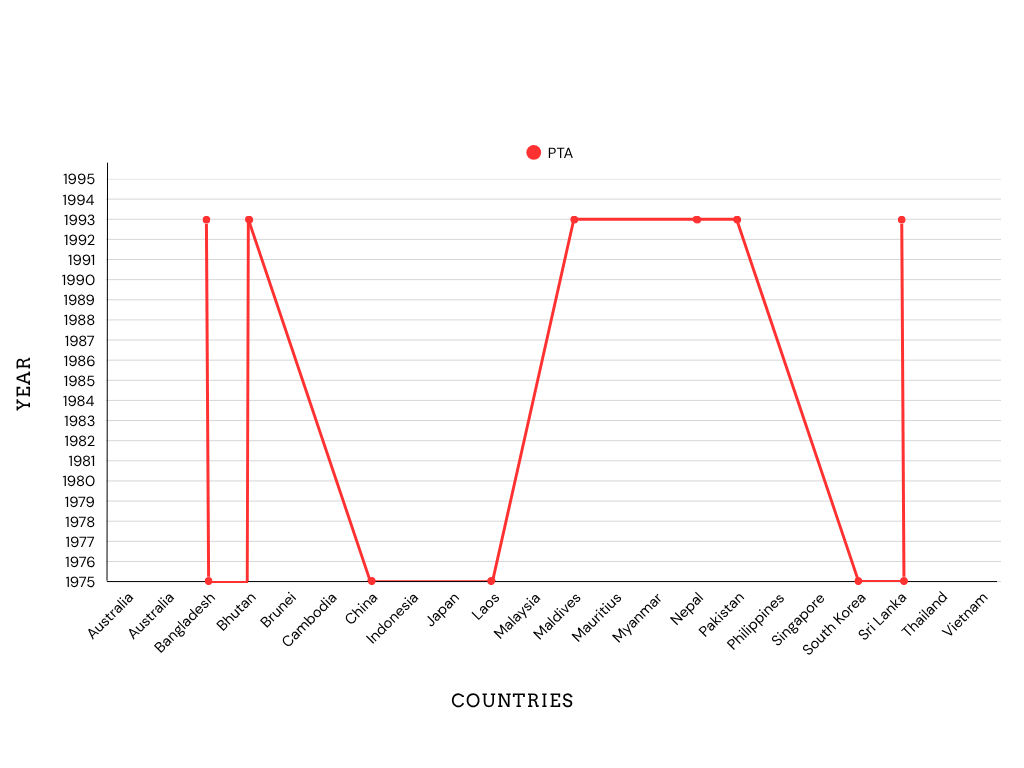
India’s Preferential Trade Agreements in the Indo-Pacific
India’s Free Trade Agreements in the Indo-Pacific
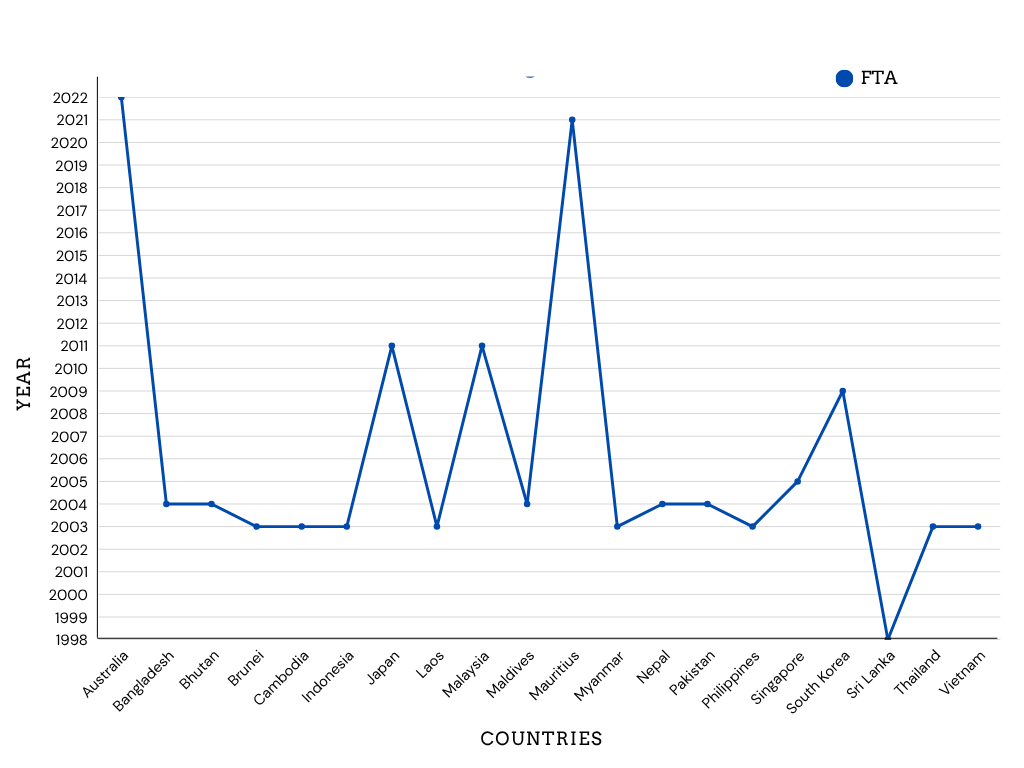
India has, in recent decades, entered into a range of Free Trade Agreements (FTAs) and Preferential Trade Agreements (PTAs) with different countries in the Indo-Pacific region. The first of these to be signed was the Asia Pacific Trade Agreement (APTA) in 1975 between India, Sri Lanka, Bangladesh, Laos, China and South Korea.[28] This was later followed by the SAARC Preferential Trade Agreement (SAPTA) in 1993 between India, Pakistan, Bangladesh, Bhutan, Maldives, Nepal, and Sri Lanka.[29] PTAs such as these allow the reduction of tariffs for goods on certain tariff lines between partner countries. FTAs, on the other hand, are much more exhaustive, allowing for the complete elimination of tariffs on a substantial number of tariff lines.[30]
As India has become more open to negotiating FTAs since the turn of the century, it has entered into a range of Comprehensive Economic Partnership and Cooperation Agreements (CEPAs and CECAs) with a range of countries. Such agreements not only include goods and services trade, but also investment and other areas of cooperation.[31] India has entered into a total of ten FTAs with countries in the Indo-Pacific region since 1998, including two multilateral agreements, the agreement on the South Asia Free Trade Area (SAFTA) and the agreement on the ASEAN-India Free Trade Area (AIFTA), and seven bilateral agreements with various countries, as can be seen on this map.[32] This brings India’s total FTA partners in the region to 20.
This network of PTAs and FTAs across the Indo-Pacific region has allowed India to boost trade and economic cooperation with many of its partners, cementing its place as a leader in the region. There is, of course, room for improvement. India has engaged in numerous rounds of trade agreement negotiations with a range of other Indo-Pacific partners, including Canada, Indonesia, Thailand, Oman, and South Africa. These negotiations, however, have all stalled in recent years, with the most recent round taking place in 2017 with Canada.[33] The only ongoing negotiations in the Indo-Pacific region are with Australia, to sign a second, more comprehensive agreement, and New Zealand.
If India is to expand its economic cooperation with countries in the Indo-Pacific, it should seek to resume stalled negotiations with the above partners, perhaps aiming for a less comprehensive agreement in the interim, as it successfully achieved with Australia. Furthermore, India should seek to initiate negotiations on bilateral agreements with new countries such as the U.S., ASEAN partners Vietnam and Myanmar, or its neighbours Nepal and the Maldives.
India’s trade balance with partners in the Indo-Pacific ($millions)

India’s trade deficit and surplus with partners in the Indo-Pacific partners ($billions)
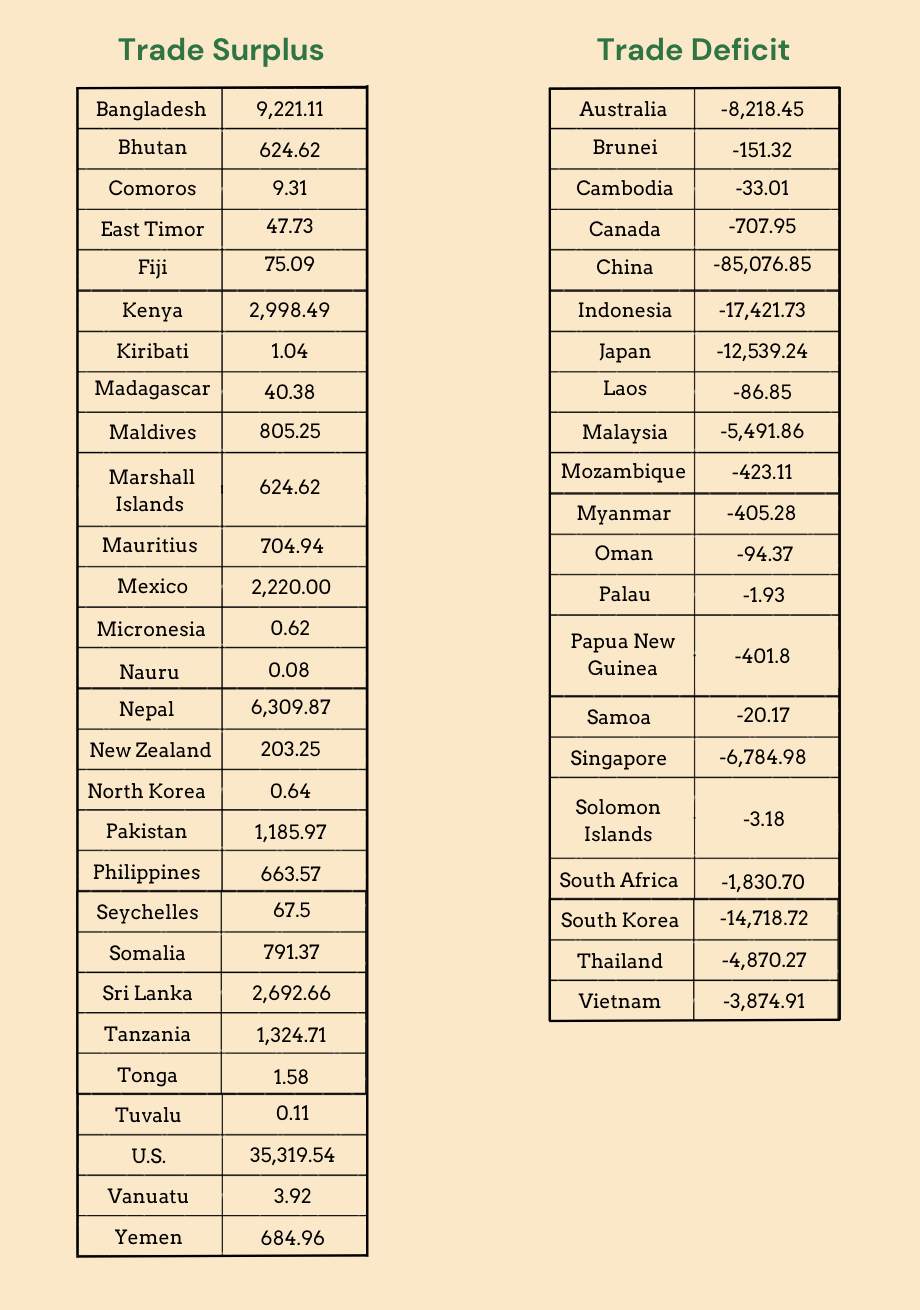
With regard to trade surpluses and deficits on the other hand, India suffers from a significant overall deficit with its Indo-Pacific partners, which sat at just over $97 billion for 2023-2024 in the Indo Pacific, accounting for a large proportion of India’s total trade deficit in the same period of just over $241 billion.[34] This regional deficit is driven largely by India’s reliance on Chinese imports, resulting in a yawning deficit of $85 billion with the latter. This significant deficit is offset only partially by India’s surplus of $35 billion with the U.S., a result of the former’s large volume of exports in engineering and electronic goods, gems and jewellery, pharmaceutical products, and petroleum products to the U.S.[35]
If India is to decrease its regional trade deficit in the Indo-Pacific, it must address issues of market access in China for Indian exporters. Indian exporters currently face significant barriers when it comes to agricultural commodities and other important goods such as pharmaceutical and IT products.[36] India must also work to decrease its trade deficit with other important partners in the region, notably Indonesia, South Korea, Japan and Australia, with whom India currently runs deficits of between $17 and $8 billion.[37]
Official Visits
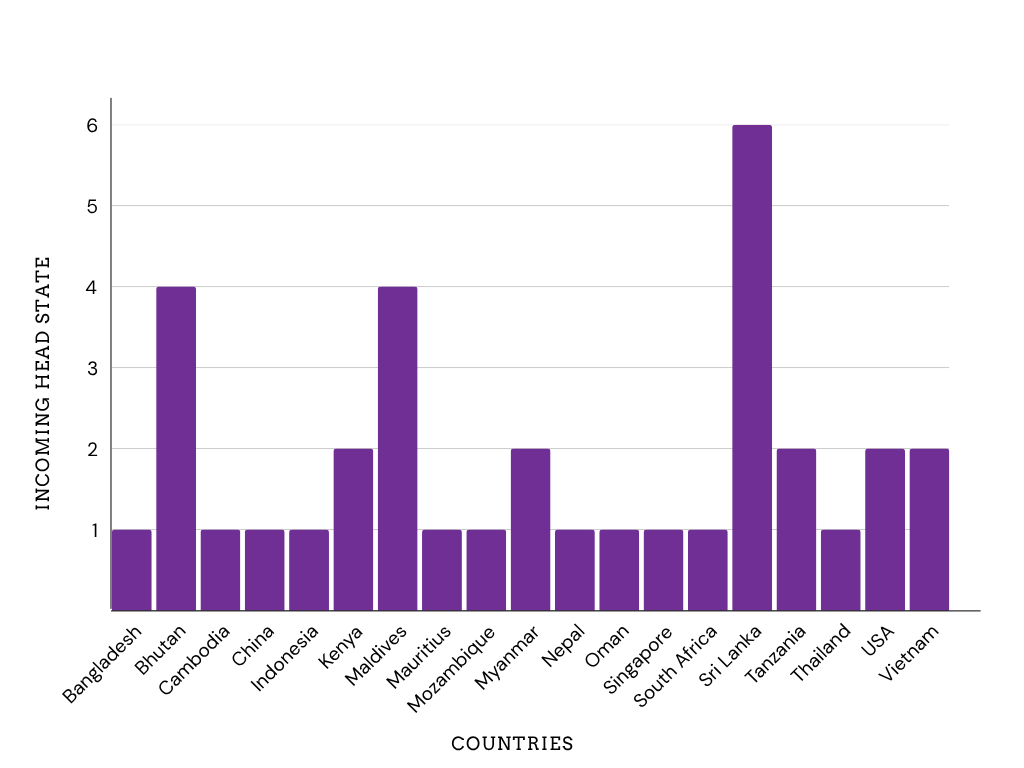
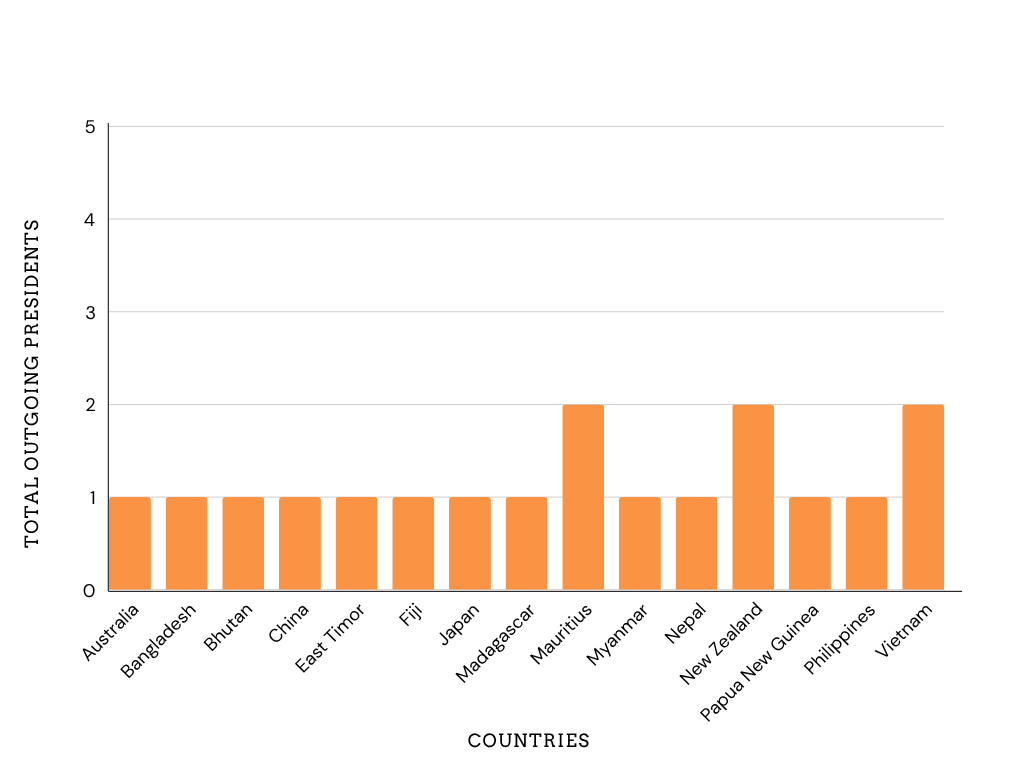
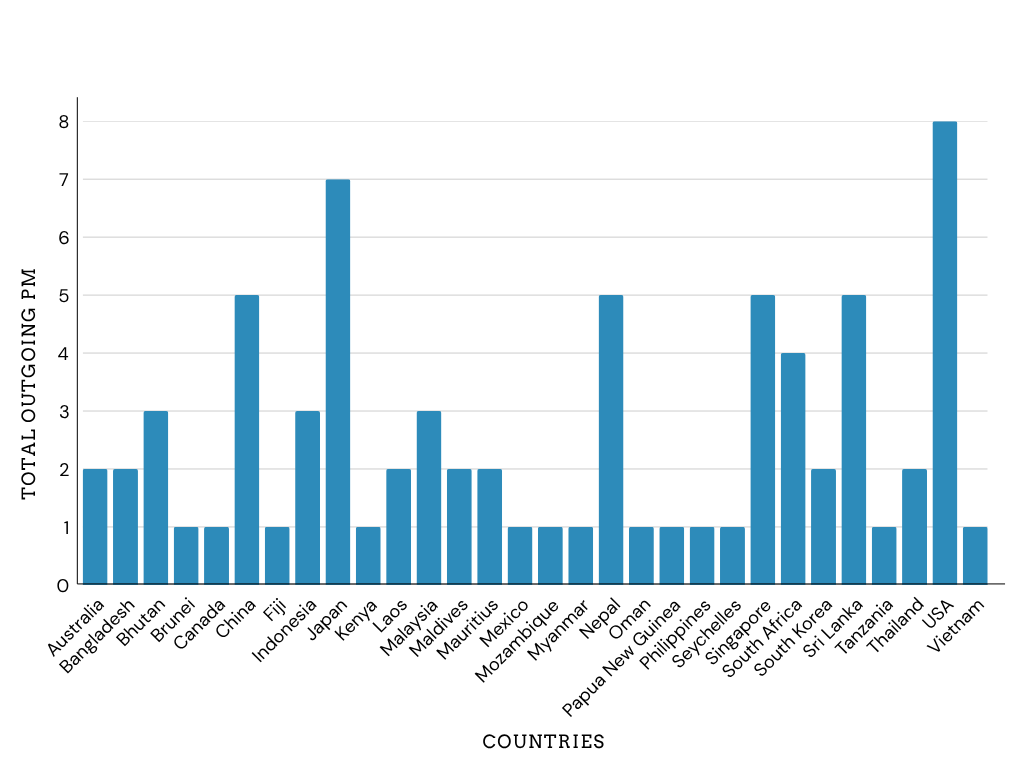
The importance of the Indo-Pacific region for India’s foreign policy is underpinned by the frequency of visits of Indian leaders to, and reception of leaders from a wide range of countries in the region. This map shows the number of outgoing visits by Prime Minister Modi, the President of India and the Minister of External Affairs, along with the number of incoming visits by foreign heads of state, heads of government and Ministers of Foreign Affairs between 2014 and 2024.
Incoming visits to India by heads of governments from the Indo-Pacific (2014–2024)

Incoming visits to India by heads of states from the Indo-Pacific
(2014-2024)
Incoming visits to India by foreign ministers from the Indo-Pacific
(2014–2024)
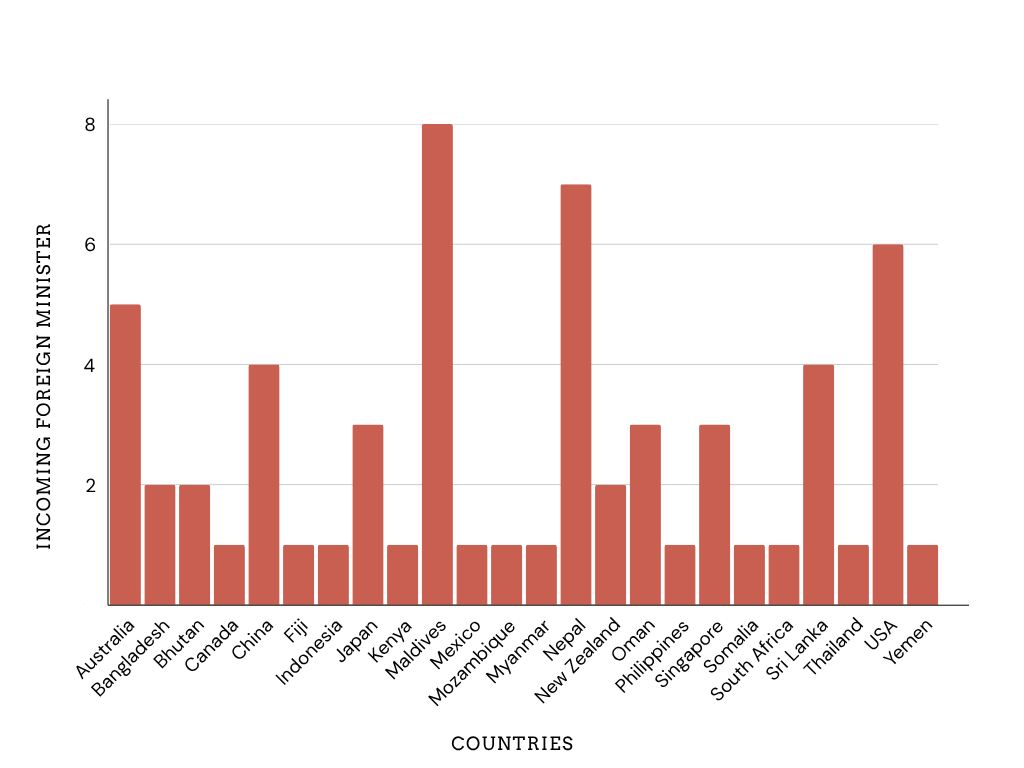
Looking first at incoming visits, India receives the largest number from countries in its immediate neighbourhood. The countries from which India received the most visits in this period were Nepal, Sri Lanka, the Maldives and Bhutan, respectively.[38] Not only does this signify the crucial role that India plays as a leader in the Indian Ocean region, but it is also a testament to the strong relationships that it has forged with countries in its geographical vicinity.
India has also received a significant number of visits from leaders of other partner countries that lie outside its immediate neighbourhood signifying its important position in regional and global affairs. These include a relatively high number of visits from Quad partners, the U.S., Australia, and Japan, as well as ASEAN partners, Vietnam and Singapore.
Visits by Indian presidents to the Indo-Pacific (2014–2024)
Visits by the Indian prime minister to the Indo-Pacific (2014–2024)
Visits by Indian external affairs ministers to the Indo-Pacific (2014–2024)

Turning now to outgoing visits of Indian leaders, we can see that the priority area for Indian leadership is not as centered around India’s immediate neighbourhood as the numbers of incoming visits may suggest. While countries such as Sri Lanka, Nepal, and the Maldives have received a significant number of official visits, they are matched by other partners such as the U.S., Japan and China.[39] These visits show the high level of importance that India has placed on its security partners in the Indo-Pacific, namely the Quad, and on ensuring amicable relations with its neighbour, China.
These high-level visits, both incoming and outgoing, help to solidify bilateral relations with India’s partners in the Indo-Pacific, paving the way for enhanced cooperation and the signing of agreements and Memorandums of Understanding (MoUs). India’s focus thus far, on its immediate neighbourhood and its most important partners has its merits; however, opening up the possibility of increased high-level exchanges with other partners could help solidify India’s position as a leader in the region. For example, Indian leaders have not visited nor been visited by leaders of many countries in the South Pacific in the last ten years, an area that is set to become only more influential in regional geopolitics and where China is increasingly asserting influence. Extending an invitation for state visits from these countries could be a way to show that India is serious about engaging with the South Pacific and that it can be a reliable partner for the region.
Note: India’s definition of the Indo-Pacific, as a region that spans from the eastern boundary on the Indian Ocean to the western boundary of the Pacific Ocean, would include countries bordering the Red Sea, the Persian Gulf, and the western coast of South and Central America, as well as Russia and countries with dependent territories in this region, such as France or the United Kingdom. However, these countries are not included in the discussions of the Indo-Pacific in the interest of precision.
Adam Wearne is a former intern, Gateway House.
This infographic was exclusively designed for Gateway House: Indian Council on Global Relations. You can read more exclusive content here
Support our work here.
For permission to republish, please contact outreach@gatewayhouse.in
©Copyright 2025 Gateway House: Indian Council on Global Relations. All rights reserved. Any unauthorised copying or reproduction is strictly prohibited.
References:
[1] “India-South Africa Bilateral Relations.” Ministry of External Affairs, Government of India, June 2024. https://www.mea.gov.in/Portal/ForeignRelation/Bilateral-brief_SA-for-XPD-June-2024.pdf.
[2] “India-Oman Bilateral Brief .” Ministry of External Affairs, Government of India, November 2023. https://www.mea.gov.in/Portal/ForeignRelation/Oman-Dec-23.pdf.
[3] “India-Japan Bilateral Relations.” Ministry of External Affairs, Government of India, October 2023. https://www.mea.gov.in/Portal/ForeignRelation/Japan_-_Bilateral_Brief_MEA_Website_Oct_2023.pdf.
[4] “Joint Statement on India – Malaysia Comprehensive Strategic Partnership.” Press Information Bureau, August 20, 2024. https://www.pib.gov.in/PressReleasePage.aspx?PRID=2047076#:~:text=The%20two%20Prime%20Ministers%20agreed,Disaster%20Resilient%20Infrastructure%20(CDRI)..
[5] Ministry of External Affairs Annual Report 2024, 2024. https://www.mea.gov.in/Images/CPV/Introduction-and-Synopsis-English.pdf.
[6] “Joint Statement: Vision and Principles for India-U.S. Comprehensive Global Strategic Partnership.” Ministry of External Affairs, Government of India, February 25, 2025. https://www.mea.gov.in/bilateral-documents.htm?dtl/32421/Joint_Statement_Vision_and_Principles_for_IndiaUS_Comprehensive_Global_Strategic_Partnership.
[7] “Trade (% of GDP) | Data.” World Bank Open Data. Accessed July 21, 2025. https://data.worldbank.org/indicator/NE.TRD.GNFS.ZS?end=2023&name_desc=false&start=1960&view=chart.
[8] Shaw, Debnath. “Changing Dynamics of India’s Foreign Policy.” Ministry of External Affairs, Government of India, August 23, 2019. https://www.mea.gov.in/distinguished-lectures-detail.htm?843
[9] Kumar, Yogendra. “India’s Maritime Diplomacy in the Indo-Pacific in Pursuit of Its National Objectives.” Ministry of External Affairs, Government of India, October 18, 2019. https://www.mea.gov.in/distinguished-lectures-detail.htm?852.
[10] “Prime Minister Meets Pacific Island Leaders.” Ministry of External Affairs, Government of India, September 24, 2019. https://mea.gov.in/press-releases.htm?dtl/31854/Prime_Minister_meets_Pacific_Island_Leaders=.
[11] “Population of Overseas Indians.” Ministry of External Affairs, Government of India. Accessed July 21, 2025. https://www.mea.gov.in/population-of-overseas-indians.htm.
[12] Singh, Ruchi. “Origin of World’s Largest Migrant Population, India Seeks to Leverage Immigration.” Migration Policy Institute, March 9, 2022. https://www.migrationpolicy.org/article/india-migration-country-profile.
[13] ibid.
[14] ibid.
[15] ibid.
[16] ibid.
[17] “Population of Overseas Indians.” Ministry of External Affairs, Government of India. Accessed July 21, 2025. https://www.mea.gov.in/population-of-overseas-indians.htm.
[18] “Flightconnections: All Flights Worldwide on a Map!” FlightConnections. Accessed July 21, 2025. https://www.flightconnections.com.
[19] “Royal Thai Government Grants Visa Exemption for Tourists from India and Taiwan from 10 November 2023 to 10 May 2024.” Ministry of Foreign Affairs, Kingdom of Thailand | กระทรวงการต่างประเทศ, November 8, 2023. https://www.mfa.go.th/en/content/india-visa-exemption-2?cate=5d5bcb4e15e39c306000683e.
[20] “IMPORTANT ANNOUNCEMENT ON VISA EXEMPTIONS FOR INDIAN PASSPORT HOLDERS.” High Commission of Malaysia, New Delhi | Ministry of Foreign Affairs, Malaysia, November 30, 2023. https://www.kln.gov.my/web/ind_new-delhi/home/-/asset_publisher/zjzc18WNnQto/blog/visa-free-travel-to-malaysia-for-indian-citizens?inheritRedirect=false#:~:text=The%20Republic%20of%20India%20passport,and%20visit%20to%20the%20country.
[21] “India-Oman Bilateral Brief .” Ministry of External Affairs, Government of India, November 2023. https://www.mea.gov.in/Portal/ForeignRelation/Oman-Dec-23.pdf.
[22] “Visit of Foreign Secretary to China.” Ministry of External Affairs, Government of India, January 27, 2025. https://www.mea.gov.in/press-releases.htm?dtl%2F38946%2FVisit_of_Foreign_Secretary_to_China=.
[23] India budget documents 2011- 2025
[24] India budget documents 2011 – 2025
[25] India budget documents 2011 – 2025
[26] “Government of India – Lines of Credit Statistics.” India Exim Bank. Accessed July 21, 2025. https://www.eximbankindia.in/lines-of-credit-GOILOC.aspx.
[27] ibid.
[28] “Asia Pacific Trade Agreement (APTA).” Indian Trade Portal. Accessed July 21, 2025. https://www.indiantradeportal.in/vs.jsp?lang=0&id=0,1,30622,30624.
[29] “Agreement on SAARC Preferential Trading Arrangement (SAPTA).” Indian Trade Portal. Accessed July 21, 2025. https://www.indiantradeportal.in/vs.jsp?lang=0&id=0,959,10581,28177,29920.
[30] “Frequently Asked Questions Free Trade Agreements.” Indian Trade Portal. Accessed July 21, 2025. https://www.indiantradeportal.in/vs.jsp?lang=0&id=0,55,288.
[31] ibid.
[32] ibid.
[33] “India’s Current Engagements in RTAS.” Ministry of Commerce and Industy. Accessed July 21, 2025. https://www.commerce.gov.in/international-trade/trade-agreements/indias-current-engagements-in-rtas.
[34] “MEIDB – System on India’s Monthly Trade.” Ministry of Commerce and Industry, Department of Commerce, https://tradestat.commerce.gov.in/
[35] ibid.
[36] “Information Sought under the Right to Information Act, 2005 No.E-551/05/2022-RTI.” Ministry of External Affairs, Government of India, February 28, 2022. https://www.mea.gov.in/Images/CPV/RTI_280222.pdf.
[37] ibid.
[38] “Visits : Incoming Visits.” Ministry of External Affairs, Government of India. Accessed July 21, 2025. https://www.mea.gov.in/incoming-visits.htm?1/incoming_visits.
[39] “Visits : Outgoing Visits.” Ministry of External Affairs, Government of India. Accessed July 21, 2025. https://www.mea.gov.in/outgoing-visits.htm?2/outgoing_visits