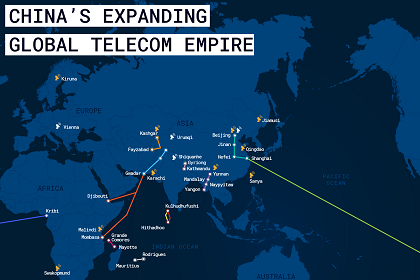
2-8-18 CableMap-02 - Copy Courtesy: Gateway House
2 August 2018

Version 2: Mapping China’s global telecom empire

This version of the Gateway House Map on China’s Expanding Global Telecom Empire identifies some more telecommunication assets -- optic-fibre and satellite ground stations -- that Beijing is working on in South and Central America, Africa, Myanmar, the Indian Ocean Region and mainland China besides the existing ones, such as the Pakistan East Africa Cable Express (PEACE). It shows the direction China’s investment is taking, its diplomatic overtures and the larger geopolitical implications of its growing telecom empire

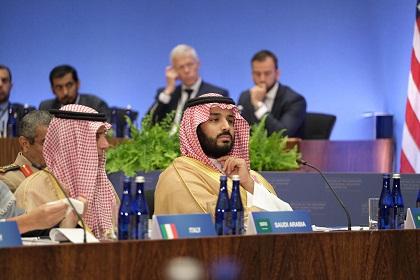
28455374735_17cf79553a_b Courtesy: Flickr
31 January 2017

Saudi prince: not quite a game changer?

Prince Salman’s accession to the throne after the death of Saudi King Abdullah on 23 January 2015 has been a game changer, both domestically and in West Asian politics. Within days, he sidelined rivals within the House of Saud, and took on Iran with a confrontational policy. But two years later, the results of his new strategy disappoint

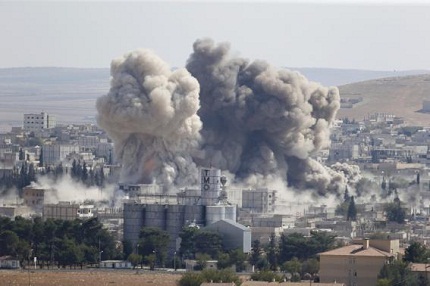
Smoke rises after an U.S.-led air strike in the Syrian town of Kobani Ocotber 8, 2014.     REUTERS/Umit Bektas Courtesy: IB Times
22 December 2016

Syria: energy battles to regional alliances

Aleppo is back under the control of the Syrian government, the Russian ambassador to Ankara is assassinated for his country’s role in Syria, and U.S. President-elect Donald Trump wants to cooperate with Russia to fight ISIS in Syria. These momentous events in modern history compel an assessment of the geopolitics surrounding Syria.

nice-attack-1 Courtesy: The Independent/AP
20 July 2016

Islamic State and France: mortal enemies

France's state policy of 'laïcité' (secularism) and its military interventions in Islamic countries has made it the prime target of IS in the West. The hardline French response to step up bombing campaigns against jihadis in Syria, Iraq, and Mali will likely continue, but conversely feeds IS strategy, which is to foment anti-Muslim sentiment among the non-Muslim French population.

UN Courtesy:
1 October 2014

India must push anti-terror compact

With the growth of the Islamic State and of terrorist groups in Africa and other parts of the world, global coordination to combat terrorism is imperative. Prime Minister Narendra Modi has urged the UNGA to adopt the Comprehensive Convention on International Terrorism, but divergent national interests remain a hurdle

west asia W123 Wikimedia Courtesy: W123/WikimediaCommons
6 December 2013

Orienting to the new West Asia

Whether backdoor geopolitics rather than careful negotiations brought about the interim agreement on Iran’s nuclear programme, the next six months will determine its fate. Reactions have ranged from a furious and mistrustful Israel to collective relief by many countries, and a worried India welcoming the agreement

halifax2 Courtesy: Sameer Patil
26 November 2013

Understanding our complex world, in Halifax

Gateway House’s Associate Fellow Sameer Patil, who participated in the fifth annual Halifax International Security Forum, blogs about his inferences from the main discussions as well as his interactions with the participants at the event

egypt protest Zeinab Mohamed flickr Courtesy: Zeinab Mohamed/Flickr
8 August 2013

Time to back the anti-Wahabbi tide

Today, the role Wahabbism plays in geopolitics poses a severe security risk not just to the West but also to the Muslim world. The West needs to rethink its strategy of promoting Wahabbi International, and realise that Wahabbism cannot be a moderated geopolitical asset

corridorsmap2 Courtesy: Gateway House
11 July 2013

Asia’s Strategic Corridors to India

The map – Asia’s Strategic Corridors to India – has emerged from Gateway House’s study of India’s strategic links with other parts of Asia. It highlights the progress India has made in forging multiple links with six strategic regions – Central Asia, West Asia, East Africa, South-East Asia, East Asia, and our immediate neighbourhood

Morsi Courtesy: European External Action Service/ Flickr
3 July 2013

Why Morsi is wrong for his people

The downfall of Egyptian president Mohammad Morsi was partly contributed by those thousands of protesters who disagreed with his view of “Us” and “Them”. Leaders such as Morsi have focused on persecuting those who refuse to share their vision; continuing down this path would have had a negative impact on history