Screenshot 2025-10-13 103335 Courtesy: Körber-Stiftung
13 October 2025

Bandung at 70: Multilateralism in a New Era of Multi-Alignment

The world is facing multiple crises which are shaking the foundations of multilateralism. The West’s structures are faltering, and the need for effective and equitable cooperation is greater than ever. Seventy years after the 1955 Bandung Conference, its principles of sovereignty, territorial integrity, cooperation and solidarity remain vital. This report revisits Bandung’s relevance for today’s reform efforts, urging renewed Global South–Europe collaboration for a sustainable global future.

Gateway House Courtesy: Gateway House
3 July 2025

China Plus One and global supply chains

A slowdown of the Chinese economy, and the shift, particularly by MNCs, from China to other more competitive locations has opened up business opportunities for latecomers to supply chains in the developing world. Evidence suggests that Southeast Asia and some South Asian countries like India, Sri Lanka, Bangladesh, could be beneficiaries of the supply chain shift, particularly in labour-intensive segments.

Getty (1) Courtesy: Gateway House
15 May 2025

The New Geopolitics and South Asia’s Trade Architecture – What Next?

Geopolitics is increasingly intertwined with the economic destiny of South Asia. Even before the U.S. tariffs were rolled out, growing polycrises had hit the global economy, which has been struggling since the pandemic. South Asia seems a relatively bright spark of regional trade and growth. This paper analyses South Asia’s trade architecture in the backdrop of a sluggish world economy in the 2020s, and makes recommendations for closer regional economic integration.

T20 Brochure 11 Img Courtesy: T20 Indonesia
22 September 2022

T20 Task Force Notes on Open Trade, Sustainable Investment and Industry

G20 President Indonesia, hosted the Think-20 (T20) Summit in Bali 4-6 September. The recommendations of the working groups resonate in the Leaders’ Statement released at the G20 Leaders’ Summit. The T20 Task Force on Open Trade, Sustainable Investment and Industry published its notes on multilateral trade reform, digital trade, health. Yose Rizal Damuri of CSIS, is the Lead Co-Chair of this Task Force.

GIGA_map_of_Indo-Pacific_Kontur_resize Courtesy: Science Po
28 July 2022

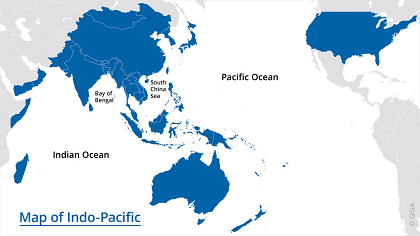
India’s blue economy and the Indo-Pacific’s future

The Indo-Pacific region envisages the Indian and Pacific Oceans as a continuum and stands on two central pillars – maritime security and economic development. The public discussions, however, are focused on maritime security, strategy and geopolitics, while economic development has received less attention. This imbalance can be corrected by creating an awareness on how to harness the potential of the region's Blue Economy and its vast resources and opportunities.

srinagar1 Courtesy: iStock Images
5 July 2022

G20 positioning from Srinagar?

Holding one of the G20 meetings in Jammu and Kashmir is a bold, audacious and timely move. It is possible because of the ceasefire along the Line of Control which has been holding since February 25, 2021. The new geopolitical setting offers India an opportunity to diplomatically disdain the Chinese, camping not too far away in the un-demarcated border areas with India.

G7s1 Courtesy: The Print
4 July 2022

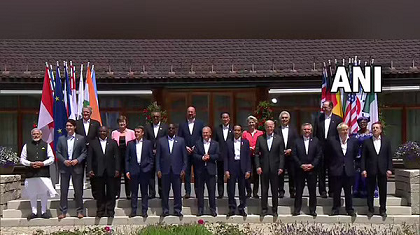
What did the G7 achieve?

The shadow of the Ukrainian war was visible at the G7 summit. Anti-Russian formations were expected, but the extensive reference to China drew attention. The leaders did their part by extensively discussing challenges relating to climate, energy, environment, health, and food security. It is now for the G7 governments to deliver, to be taken seriously.

Narendra-Modi-Silicon-Valley-684x420 Courtesy: Twitter: Digital India Archives
19 May 2022

Digital public goods for the Indo-Pacific

With mass digitisation, India has proved that technology is not just for the educated, privileged, and wealthy. The country's open and secure digital public platforms can be significant for the Indo-Pacific, the world's most data-rich region. The Indian model is applicable because it is open-source, interoperable, auditable, and enshrines individual rights, ownership, and empowerment.

china-solomon Courtesy: Financial Times
21 April 2022

Economic and human security in the Indo-Pacific

China has established a dominant presence in the Indo-Pacific through exploitative economic engagements. This has destabilised smaller nations in the region and made them dependent on Chinese support. For a free and open Indo-Pacific, India must press its advantage in human and economic capacity building.