Website articles  (5) Courtesy: PTI
9 May 2025

Three messages from Operation Sindoor

Operation Sindoor conveyed three messages: First, to Pakistan that it will have to bear the consequences of continuing to support terrorism. Second, to terrorists, that Bharat will inflict the same pain, if not more, than they inflict on Indian citizens. Third, to the world, that Bharat is resolute in responding to terrorism in a “measured, non-escalatory, proportionate, and responsible” manner.

Website articles  (3) Courtesy: Agence France-Presse
8 May 2025

How China can assist Pakistan post Pahalgam

India-China relations, undergoing a thaw since October 2024, have been slow to mend. In this scenario it is worth examining what assistance China can give Pakistan in case of military action by India, post Pahalgam. The state of play on the India-China border will also have a major implication for this.

World Leaders Courtesy: East Asia Forum
17 April 2025

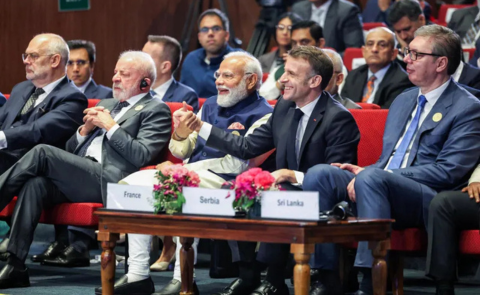
Multipolarity is gaining ground

The traditional power structures of ‘unipolarity’ or ‘bipolarity’ prevalent over the past 80 years are no longer appropriate to describe the current global order, with more countries increasingly supporting the evolving multipolar world. With the old ‘rules-based’ order becoming less relevant, emerging powers like India have an opportunity to draft more equitable rules to match their multipolar intentions.

FILE PHOTO: Anura Kumara Dissanayake, the presidential candidate from National People's Power, addresses his supporters during an election campaign rally ahead of presidential election, on the outskirts of Colombo, Sri Lanka, September 18, 2024. REUTERS/Stringer/File Photo Courtesy: Reuters
6 March 2025

Sri Lanka balances India and China

Sri Lanka is playing a balancing act as it manages its ties with India and China. It is heavily dependent on the two rival Asian giants for its economic revitalisation and future growth, but it must be strategic in its approach with both countries as it attempts to manage its foreign debt and ensure project sustainability while maintaining geopolitical neutrality.

BERNAMA Courtesy: BERNAMA
13 February 2025

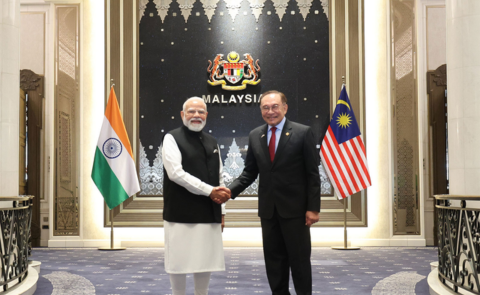
High expectations of Malaysia as ASEAN chair

Malaysia’s chairmanship of ASEAN in 2025 is pivotal. It will have to steer ASEAN toward regional peace, stability, and prosperity while reinforcing its centrality. All this during a time of heightened geostrategic rivalry, economic deglobalisation, rising protectionism, and nationalist trends.

AFP_36WT3X2 Courtesy: AFP
6 February 2025

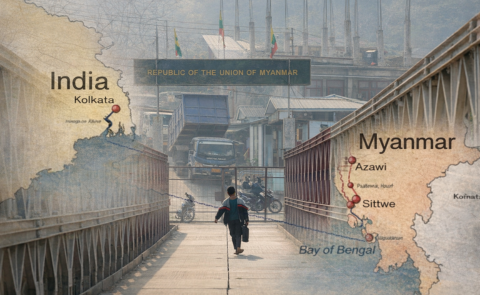
Myanmar, four years on

February 1 marks four years of the military coup in Myanmar, which plunged the country into a bloody civil war, still on-going. The crisis is deepening, as the struggle between the Junta forces and a fragmented resistance wages on with no resolution in sight. A stalled mediation by ASEAN, and lack of consensus amongst neighbouring countries on how to help, leaves Myanmar’s future uncertain.

FILE PHOTO: Chinese President Xi Jinping (C), Vice President Wang Qishan, Politburo Standing Committee member Zhao Leji, National People's Congress (NPC) Standing Committee Chairman Li Zhanshu, Premier Li Keqiang, Politburo Standing Committee member Wang Huning and Vice Premier Han Zheng arrive for the closing session of the Chinese People's Political Consultative Conference (CPPCC) at the Great Hall of the People in Beijing, China March 10, 2021. REUTERS/Carlos Garcia Rawlins/File photo Courtesy: Reuters
16 January 2025

Preparing China’s economy for 2025

Two important conclaves held in December 2024 - a Politbureau meeting and the Central Economic Work Conference – set the tone for China’s economic focus in 2025. The economy needs a resurgence, given the domestic environment of low spending and the external threat of high tariffs – the outcome of swapping development for security. In 2025, China’s mandarins will try and find a balance between the two.

longmen Courtesy: UNESCO
9 January 2025

India-China: learning from each other

India and China are the world’s most populous countries, with much in common and much divergence. Reform, discipline, long-term thinking and scale brought China to its present near first-world conditions; India is accommodative with its democracy, cultural diversity and all-round religiosity to achieve development, wealth creation, cultural preservation and self-respect. There’s a great deal that the two Asian giants can learn from each other.

2024-10-24T162134Z_1804345792_RC23RAA5M4T3_RTRMADP_3_RUSSIA-BRICS-PUTIN Courtesy:
13 November 2024

BRICS gains heft while in transition

The 16th BRICS Summit, held in Russia’s Kazan in October, was the first summit of the expanded grouping. With 13 new partner states invited, it revealed how increased membership has the potential to enhance the grouping’s influence. For India, BRICS serves as a bridge between the west, the east, the north and the south, making New Delhi the geopolitical sweet spot.