

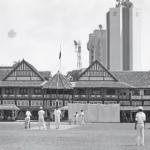
On the southernmost tip of Mumbai’s Azad Maidan stands a century-and-a-half old Swiss Chalet-style clubhouse, designed by English architect Charles Frederick Stevens. In front is a dazzling patch of green, demarcated from the rest of the vast public maidan it is part of, by a walkway that shortens the distance between the city’s two termini railway stations: Churchgate and Chhatrapati Shivaji Maharaj.[1] [2] Commuters and pedestrians are an ever-present audience for the activities of the Gymkhana greens, often squatting on its northern boundary to take in the cool evening breeze, and watching the games being played. [3]
The Gym, as it is popularly referred to by its sports-loving members, was the venue of India’s first international cricket test match – India vs. England played from 14 to 17 December 1933. It was also the ground where the first international rugby tournament in India was played: Bombay Gymkhana (BG Club XV) vs. the Australian national rugby team, the Wallabies. The game, played in late 1939, was serendipitous, as the Australian team stopped in Bombay on its way home by sea from England. [4]
These two milestones are among the many highlights of a rich legacy of this club, the incubator for competitive Indian cricket and rugby, as well as for sports like football, squash, badminton, tennis, swimming, snooker, and billiards.[5]
Sporting achievements aside, the Bombay Gymkhana is the first all-male members-only club in Mumbai to open its doors to ladies’ memberships in the 1990s, granting them equal voting rights with men.
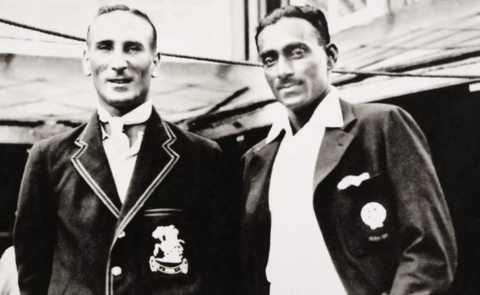
Photo courtesy: Wisden Almanack[6]
Despite being a whites-only club for most of its early existence, until 1960, when it took its first Indian member, the Gym succeeded in nurturing local sports talent during its first 85 years. This happened quite by chance. In 1877, when the Gym played its first annual cricket test match against the Parsees XI, a team formed by the Parsee clubs playing on the city’s maidans.[7] Soon, the annual matches on the Gym grounds began to include the Hindu Gymkhana team. In 1907, the first Triangular tournament between the Gym, Parsee Gym and Hindu Gym teams was played on its grounds. When the Islam Gymkhana team joined this trio in 1912, it became a Quadrangular. When finally, in 1938, the “others” – largely Christians, Anglo-Indians, other Brits and Europeans – joined, the Pentangular Tournament came about.[8] These annual cricket matches were like fetes, attended by crowds of about 10,000 spectators, consisting of the native elites of Sethias and Indian royalty, and various Europeans who were accommodated in separate tents. Local cricket fans crowded around the field, some risking life and limb by perching themselves on surrounding trees for a better view. [9]
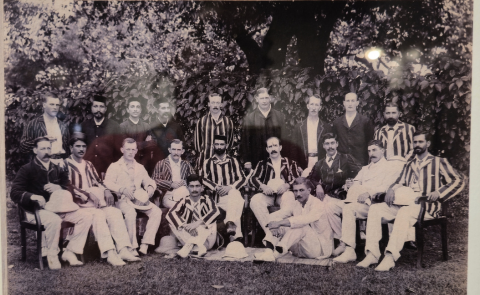
Photo courtesy: Bombay Gymkhana archives
The Gym members watched from The Pavilion, a central one-storied structure with two wings. One accommodated a gentlemen’s changing room, and the other had an open hall for indoor sports and a bar.[10] On the first floor were rows of planters’ chairs for a quick siesta, plus a billiards room. The first Pavilion was built by the Public Works Department Engineer John Adams, but after a wing collapse in December 1907, a rebuilt Pavilion was inaugurated by the then Governor of Bombay, Sir George Sydenham Clark. [11]
This laser focus on sports is the result of the founding minutes of the Gym. On 19 June 1875, in the office of William Nichols & Company, Fort, two officers from the Royal Engineers, Captain E. L. Marryat and Lieutenant C. L. Young, presented a blueprint to representatives of various single-sport city gymkhanas, to establish a central sports gymkhana for the city, called the Bombay Gymkhana Club.[12] This was envisaged by amalgamating the numerous one-sport only gymkhanas set up by the British expat community in the city. [13] The next year, boat (rowing) club merged with the Gym, followed by polo club in 1879.[14] Though hard to believe today, rowing competitions were once held by the Gym in the city’s harbour, and polo on the Azad Maidan, after these clubs merged with the Gym.
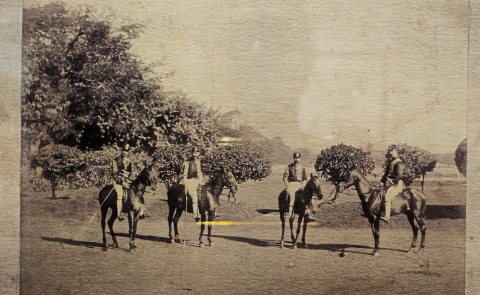
Photo Courtesy: Bombay Gymkhana archives
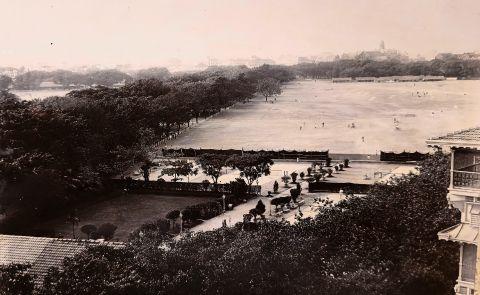
Photo courtesy: Bombay Gymkhana archives
Boating and polo did not survive on the Gym’s roster of sports, but rugby did.
Unlike cricket, a no-contact sport, rugby, first played at the Gym in 1890, was a game that Indians did not take to until after Independence. They may have watched it being played on the Maidan by the Europeans and gasped at the thumping tackles of the ‘Forwards’ and gleefully cheered the dainty moves of the ‘Backs’ but were not enticed to play this full-contact sport because of traditional biases. This reticence was overcome by active outreach. Aga Hussain, a former captain of the Gym and the India rugby teams, recalls that it was Prof. (Dr) James Barton of Wilson College who recruited him to play for the Bombay Gym team in 1972 because, as a boxer, he would not be repelled by physical contact. “It changed my life,” recalls Husain, tongue-in-cheek, “and also put an end to any hope of my taking on Mohammed Ali.”
By the 1950s and 1960s, this sport began to wane as the Gym’s British, European, American, and Japanese members began returning to their home countries, and more Indian members were inducted. From fielding four home teams, the Gym could barely muster up two. Hussian says an Irishman, the late R. W. Leybourne Callaghan, a passionate Gym rugby player, an Indophile, and the managing director of Roche Pharmaceuticals, who took it upon himself to breathe life into this sport by creating new teams.[15] [16] By the end of the 1960s, the Gym had four teams again: the Gym, Wilson Gymkhana (which included Cathedral School boys), the Greater Bombay Police, and the Maharashtra State police.[17]
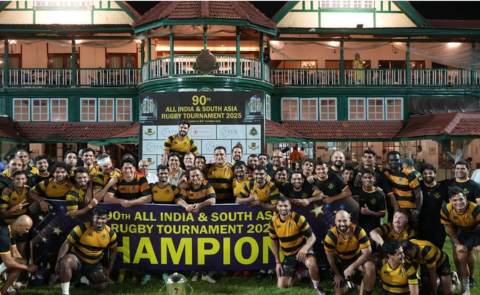
Photo courtesy: Jahaan Dastur
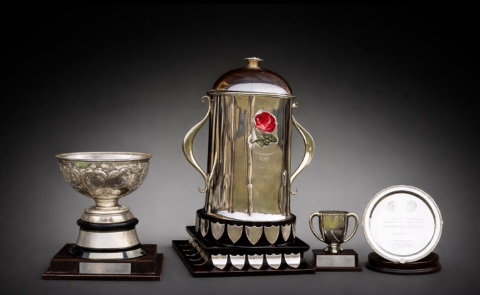
Photo courtesy: Aga Hussain
Rugby as a sport may have begun in the Calcutta Cricket & Football Club (est. 1792), where it was played for the first time in 1889, a year earlier than at the Bombay Gym. But the oldest rugby cup tournament in India began as an inter-club match at the Bombay Gymkhana in 1892, playing for the Bombay Cup. It is possibly the oldest rugby tournament outside Great Britain, and the oldest in Asia, which is home to 36 rugby-playing unions or national teams.
Building on this history and their love for the game, the Indian Rugby Union (Rugby India) was formed in 1998, the result of the efforts of senior rugby players from the Gym.[18] By institutionalising the game under a central body recognised by the sports ministry opened doors. Rugby India was invited to join the Asian Rugby Union and World Rugby bodies.[19] India played its first international game in Singapore on 21 October 1998 and has participated in international competitions ever since.
International cricket shifted from the Bombay Gymkhana pitches to the Brabourne Stadium and the Cricket Club of India in 1937, and later to the Wankhede Stadium.[20] But the Gym’s grounds as a venue for two major cricket test matches has historicity. The first was Hindus XI against the Marylebone Cricket Club (MCC), in 1926 for the Dorabjee Tata Cup. The Hindus XI was captained by the famous CK Palwankar Baloo, and MCC team was led by Arthur Gilligan. The second, and more remembered was the 1933 first international test match played in India between India and England.[21]
The memories of the 1933 match are contained within the Gym’s oldest member, 101-year-old lawyer Vicajee Taraporewala, who was taken with his older brother for this match by his father’s office peon.[22] “We were seated in the stands built diagonally opposite the Tata Palace,” he recalls. “I can still visualise the two captains, C.K. Nayudu and Douglas Jardine, walking onto the field for the toss.” The crowd, numbering one lakh, was mixed, but there was little doubt who they were rooting for: India. Former national cricketer and Gym member, Yajuvindra (Sunny) Singh, who spoke at the 92nd anniversary of this first-ever test match on Indian soil, said that the highlight was the Indian team’s batsman Lala Amarnath scoring a century in the second innings of this four-day international.[23] As soon as he scored a hundred, the crowds burst into a roar. India’s Captain Nayudu, batting opposite Amarnath, ran across to hug Amarnath and the crowds began spilling into the grounds of the Gym. Lala Amarnath had scored the first century for India on home ground in his debut match.
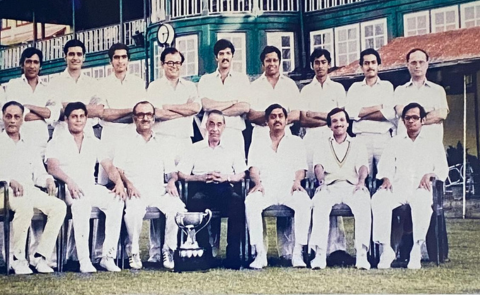
Photo courtesy: Dr Aadil Chagla
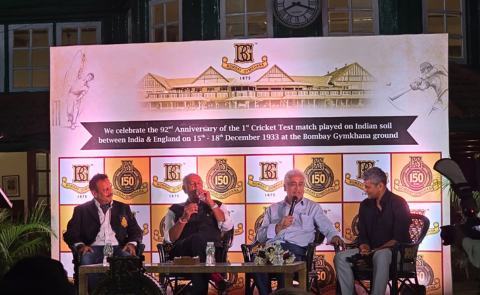
Though international cricketing action shifted from the Gym’s open grounds to a stadium, the famous R.F.S Talyarkhan Memorial Invitation Cricket Shield (est. 1972), an inter-club tournament, is held annually by the Gym. Famous cricketers and Gym members, like the late Nawab ‘Tiger’ Pataudi, Hanumant Singh, and Yajurvindra Singh, have played on the Club team for this Shield whilst they were still test cricketers.[24] Dr (Prof.) Aadil Chagla, a neurosurgeon, cricketer, and secretary (cricket) at the Gym remembers the “superb members’ cricket team of the 1980s and 1990s. In those days, there were no cricket academy boys like today; we were the boys who played for the Bombay Gym.”
Alongside sports, the Gym began to build a social life.
In the 1950s and 1960s, the Gym still retained vestiges of its colonial roots. Every afternoon, the Englishmen (and there were still many in those days) would leave their office at 12.30 pm sharp and come to the club for lunch. “Tables were laid out on the verandah and a few on the first floor. After lunch, they would grab a siesta on the planter’s chairs on the first floor, before returning to work,” Vicajee Taraporewala remembers with fondness.
For decades, ladies did not participate in the life of the Gym. They were specifically not allowed in the Bar and on the first floor, except when a tournament was being played on the maidan. By the late 19th century, in addition to a weekly Ladies Nights, women were invited to the “Smoking Concerts” hosted by the Gym’s own concert group, The Minnesingers.[25] The club cuisine, Taraporewala recalls, was ‘Continental’- well into the 1960s and 70s, with a slow shift towards Indian and Chinese food. What he particularly remembers was the spectacular monthly buffet, now discontinued.
With its Sesquicentennial celebrations at the halfway mark and as the Gym enters its 151st year, old timers may look at its past with nostalgia. They needn’t worry. The Gym’s present remains stellar because it never lost its original focus: sports. The Bombay Gymkhana is probably the only sports club in the world today that has succeeded in continuously hosting a repertoire of competitive field sports, by rotating them seasonally, in this vibrant green corner of the Azad Maidan.
Sifra Lentin is Bombay History Fellow at Gateway House.
This article was exclusively written for Gateway House: Indian Council on Global Relations. You can read more exclusive content here.
Support our work here.
For permission to republish, please contact outreach@gatewayhouse.in
©Copyright 2026 Gateway House: Indian Council on Global Relations. All rights reserved. Any unauthorised copying or reproduction is strictly prohibited.
References:
[1] Chhatrapati Shivaji Maharaj Terminus’ original name was Victoria Terminus or VT. This grand station was built to commemorate Queen Victoria’s Diamond Jubilee in 1897.
[2] English Architect Claude Batley is also credited because of the work he did later on the Gym about 1917. By 1919, a covered corridor linked the Gym’s verandah to the Esplanade and Waudby roads to its west and east, respectively.
[3] In the centre of the clubhouse on the ground floor is the huge brass bell of The Bombay Light Horse. It states that in the 1870s, before the Bombay Gymkhana was established, its grounds were part of the Bombay Royal Golf Course (BRGC), whose golf links encompassed the Azad, Oval, Cross maidans, and the Cooperage grounds. The BRGC had a cavalry unit attached to it named the Bombay Light Horse. This Bell was the quarter guard bell or time-keeper of this cavalry unit, and was also rung in emergencies.
Today, this bell is rung on India’s Republic Day (26 January) and Independence Day (15 August) and also to announce the commencement of the Gymkhana’s General Body and Managing Committee meetings.
[4] The Australian National Rugby Team, the Wallabies, captained by Vay Wilson, arrived in Great Britain on 2 September 1939, scheduled to play 28 matches over 10 months. Unfortunately, Britain joined the War the next day. The Team made its way home after three weeks. During its stopover in Bombay, it played a match against the Bombay Gymkhana team, winning 26-0.
https://worldrugbymuseum.com/from-the-vaults/club-rugby/war-games-rugby-in-1939
[5] In its colonial avatar, it was active in boating, polo, hunting, golf, and baseball. Till recently, it hosted the Aga Khan Hockey Cup (est. 1896), which the Gym hopes to revive soon. Last year a Paddle court was built.
Among its more sedentary games is the card game, Bridge, and more recently Mahjong was introduced.
[6] https://www.wisden.com/wisden-cricketers-almanack/ck-nayudu-indias-first-test-captain-who-made-a-big-impression-in-england-almanack
[7] The Parsi Gymkhana was established in 1888 on Marine Drive, formerly known as Kennedy Seaface.
[8] It was because of the communal basis of the Pentangular that it was discontinued in 1946, and zonal matches were introduced in its place.
See “Cricket in Colonial Bombay: 1850-1940”2006. The International Journal of the History of Sport 23 (6), pp 1014-32.
[9] Sethia means a wealthy businessman.
[10] This open hall was used for games like badminton and gymnastics. Boxing was conducted at premises in Hummum Street, Fort, while the Gym anchored its two boats at the Wellington Reclamation, today’s Apollo Bunder. Boating shifted to Mahim Creek in 1890 after a boat shed was built there, as it was more conducive to rowing than the busy harbour, and later to Bandra in 1892.
Robinson, H.N., The First Fifty Years: Bombay Gymkhana (Bombay, Bombay Gymkhana,1964) p. 12.
[11] The new building was designed by Architect Charles W. Stevens. This building still stands and comprises the Club’s central portion today.
[12] Robinson, H.N., The First Fifty Years: Bombay Gymkhana (Bombay, Bombay Gymkhana,1964), p. 5.
[13] Robinson, H.N., The First Fifty Years: Bombay Gymkhana (Bombay, Bombay Gymkhana,1964), p.5.
[14] Guha, Ramachandra, A Corner of a Foreign Field: The Indian History of a British Sport (London, Picador, 2002), p.20
[15] Callaghan assembled a core group of rugby enthusiasts to help him form additional teams. There was Walter “Wally” Abraham, a Bursar at Cathedral & John Connon School, who ensured the school continued to include rugby as an inter-house sport; Sarosh Nagarvala, a Gym member whose father was the famous Deputy Police Commissioner (Bombay Police Special Branch) J. D. Nagarvala who investigated Mahatma Gandhi’s assassination case, he was assigned to introduce the sport to the Maharashtra State Police and Greater Bombay Police; and Dr. James Barton, a professor of chemistry at Wilson College, formed a team of collegians and Cathedral School boys.
Callaghan was the managing director of Roche Pharmaceuticals and resided for many years at the Royal Bombay Yacht Club Chambers. He passed away in Mumbai and is buried here.
[16] Interview with Aga Hussain and his son, Nasser Husain, CEO, Indian Rugby Football Union, better known as Rugby India, by this author on 20 November 2025. Actor Rahul Bose is president of the board of Rugby India.
See the Indian Rugby Football Union’s information manual https://rugbyindia.in/wp-content/uploads/Information-Manual_RTI-Act_Rugby-India_v04_10122022.pdf
[17] Today, the Greater Bombay Police team is renamed the Greater Mumbai Police team.
[18] The trigger to form Rugby India happened when the Gym team was playing in Delhi. Husain, being the seniormost player, was approached by two officious-looking men who claimed to represent rugby in India. “They didn’t even know that a rugby team is made up of 15 players with five reserves. Their answer was 11 players, as in cricket or football, with two in standby,” he recalls. Rugby player Wes Paes, the father of Wimbledon tennis player Leander Paes, and senior Gym rugby players, like Husain and Actor Rahul Bose, reached out to teams in Calcutta and Delhi to form this national body.
Since 2005-06 Rugby India has introduced rugby in 28 Indian states. There are men’s, women’s, boys’, and girls’ state teams.
[20] See Lentin, Sifra, Wankhede Stadium scores a half century (25 June 2025)
https://www.gatewayhouse.in/wankhede-stadium-scores-a-half-century/
[21] For more details on the 1926 and the 1933 test matches against the MCC see Guha, Ramachandra, A Corner of a Foreign Field: The Indian History of a British Sport (London, Picador, 2002), pp. 172-73, 212-14.
[22] The peon wanted leave for the days of the test match; he was given leave on the condition that he take the two Taraporewala boys with him.
[23] India Cricketer Yajuvindra (Sunny) Singh spoke at the 92nd Anniversary of the first international test match, which was commemorated on 15 December 2025 on the Bombay Gym grounds. In addition to Singh, former India cricketers Karsan Gavri and others spoke, as well as former national-level players like Lawyer Avinash Rana, Dr Aadil Chagla, and TV Journalist Rajdeep Sardesai. At this function, the Indian Ladies Cricket team coach, Amol Mazumdar, was felicitated. This author was present at this event.
[24] India test cricketers Jayantilal and Dilip Vengsarkar played for the Bombay Gymkhana team after their test careers were over.
[25] By 1877, Ladies Nights were held every Wednesday for roller skating and badminton. Women were allowed to use the Pavilion on Tuesday and Friday mornings. In 1880, archery was introduced at Ladies’ Night and a bowling green set up in front of the Pavilion. Women played sports like skittles, badminton, squash, gymnastics, and tennis. Today, it is common to see ladies and girls playing football and rugby on the Gym grounds.
See Robinson, H.N., The First Fifty Years: Bombay Gymkhana (Bombay, Bombay Gymkhana,1964)