

On January 7, 2026, the U.S government announced that it will withdraw from all International Organisations, Conventions, and Treaties that conflict with American interests. This list included 31 United Nations (UN) organisations.[1]
Just a week prior, Washington pledged $2 billion for UN humanitarian aid. The U.S. contributed the largest share – 22% – of the UN’s regular budget. And it hasn’t paid its dues since 2019. This withdrawal creates a huge gap on the UN balance sheet, already stressed from funding shortages.
To counter those, the UN agencies had already begun accepting donations from non member-state entities like philanthropies and private donors. China has stepped up its contributions – and thereby influence – in the UN, from $190 million in 2010[2] to $12.5 billion in 2024.[3] Now the world’s richest philanthropies are doing the same. It is not illegal, but it distorts the mission of the UN.
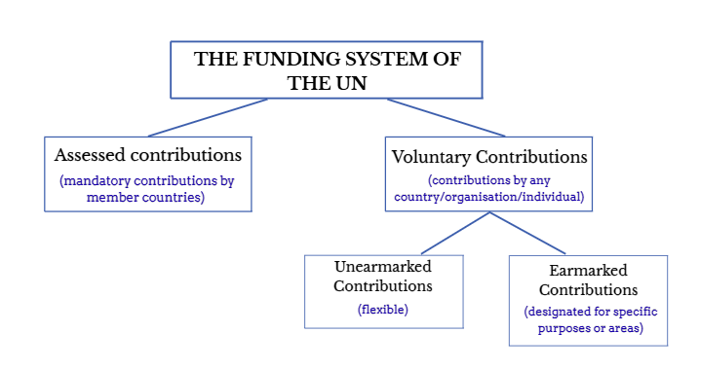
Chart 1: The funding system of the UN
Gateway House has studied the top eight UN agencies which received the largest amount of philanthropic donations between 2019 to 2024. The report, The Influence of Philanthropies in the United Nations, analyses the funding received by these organisations and the alignment between the missions of the UN bodies and their philanthropic donors.
The funding system of the UN consists of two main types (Chart 1): (a) assessed contributions (mandatory contributions by member countries) and (b) voluntary contributions (contributions by any country/organisation/individual). Voluntary contributions are further divided into unearmarked funds (flexible) and earmarked funds (designated for specific purposes or areas of the UN agency).
In the last two decades, the UN hasn’t received full contributions from all members; only 53 out of the 193 member states have paid their full assessed contributions each year since 2019.[4] Philanthropic and private donor-driven earmarked contributions, on the other hand, have increased significantly, from $19 billion in 2011 to $41 billion in 2024, while member mandatory contributions have remained largely stagnant at around $13 billion.[5] Flexible voluntary funding by countries has consistently lagged behind and continues to decline. In 2024, the UN recorded total revenues of $68.3 billion with donor-driven or ‘earmarked’ contributions making up 62% of this.
This pattern of funding has serious implications, as the majority of the funding is focused on programmes specified by the donors, asserting their influence in the UN. It leaves the other goals of the UN underfunded and often unfullfilled.
Chart 2: Top Philanthropic Donors of the Top Eight UN Agencies*
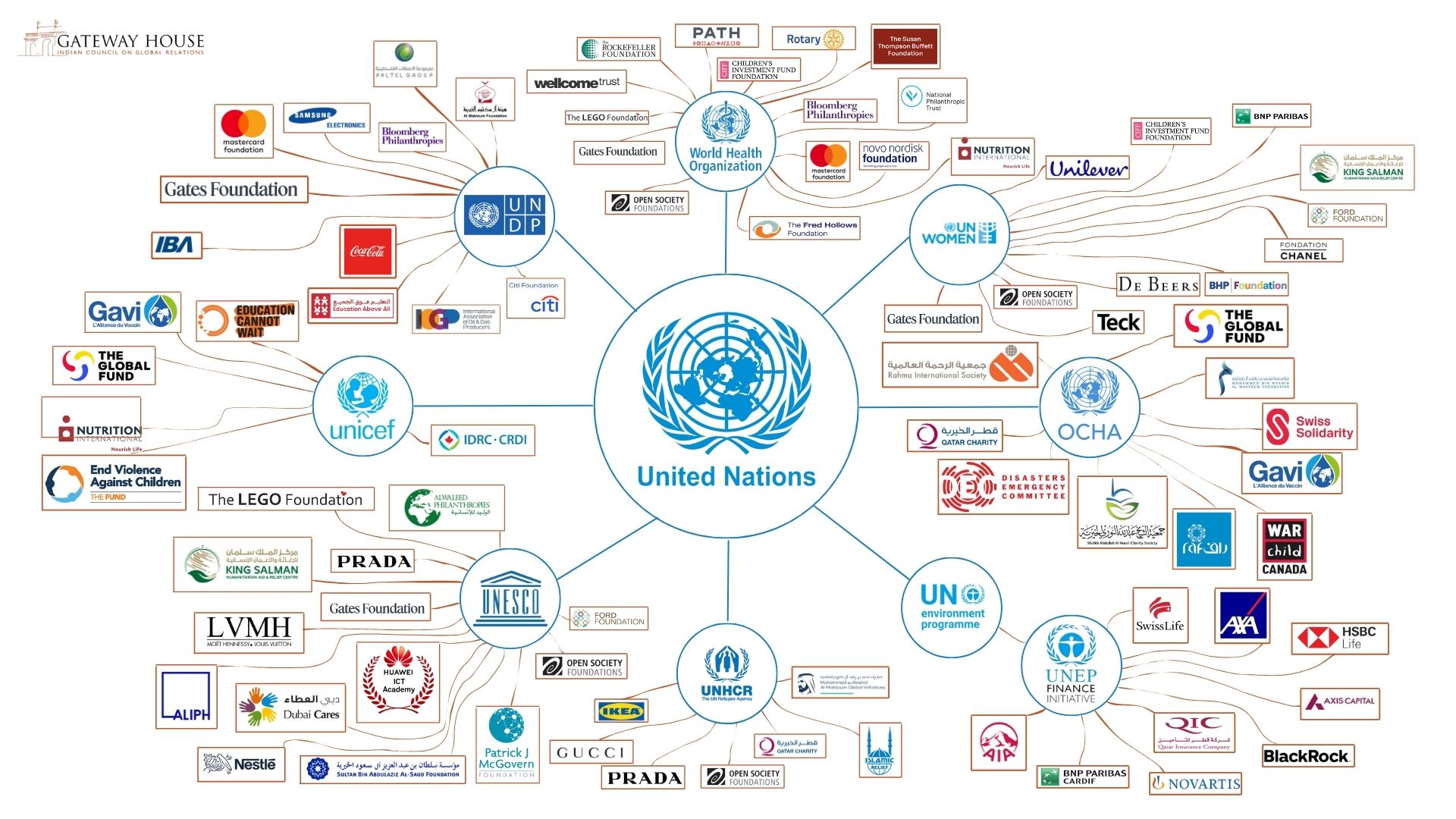
The Gates Foundation stands out as the most influential philanthropic actor within the UN, having donated $2.1 billion[6] from 2019 to 2024. Cumulative UN data from 2011 to 2024 shows an even larger amount – $49 billion.[7] The other two large donors to the UN are the Global Fund and Gavi Alliance, which have donated $66 billion and $37 billion respectively, from 2011 to 2024. These three donors are interconnected. The Gates Foundation donates to both the Global Fund ($2.3 billion, 2017-2025)[8] and the Gavi Alliance $3.3 billion, 2016-2025).[9]
The United Nations Children’s Fund (UNICEF) received the highest amount of philanthropic funding – $48 billion between 2019 to 2024, with the largest donor being the Gavi Alliance, contributing $715 million from 2022-24.[10] UNICEF was the largest buyer of vaccines globally and delivered 2.79 billion doses to 105 countries which aligns with Gavi’s goals on vaccine development and distribution, but other goals of the UNICEF’s remained ignored.
The World Health Organisation (WHO) is the second largest recipient of philanthropic donations, $13.3 billion (2019-24). Before it withdrew its funding, the U.S. was the largest donor to the WHO, contributing $893 million in 2018-2019, but has been replaced by the Gates Foundation.[11]
The funding by itself is not a cause for concern. However, the missions of these philanthropies and the UN agencies are often misaligned with funds often being diverted to causes that support the goals of funders rather than the needs of the countries.
In the case of the WHO – from which the U.S. withdrew its membership on Jan 20[12] – all of the Gates Foundation donations are earmarked for specific causes like as polio eradication, vaccination, and nutrition while the WHO mandate is broader, covering other priority areas like non-communicable diseases (NCDs) such as cancer and diabetes, not just communicable diseases like HIV and malaria.
Chart 3: WHO Audited Financial Statement 2024[13]
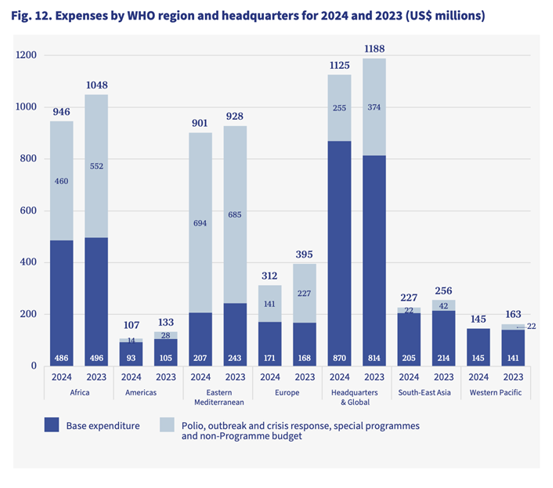
As seen in Chart 3, a major chunk of money is diverted to polio eradication. Since 1988, polio cases have decreased by 99% and remain endemic only in two countries – Afghanistan and Pakistan,[14] whereas 41 million people are killed each year due to NCDs, equivalent to 74% of all deaths globally.[15] However, the WHO is compelled to use the majority of the philanthropic funding it receives towards polio eradication activities.
Questions have been raised about some of the UN’s philanthropic donors, particularly those from the Gulf countries. Qatar Charity is the fourth-largest philanthropic donor to the UN, donating $656 million (2019-24). The Sheikh Thani Bin Abdullah Foundation for Humanitarian Services (RAF) is the single largest philanthropic donor to the UN High Commissioner for Refugees (UNHCR), contributing $153 million from 2019-2024. However, the 2021 Middle East Forum and Nordic Research and Monitoring Network report state that the RAF, Qatar Charity, Qatar Red Crescent, and Eid Charity are affiliated with terror financiers.[16] This raises questions as to why the UN accepts funds from controversial foundations despite designating donors of these foundations as terrorists?
The U.S withdrawing its funding of United Nations Educational, Scientific and Cultural Organization (UNESCO) in 2017 caused a vacuum of $80 million, which was eventually filled in by China. It has contributed an estimated $1.1 billion to UNESCO as of 2024 and its contributions are linked to capacity building, ICT education and digital skills. The second-largest philanthropic donor to UNESCO is Huawei ICT Academy, a Chinese entity. Huawei faces allegations on corporate espionage and spying.[17]
These concerns are exacerbated by inconsistent disclosure across UN agencies. In this study, UNICEF, UNESCO, and United Nations Environment Programme (UNEP) are identified as non-transparent, failing to disclose donor-specific funding data in audit reports, annual reports, or financial statements. Data availability varies widely across agencies, with figures scattered across different documents and years, making comprehensive and consistent analysis difficult. Without clear disclosure of private and philanthropic funding, it becomes nearly impossible to assess donor influence, evaluate alignment with UN mandates, and accountability.
This ultimately leads to an important question: are the rise in such external donations mean that the UN agencies are evolving into extended arms of philanthropic and private organisations to exert their influence over global issues?
Big Philanthropy has become indispensable to the UN’s financial survival, and it has also reshaped the organisation’s priorities and power structures. For the wealthy countries which can solve their own problems bilaterally, this is less of an issue. But for the vast majority of the 193 countries which pay their dues, the UN is a valuable platform from which to voice their concerns and aspirations, globally. When the platform is distorted to represent a few, rather than the many, it becomes a fundamental challenge for all.
Raveena Shivashankar and Manas Pawar are researchers at Gateway House: Indian Council on Global Relations, Mumbai. This article is based on a report on the same subject.
This report is the second in the series of extrenal influences on the UN system, the first was China’s influence here: China’s Expanding Influence in the UN System.
This article was exclusively written for Gateway House: Indian Council on Global Relations. You can read more exclusive content here.
For interview requests with the author, or for permission to republish, please contact outreach@gatewayhouse.in.
© Copyright 2026 Gateway House: Indian Council on Global Relations. All rights reserved. Any unauthorized copying or reproduction is strictly prohibited
References:
*Chart 2, This graph only shows the common philanthropic donors who donate in the listed eight agencies. The number of all philanthropic donors in the eight agencies exceeds the number of agencies shown in this graph. This graph is just a visual representation of the common donors to the UN.
[1] The White House. “Withdrawing the United States from International Organizations, Conventions, and Treaties That Are Contrary to the Interests of the United States.” January 2026. https://www.whitehouse.gov/presidential-actions/2026/01/withdrawing-the-united-states-from-international-organizations-conventions-and-treaties-that-are-contrary-to-the-interests-of-the-united-states/
[2] Gateway House: Indian Council on Global Relations. “China’s Expanding Influence in the UN System.” Accessed January 2026. https://www.gatewayhouse.in/chinas-expanding-influence-un-system/
[3] Gateway House: Indian Council on Global Relations. “China’s Expanding Influence in the UN System.” Accessed January 2026. https://www.gatewayhouse.in/chinas-expanding-influence-un-system/
[4] Pew Research Center. “How the United Nations Is Funded and Who Pays the Most.” July 31, 2025. https://www.pewresearch.org/short-reads/2025/07/31/how-the-united-nations-is-funded-and-who-pays-the-most/
[5] United Nations System Chief Executives Board for Coordination (CEB). “Revenue by Type.” UN System Financial Statistics. Accessed January 2026. https://unsceb.org/fs-revenue-type
[6] This figure is for the 8 agencies as per the report
[7] United Nations System Chief Executives Board for Coordination (CEB). “Revenue by Non-Government Donor.” UN System Financial Statistics. Accessed January 2026. https://unsceb.org/fs-revenue-non-government-donor
[8] The Global Fund. “Pledges and Contributions Report.” Accessed January 2026. https://www.theglobalfund.org/en/government/
[9] Gavi, the Vaccine Alliance. “Annual Contributions and Proceeds: Donor Profiles.” Accessed January 2026. https://www.gavi.org/investing-Gavi/funding/donor-profiles/annual-contributions-and-proceeds
[10] The philanthropic contributions data were available only from year 2022-24
[11] World Health Organization. “Contributors (2018–2019).” WHO Open. Accessed January 2026. https://open.who.int/2018-19/contributors/contributor
[12] The White House. “Withdrawing the United States from the World Health Organization.” January 2025. https://www.whitehouse.gov/presidential-actions/2025/01/withdrawing-the-united-states-from-the-worldhealth-organization/
[13] The White House. “Withdrawing the United States from the World Health Organization.” January 2025. https://www.whitehouse.gov/presidential-actions/2025/01/withdrawing-the-united-states-from-the-worldhealth-organization/
[14] Centers for Disease Control and Prevention. “Why Polio Vaccination Matters.” Accessed January 2026. https://www.cdc.gov/global-polio-vaccination/why/index.html
[15] World Health Organization. “Noncommunicable Diseases.” WHO Knowledge Action Portal. Accessed January 2026. https://www.knowledge-action-portal.com/en/content/noncommunicable-diseases
[16] World Health Organization. “Noncommunicable Diseases.” WHO Knowledge Action Portal. Accessed January 2026. https://www.knowledge-action-portal.com/en/content/noncommunicable-diseases
[17] Nordic Monitor. “Qatar Regime’s Controversial Charity Funded al-Qaeda-Linked Turkish Outfit for $23 Million.” November 2021. https://nordicmonitor.com/2021/11/qatar-regimes-controversial-charity-funded-al-qaeda-linked-turkish-outfit-for-23-million/