Quad amidst a geopolitical flux Courtesy: Twitter | @narendramodi
23 September 2021

Quad amidst a geopolitical flux

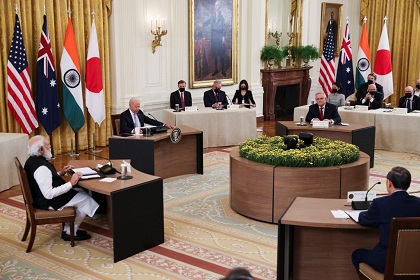
On September 24, the Quad leaders will attend the first in-person summit of the grouping in Washington DC. There is much to discuss for the four leaders, given recent developments: the Taliban takeover of Afghanistan, the Australia-UK-US (AUKUS) security partnership and the EU's new Indo-Pacific strategy. The Quad also needs to focus on long term goals like institutionalising itself and devising a strategy to counter the China challenge.

Imperial powers: Leaving chaos behind Courtesy: U.S. Air Force
9 September 2021

Imperial powers: Leaving chaos behind

The withdrawal of U.S. and NATO troops from Afghanistan is not the first time that a hasty and messy departure of foreign forced has taken place. History is replete with examples of imperial powers suddenly leaving countries that they secured for years, without ensuring a peaceful transition of power. The sub-continent has now seen it twice, the last time was in 1947, when the British preponed their withdrawal from India, hastily partitioning the country and leaving a region at war with itself. Ambassador Neelam Deo, co-founder, Gateway House, explains why and how this happens.

P051085-560456 Courtesy: European Commission
13 May 2021

India-EU: Everything is in place

This India-EU summit was different from the ones past, and India is a significant gainer. A trade agreement and connectivity partnership aside, the EU has stepped up to help India during this emergency, viewing it not as a weak state but as a partner in distress. The geopolitical indicators for an enhanced engagement are now also in place.

resized final Courtesy: Manufacturing Business Technology
11 February 2021

The U.K. pivots to Asia

The U.K. is out of the EU, and re-positioning itself into the idea of Global Britain, seeking partnerships into diverse groupings and regions. India was an early strategic, defence and digital outreach, but a serious pivot has been made to broader Asia for trade and investment linkages, with vigorous follow-up. The re-entry and acceptance of Britain in Asia, has implications.

shutterstock_752563282 Courtesy: Shutterstock
31 January 2020

Brexit, finally?

Britain left the European Union on 31 January 2020. There will be no immediate outcome, but the intention of all the European leaders is to make it an amicable departure over the course of the year. Ambassador Neelam Deo, Director and Co-founder of Gateway House, discusses Brexit’s geopolitical implications and its impact on India’s relations with the EU and UK

germany Courtesy: Shutterstock
20 June 2019

Germany and the European Parliament elections

The results of the European Parliament elections, held late last month, served as an eye-opener for individual member states, such as Germany. A former ambassador to Germany offers an analysis of the leadership changes afoot, shifting coalitions – and also the prospect of stability amidst all the flux

EU-Parliament-Chamber-credit-European-Parliament Courtesy: LSE Blogs
23 May 2019

EU’s right coalesces

The German-French collaboration has been the motor of the European Union so far, but there has been a rise of resentment within the other European countries, with a mobilisation of right-wing parties and talk of an Italian-Polish motor instead, says Neelam Deo, Director and Co-Founder of Gateway House, in this interview. Elections to the European Parliament are taking place from May 23-26

President_Donald_Trump_and_Prime_Minister_Justin_Trudeau_Joint_Press_Conference_February_13_2017 Courtesy: Wikimedia Commons
25 October 2018

Three pillars of Canada’s worldview

The United States, Europe and the Asia Pacific today form Canada’s tripartite foreign policy priorities. The ASEAN is its sixth largest partner, which was not so 20 years ago, but economic engagement with India – still small, compared to China and Japan – has scope to grow