bimstec 2022 Courtesy: BIMSTEC
31 March 2022

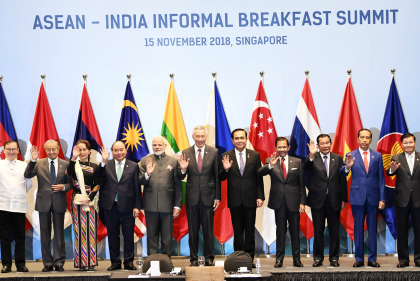
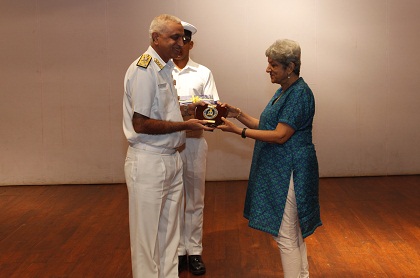
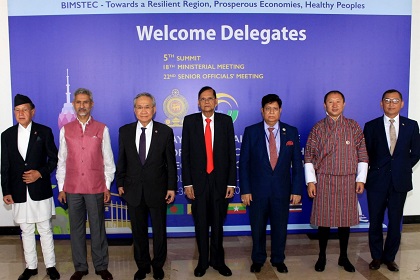
BIMSTEC steps forward

BIMSTEC is of special importance to India as it is a crucial link between the Neighbourhood First and Act East policies. This almost 25 year old multilateral can contribute to the Indo-Pacific region by addressing challenges in strategic areas of regional connectivity, security cooperation, free trade, and geoeconomic ties with external partners.
Logistics,And,Transportation,Of,Container,Cargo,Ship,And,Cargo,Plane Courtesy: Shutterstock
10 March 2022

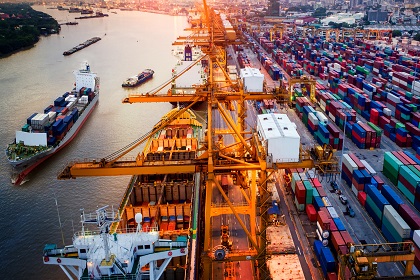
India in the Resilient Supply Chain Initiative

Concerns of global supply chains being overdependent on China has shifted the focus to India. This became clear in 2021 when Australia, Japan and India together launched the Resilient Supply Chain Initiative. India must now leverage its unique position in the Indo-Pacific region by incorporating well-planned industrial clusters and models.

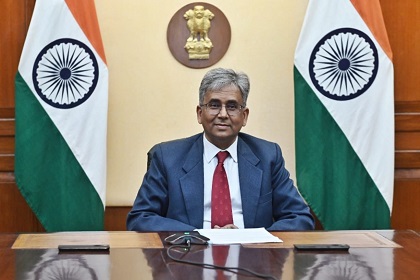
amb saurabh kumar Courtesy: Ministry of External Affairs, Government of India
3 February 2022

India’s Indo-Pacific vision

Saurabh Kumar, Secretary (East), Ministry of External Affairs, Government of India, delivered the keynote address at the panel discussion on India in the Indo-Pacific: Pursuing Prosperity and Security, organised by Gateway House and the U.S. Embassy, New Delhi, on 1 February 2022. He outlined India's vision for a free and inclusive Indo-Pacific, and the initiatives undertaken to further cooperation among nations in the region.

Countering China's Maritime Greyzone activities Courtesy:
22 July 2021

Countering China’s Maritime Grey Zone Activities

On 15 July, Gateway House co-hosted a webcast with Konrad-Adenauer-Stiftung (KAS) on 'Countering China’s Maritime Grey Zone Activities'. The panel discussed the potential strategies that smaller nations in the region can adopt to overcome the challenges of Chinese maritime grey zone activities, and the role of regional maritime powers in capability-building of maritime law enforcement agencies.

kcmodi0312_0 Courtesy: Flickr/MEA
28 November 2019

Assessing the 35th ASEAN Summit

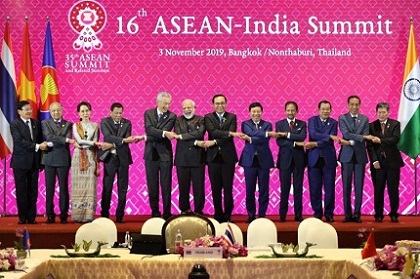
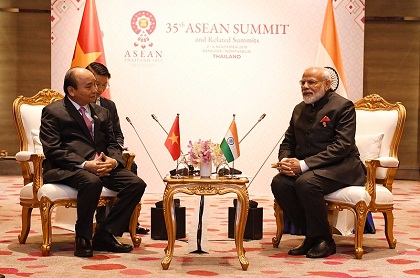
The 35th summit of the Association of South East Asian Nations, held in Bangkok early in November, showed that a shifting geostrategic landscape notwithstanding, “ASEAN centrality” in the region is a top priority with members. It also served as a backdrop for three summits that ASEAN held on November 4 with China, U.S. and India

49012249412_d8b02bb141_c Courtesy: MEA/Flickr
7 November 2019

Goodbye, RCEP

There have been mixed reactions to India’s not signing on to the Regional Comprehensive Economic Partnership. India is often criticised for abstaining from trade agreements and being a protectionist nation, but in fact, the reverse is true. The country’s trade to GDP ratio of 43% is higher than China’s 38% and the U.S.’ 27%. This shows how important trade is for India, particularly if it wants to reach the 2024 goal of being a $5- trillion economy.

regan Courtesy: Pacom
11 April 2019

Canada in the Indo-Pacific

Canada, which has been slow to respond to a changing trans-Pacific neighbourhood, can join India and the ASEAN member states to embark on a trilateral dialogue on the Indo-Pacific’s importance in terms of political, strategic and other domains. An alignment in outlook can strengthen the security and prosperity of a region, currently mired in U.S.-China rivalries

32015837878_7c9f57e917_o Courtesy: MEA/Flickr
29 November 2018

ASEAN-India Connectivity

The following remarks were given by Ambassador Rajiv Bhatia, Distinguished Fellow, Foreign Policy Studies, Gateway House as a speaker at the ASEAN-India Business Summit on November 27, 2018.