Website articles  (22) Courtesy: Getty Images
3 July 2025

Diversifying supply chains for critical minerals

The Quad Foreign Ministers’ Meeting in Washington on 1 July, 2025, underscored the importance of diversified and reliable global supply chains, especially for critical minerals. A Gateway House report shows how to strengthen supply chains for rare earths by creating deep financial markets similar to those that exist for bullion and oil.

Gateway House Courtesy: Gateway House
3 July 2025

China Plus One and global supply chains

A slowdown of the Chinese economy, and the shift, particularly by MNCs, from China to other more competitive locations has opened up business opportunities for latecomers to supply chains in the developing world. Evidence suggests that Southeast Asia and some South Asian countries like India, Sri Lanka, Bangladesh, could be beneficiaries of the supply chain shift, particularly in labour-intensive segments.

Ludovic MARIN  AFP Courtesy: Ludovic MARIN / AFP
12 June 2025

Macron’s strategic Indo-Pacific sail

Macron’s 2025 tour of Southeast Asia was intended to reinforce France’s strategic commitment to the Indo-Pacific. By engaging with three key ASEAN members - Vietnam, Indonesia, and Singapore - France wants to forge partnerships beyond its traditional transatlantic ties. Its Indo-Pacific vision is based on its territorial presence, economic interests, and diplomacy values, which it hopes will be an alternative to the binary logic of U.S.-China rivalry.

Getty (1) Courtesy: Gateway House
15 May 2025

The New Geopolitics and South Asia’s Trade Architecture – What Next?

Geopolitics is increasingly intertwined with the economic destiny of South Asia. Even before the U.S. tariffs were rolled out, growing polycrises had hit the global economy, which has been struggling since the pandemic. South Asia seems a relatively bright spark of regional trade and growth. This paper analyses South Asia’s trade architecture in the backdrop of a sluggish world economy in the 2020s, and makes recommendations for closer regional economic integration.

World Leaders Courtesy: East Asia Forum
17 April 2025

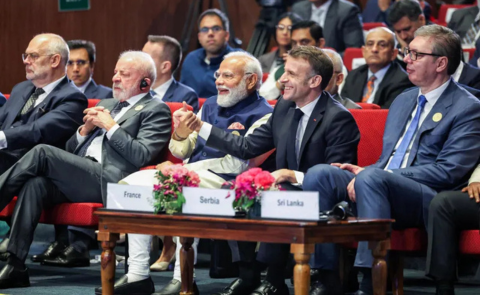
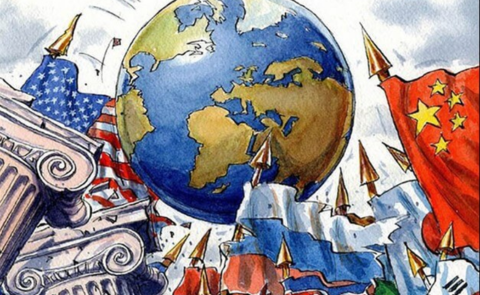
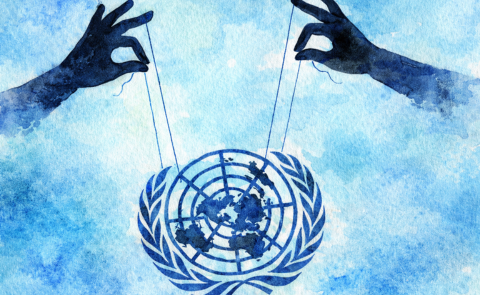
Multipolarity is gaining ground

The traditional power structures of ‘unipolarity’ or ‘bipolarity’ prevalent over the past 80 years are no longer appropriate to describe the current global order, with more countries increasingly supporting the evolving multipolar world. With the old ‘rules-based’ order becoming less relevant, emerging powers like India have an opportunity to draft more equitable rules to match their multipolar intentions.

Report Courtesy: Körber-Stiftung
17 April 2025

Momentum for Middle Powers: Emerging Middle Powers Report

The world is undergoing profound transformations that are not being driven only by the United States, China or Russia. Small and medium-sized States are carving out a legitimate place for themselves in the emerging new order. This second edition of our annual Emerging Middle Powers Report is a reminder that the signs of the times are showing a new momentum for middle powers.

Turkstreampipe Courtesy: President of Russia-Events website
30 January 2025

LNG: winners and victims

Europe has reduced its reliance on Russian gas following the war in Ukraine, and its chief supplier Russia is mired in western sanctions. What does it mean for Russia? It has certainly changed the fortunes for American gas to be sold to Europe: as of 2023, the US had become the world’s top exporter of gas.

Map-2-International-Trade Courtesy: Oxford University Press
23 January 2025

The ancient precursor to IMEC

The India Middle-East Europe Economic Corridor (IMEC) announced during India’s G20 leaders’ summit in September 2023 aims at security and ease of connectivity by multi-modal physical, digital and energy corridors connecting India, UAE, Saudi Arabia, Israel, and Europe. Like many of the connectivity projects created around the world today, IMEC’s origins are 2,300 years old, ancient routes that connected the Indian Ocean to the Mediterranean Sea

rfi bjorn Courtesy:
26 September 2024

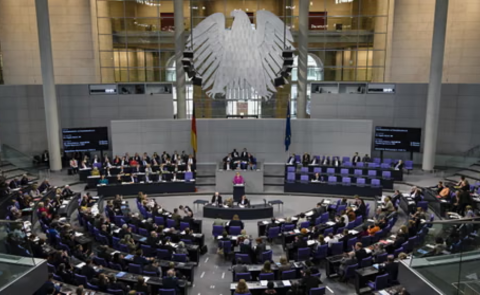
Germany sees anxious change

Recent state elections in Brandenburg, Saxony and Thuringia in east Germany saw the far-right Alternative for Democracy (AfD) and the left-wing Bündnis Sahra Wagenknecht (BSW) make significant gains in vote share. With German federal elections just a year away, major parties like the ruling CDU and SPD which have seen voter support erode considerably, will now have to re-strategise to stay relevant in Germany’s transforming political landscape.