Themba HadebeAP Courtesy: Themba Hadebe/AP
27 November 2025

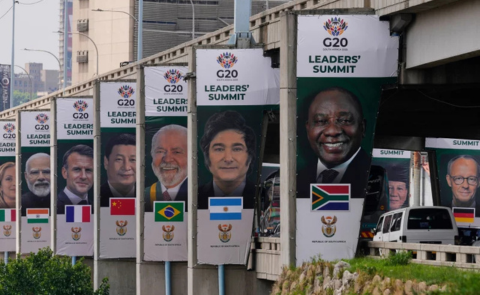
Johannesburg G20 summit: advancing amidst anxiety

The G20 Summit in Johannesburg ended on a widely-shared sense of satisfaction and achievement, with the Global South’s perspective well-articulated, but divergent from some in the Global North. Now the G20's challenge is to restore its unity and credibility by working toward reconciliation with its next president, the U.S. Can India enhance its credibility and influence as a North-South bridge-builder?

revised design Courtesy: Gateway House
27 November 2025

Rise of the Davos Competitor

U.S. health secretary Robert Kennedy Jr. called the World Economic Forum a “billionaires’ boys club” imposing totalitarian controls. Indeed, since 1971, the elite platform shaped geopolitics. But its Western-centricism kept out the concerns of the rest. This gave rise to alternative forums, which look beyond financial agendas to the perspectives shaping the Global South. Here are 45 of biggest, half of which began just two decades ago.

Website articles  (11) Courtesy: UNDP
20 November 2025

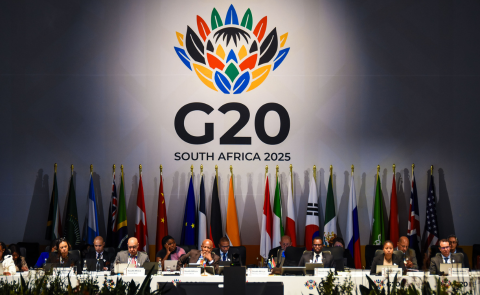
A G20 summit with African characteristics

The G20 Summit in Johannesburg in November will close four years of developing countries holding the grouping’s Presidency. It has left a positive imprimateur on the G20. The next President, the U.S., will inherit a more diverse body, with equal attention being given to issues of the Global North and the Global South.

Gateway House Courtesy: Telegrafi
6 November 2025

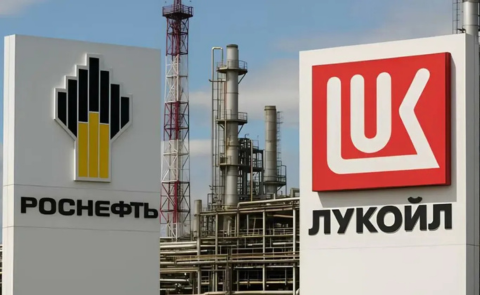
U.S. Sanctions on Russian oil giants

On October 22, 2025, U.S. President Donald Trump imposed sanctions on Russia’s oil giants, Rosneft and Lukoil. The move has clear geopolitical motives—to remove a major supplier from an oversupplied oil market. Indian oil companies, key buyers of Russian crude, now face pressure to cut imports, undermining India’s energy diversification and shaking global oil markets, including the U.S. economy.

Website articles  (2) Courtesy: Atlantic Council
6 November 2025

Trump’s Asia tour redefines China approach

U.S. President Donald Trump embarked on a five-day trip to Asia, arriving in Kuala Lumpur on October 26. Covering Malaysia, Japan, and South Korea, the visit marked a shift in focus from the Ukraine and Gaza conflicts to Southeast and East Asia, as his administration is set to finalise its China policy and Indo-Pacific strategy. The trip yielded important results, though their impact will take time to assess.

Website articles  (4) Courtesy: Indian Embassy in Moscow / FB
30 October 2025

India in Russia’s polycentric world order

The Valdai 2025 conference’s single confirmation was this: Russia believes the post-Western world is already functioning. It is no longer seeking to re-enter Western-led institutions; it is building around them. The polycentric world is like a network, not a hierarchy. No one needs to choose a camp.

Koerber Stiftung (3) Courtesy: Getty
16 October 2025

Labour Corridors: India-Russia’s Next Bet

The labour movement in the India-Russia corridor is a new element in the bilateral. It is already visible in the Delhi–Moscow flights. The usual students and tourists now share the cabin with welders, salon workers, and builders, many on their first overseas assignment. The trend signals a shift in Russia’s migration geography and opens a corridor linking India’s skill base with Russia’s industrial demand.

AFP (1) Courtesy: ANI
16 October 2025

Uncertainty around the Quad

The Quad summit is expected to be hosted by India in the second half of 2025, possibly in November. However, the grouping faces turbulence that transcends the current flow of India-U.S. relations. The relevance of Australia and Japan, too, needs to be factored in. Beijing considers the Quad as “the Asian NATO” that aims to contain China. Since the commencement of Trump 2.0, the grouping has been struggling to redefine its role and mandate.

af880793-acd2-761f-53db-1b11c34691bf Courtesy: Gateway House
16 October 2025

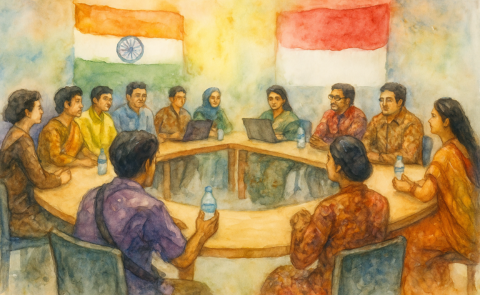
The unbreakable Indonesia-India bond

India and Indonesia are bound by history, culture, trade, and shared values. Their relationship must now add a new dimension — higher education and research. Both nations have long relied on outdated Western models. With a tech-savvy generation and receding colonial memory, the two largest democracies must build research bridges and empower students to become the leaders, innovators and humanitarians of tomorrow.

Screenshot 2025-10-13 103335 Courtesy: Körber-Stiftung
13 October 2025

Bandung at 70: Multilateralism in a New Era of Multi-Alignment

The world is facing multiple crises which are shaking the foundations of multilateralism. The West’s structures are faltering, and the need for effective and equitable cooperation is greater than ever. Seventy years after the 1955 Bandung Conference, its principles of sovereignty, territorial integrity, cooperation and solidarity remain vital. This report revisits Bandung’s relevance for today’s reform efforts, urging renewed Global South–Europe collaboration for a sustainable global future.