Koerber Stiftung (3) Courtesy: Getty
16 October 2025

Labour Corridors: India-Russia’s Next Bet

The labour movement in the India-Russia corridor is a new element in the bilateral. It is already visible in the Delhi–Moscow flights. The usual students and tourists now share the cabin with welders, salon workers, and builders, many on their first overseas assignment. The trend signals a shift in Russia’s migration geography and opens a corridor linking India’s skill base with Russia’s industrial demand.

AFP (1) Courtesy: ANI
16 October 2025

Uncertainty around the Quad

The Quad summit is expected to be hosted by India in the second half of 2025, possibly in November. However, the grouping faces turbulence that transcends the current flow of India-U.S. relations. The relevance of Australia and Japan, too, needs to be factored in. Beijing considers the Quad as “the Asian NATO” that aims to contain China. Since the commencement of Trump 2.0, the grouping has been struggling to redefine its role and mandate.

Screenshot 2025-10-13 103335 Courtesy: Körber-Stiftung
13 October 2025

Bandung at 70: Multilateralism in a New Era of Multi-Alignment

The world is facing multiple crises which are shaking the foundations of multilateralism. The West’s structures are faltering, and the need for effective and equitable cooperation is greater than ever. Seventy years after the 1955 Bandung Conference, its principles of sovereignty, territorial integrity, cooperation and solidarity remain vital. This report revisits Bandung’s relevance for today’s reform efforts, urging renewed Global South–Europe collaboration for a sustainable global future.

President of Russia Courtesy: President of Russia
2 October 2025

Valdai frames Russia’s global doctrine

Each autumn, Russia convenes its flagship Annual Summit — a gathering of global leaders, business elites and intellectuals. Often compared in scale to Davos or Shangri-La, what sets Valdai apart is President Vladimir Putin’s extended, unscripted dialogue with the audience. Over the years, India has moved to the centre of this dialogue, reflecting its strategic weight and offering rare insight into Moscow’s evolving worldview.

VOA Courtesy: VOA
2 October 2025

Time to re-burnish Global South credentials

The year 2025 is often compared to the Bandung moment of 1955, and for good reason. With the U.S. reordering traditional relationships, the opportunity for greater emphasis on the Global South is now. It is therefore time for India, Africa and ASEAN among others to re-burnish their Global South credentials and use that identity as a platform to engage each other more deeply.

ANI Courtesy: ANI
11 September 2025

India and Indonesia reconnect 

India and Indonesia are two Asian leaders and democracies which are reconnecting after decades, even centuries – in a world rife with new volatility and uncertainty. Both countries can collaborate and learn: Indonesia is an adept trading nation and India is a powerful tech player. The two governments are on a mission to deepen and diversify their relationship, stepping out of their past, and bringing fresh thinking.

X  @Narendra Modi Courtesy: X / @narendramodi
4 September 2025

Modi in Japan: a larger Asia mission

Prime Minister Narendra Modi’s visit to Japan is significant for India domestically and its extended Asian influence. His visit, just prior to the SCO Summit in China, represents a shrewd endeavour at balancing the several priorities of Indian foreign policy

G20.Org Courtesy: G20.org
28 August 2025

Appraising Brazil’s G20 Presidency

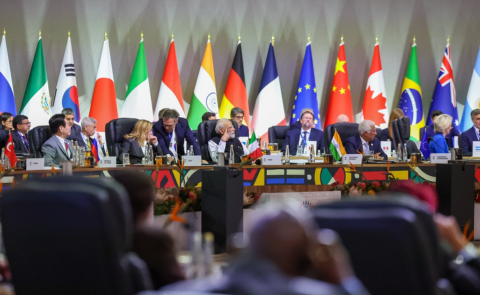
The G20’s current cycle is unique, with four Global South nations presiding consecutively: Indonesia, India, Brazil, and now South Africa. Brazil’s 2023-24 presidency exhibited both achievements and struggles, prioritising social inclusion, hunger, energy transition, and governance reform. The handover to South Africa marks a significant milestone in G20 history. Will the momentum be followed by the U.S., the next G20 president but also a G20 sceptic?

PM 5 nation visit (1) Courtesy: Gateway House
7 August 2025

India becomes strategic with Latin America

India’s engagement with Latin America is gaining momentum, marked by PM Modi’s recent visits to Brazil, Argentina, and Trinidad & Tobago. Amid rising Chinese influence, sustained political engagement and targeted investments are key to unlocking Latin America’s potential for India’s benefit. India needs a multifaceted strategy that blends economic engagement with public diplomacy and more official visits at higher political levels.

indo pacific  (7) Courtesy: Daily News Egypt
31 July 2025

Egypt positions its foreign policy

Egypt sits at the intersection of three continents and two seas, and its foreign policy is a geographic, historic and strategic consequence. From Tripoli to Kortum, Addis Ababa to Brussels, New Delhi to Moscow, Beijing to Washington, Cairo employs diplomacy as a key national security tool, positioning itself as a cornerstone of geopolitical stability within an increasingly multipolar world.