Mecca Accord Courtesy: Gateway House
23 September 2026

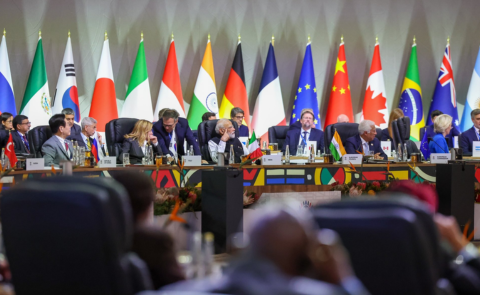
Essay: Mecca Accord re-engineers regional security?

The sustainability of the Mecca Accord is determined by its response to three geopolitical challenges represented by India, Iran, and Israel. The India test centres on preventing the export of South Asian conflicts to the Gulf, the Iranian test rests on institutionalising sustainable deterrence beyond formulas of perpetual clash, and the Israeli axis tests the mechanisms for reshaping Saudi ties with American security and the future of regional normalisation.

Website articles  (85) Courtesy: FB / @The Statesman
30 April 2026

Legacy and new issues with India-Sri Lanka

India’s Vice President C. Radhakrishnan visited Sri Lanka from April 19-20, reaffirming Colombo’s importance in India’s Neighbourhood First Policy and MAHASAGAR vision. While ties remain stable, legacy issues persist: Tamil demands for devolution, illegal fishing disputes, and the stalled Economic and Technology Cooperation Agreement. The hope is for these to be resolved within Sri Lanka; till then, the unresolved challenges will continue to test the depth and durability of the bilateral.

Website articles  (84) Courtesy: Reuters
23 April 2026

India’s Neighbourhood First policy needs a reboot

Outcomes of the Neighbourhood First policy (NFP) are often mixed, shaped by actions on both sides. Recent engagements with Bangladesh, Myanmar, Sri Lanka, and Nepal suggest an opportune moment to recalibrate NFP, enhance its effectiveness, and bridge perceptions of India as an “elder brother” rather than a “big brother.”

Website articles  (50) Courtesy: Gateway House
4 March 2026

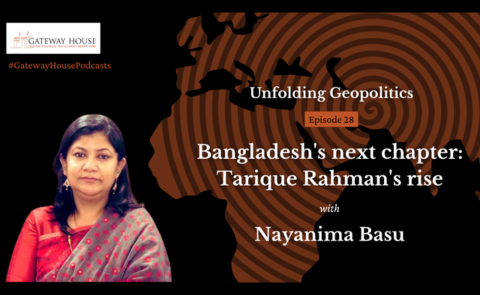
Unfolding Geopolitics Episode 28 |Bangladesh’s next chapter: Tarique Rahman’s rise

Tarique Rehman has been elected as the new Prime Minister of Bangladesh following the recent elections. Nayanima Basu, Adjunct Fellow at Gateway House, visited Bangladesh and shares her on-ground impressions of the country and its people, the continued influence of student movements, concerns over minority rights, and the resurgence of Jamaat-e-Islami. The future of India-Bangladesh ties must be closely watched as a new chapter begins, underscoring the need for a recalibrated, trust-based bilateral approach.

News on Air Courtesy: News on Air
8 January 2026

2026: India’s foreign policy challenges

In the shifting sands of contemporary geopolitics, terms such as ‘fluid multipolarity’, ‘multiplexity’, ‘tripolarity’, and ‘bipolarity with multipolar characteristics’ are replacing the old dogmas and orders. But what is driving the world today? How does India plan to protect its vital interests in the current age of ongoing polycrisis? The road ahead is challenging, marked by risks and uncertainty.

Koerber Stiftung Courtesy: Koerber Stiftung
16 October 2025

Bandung at 70, still hopeful

While the Bandung Conference’s vision remains unrealised, its spirit can be an inspiration to reform and innovate in the international system as well as to ensure the survival of multilateralism – not only for today’s multi-aligned descendants of the conference participants but also for countries in Europe and beyond.

Ivan Courtesy: Gateway House
8 October 2025

Unfolding Geopolitics Episode 23 | India renews engagement with Afghanistan

Afghanistan’s Foreign Minister Amir Khan Muttaqi will visit India on October 10, marking the first high-level Taliban visit since the group took over Kabul in 2021. Nayanima Basu discusses the purpose of this visit and the importance of engagement with Afghanistan. She explains the roles of China, which seeks business; Pakistan, which pursues political interests; and the U.S., which has a renewed interest in Bagram Air Base and its return to the country it abandoned.

PIB Courtesy: PIB
4 September 2025

What the China-India readouts mean

Chinese Foreign Minister Wang Yi’s visit to India comes after three years, and the outcomes from it throw up interesting issues. Three read-outs issued from this visit. One from the Chinese side and two from the Indian side. The diverse nature of the India and Chinese read-outs is striking. Certainly the visit yielded benefits; the test lies in the deliverables.

A community park in Nyingchi Courtesy: Nayanima Basu
4 September 2025

Talk Tibet, with candour

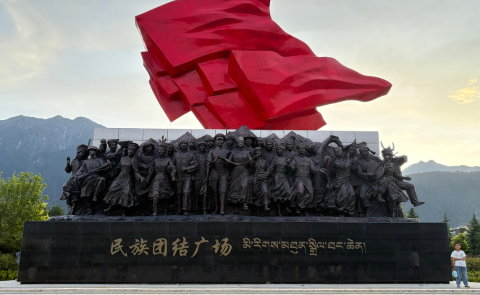
Today’s Lhasa is far from being a forbidden land where oracles are more common than human beings. It is a modern Chinese city, with swish hotels, art galleries and businesses. The transformation – and Sinicisation - of Tibet has accelerated under Chinese President Xi Jinping. The selection of the next Dalai Lama will cement the Chinese hold over that land

X  narendramodi Courtesy: X / Narendra Modi
22 August 2025

India-China risky boundary early harvest

Chinese Foreign Minister Wang Yi's two-day visit to India achieved a significant goal: to resolve the bilateral border dispute and ensure Prime Minister Narendra Modi’s presence at the Shanghai Cooperation Organisation summit. It’s not a reaction to the U.S.-India tariff tensions, but a realistic policy compulsion felt by India.