ADEM ALTANAFP via Getty Images Courtesy: Adem Altan/AFP via Getty Images
3 July 2025

Iran’s second chance to transition

Iranian foreign policy must move toward strategic autonomy and internal concord. As witnessed after the 1988 ceasefire with Iraq, such moments can mark an inflexion point - one that prioritises national reconstruction, resilience, and welfare; strategic recalibration, strengthening of confidence, and finding a geopolitical identity. Iran has been there before, and can apply those experiences again.

Inc42 Courtesy: Defense News
26 June 2025

Drones are the game-changer

Warfare is changing its character, and drones are playing a big role in it. Technology that was first extensively used in the Vietnam war is a current conflict staple. With the increasing use of artificial intelligence, drones are becoming more powerful and useful.

Website articles  (18) Courtesy: Reuters photo
28 May 2025

Strategy meets statecraft: Trump in Riyadh

Presidential visits abroad are high-level instruments of statecraft and, more often than not, signals of geopolitical priorities. The recent visit of U.S. President Donald Trump to the United Arab Emirates, Saudi Arabia, and Qatar, exemplified this, indicating the administration's policy orientation.

Map-2-International-Trade Courtesy: Oxford University Press
23 January 2025

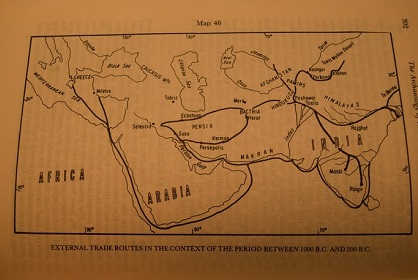
The ancient precursor to IMEC

The India Middle-East Europe Economic Corridor (IMEC) announced during India’s G20 leaders’ summit in September 2023 aims at security and ease of connectivity by multi-modal physical, digital and energy corridors connecting India, UAE, Saudi Arabia, Israel, and Europe. Like many of the connectivity projects created around the world today, IMEC’s origins are 2,300 years old, ancient routes that connected the Indian Ocean to the Mediterranean Sea

The Other Quad Courtesy: Samirsinh Dattopadhye Blog
18 November 2021

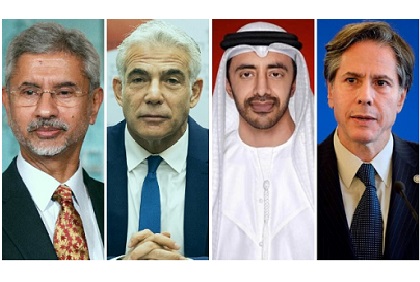
The Other Quad

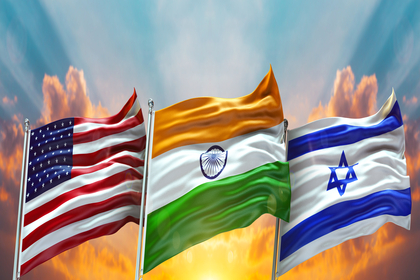
Last month, at a hybrid meeting, the Foreign Ministers of India, the U.S., Israel, and the UAE set up a forum for quadrilateral cooperation. In the many issues discussed, the technology dimension shows the most potential for collaboration, with unique contributions of expertise and resources available from each country's tech hubs: Bengaluru, Silicon Valley, Dubai and Tel Aviv.

Source: Shutterstock Courtesy: Shutterstock
15 June 2021

Shaping the Israel-India-U.S. defense technology partnership

The idea of a U.S.-India-Israel trilateral cooperation is not unknown, but rather unfulfilled. Diaspora associations have repeatedly raised the idea of a technology triangle amongst the three countries, and in 2020, the three countries explored a potential cooperation in 5G communication technology. On these terms, taking advantage of the bilateral synergies and establishing a start-up corridor between Tel Aviv, Silicon Valley, and Bengaluru, can launch this partnership.

cyber attacks on critical infrastructure: is india ready? Courtesy: Twitter | @ColPipe
27 May 2021

Cyber attacks on critical infrastructure: Is India ready?

The ransomware attack on Colonial Pipeline in the U.S. has underlined the importance of cyber security in critical infrastructure. India has not escaped the brunt of a recent global surge in cyber attacks. Though New Delhi has taken steps to protect critical infrastructure, problems in information sharing of threat vulnerabilities impede an effective response.

india-u.s.-israel emtech partnership Courtesy: Shutterstock
29 April 2021

India-U.S.-Israel EmTech partnership

As new technological advances take place every day, India must keep up. While the U.S. is still a front-runner in defence technologies, China and Russia are catching up quickly. In order to counter this, India can insert itself into the pre-existing bilateral co-operation between the U.S. and Israel. Sameer Patil, Fellow, International Security Studies Programme tells us how.