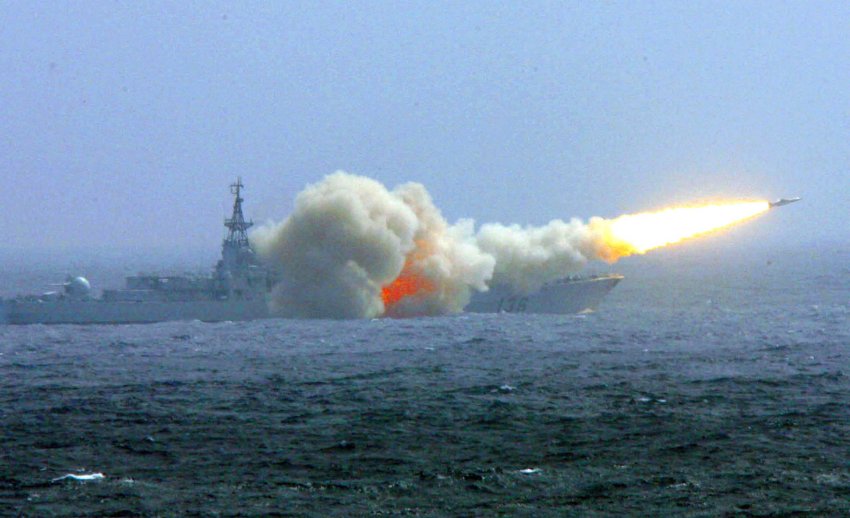
In this photo released by China's Xinhua news agency, a destroyer of the South China Sea Fleet of the Chinese Navy fire a missile during a traning in South China Sea on Saturday, Nov. 17, 2007. Dozen of warships of the South China Sea Fleet were deployed in the competitive training to improve combat capability of the fleet, Xinhua said.  (AP Photo/Xinhua, Zha Chunming) Courtesy: India Strategic
16 July 2015

Military strategies collide in the Asia-Pacific

The recent re-evaluation by the US, China, Japan, and Russia of their military strategies reflects new geopolitical equations in which the Asia Pacific is a major strategic intersection. Turmoil in this region can impact India’s trade and security interests, and to avoid this India must craft a balance between its relations with all the countries involved
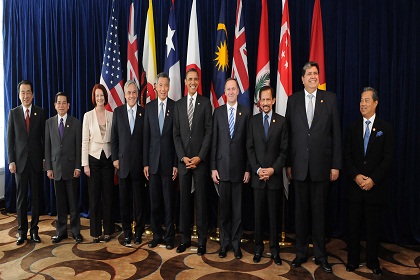
Leaders_of_TPP_member_states- wikipedia Courtesy: Wikipedia
20 May 2015

TPP and RCEP: the hare and the tortoise?

The Trans-Pacific Partnership might soon be concluded if the U.S. Congress fast-tracks it, as recently announced, while the Regional Comprehensive Economic Partnership Agreement remains on slow-track. But the TPP, although ambitious, follows an outdated template, and it is the dynamic RCEP that can be a model for a new global rules-based framework

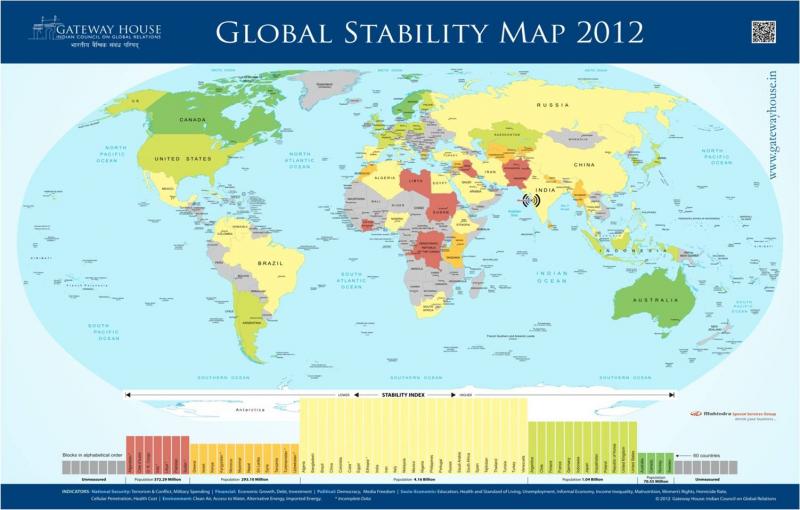
Global Stability Map Courtesy: Gateway House
1 August 2012

Global Stability Map 2012

Gateway House prepared a Global Stability Map, using 20 differing indicators, to analyze the stability of 60 countries around the world. Using criteria that are important to the emerging economies of the world, the map provides an Indian perspective of the world today.

9,11 photo Courtesy:
7 September 2011

America: Ten years after 9/11

A decade after 9/11, the U.S. has prevented further terrorist attacks - a major achievement. But with a $1.3 trillion budget deficit, a debt downgrade, and 24 million Americans searching for jobs, the U.S. needs to attend to matters at home rather than intervening in the world's affairs.