Decoupling from China
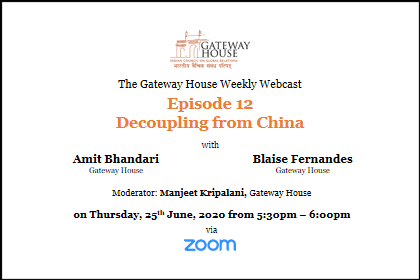
Amit Bhandari, Fellow, Energy & Environment, Gateway House was in conversation with Blaise Fernandes, Director, Gateway House. This discussion was moderated by Manjeet Kripalani, Executive Director, Gateway House.

 Courtesy: Gateway House
Amit Bhandari, Fellow, Energy & Environment, Gateway House was in conversation with Blaise Fernandes, Director, Gateway House. This discussion was moderated by Manjeet Kripalani, Executive Director, Gateway House.
 Courtesy: Gateway House
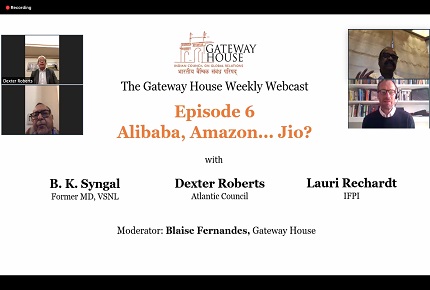
Blaise Fernandes, Director, Gateway House was in discussion with Dexter Roberts, Non resident Senior Fellow, Asia Security Initiative, Atlantic Council and author of ‘The Myth of Chinese Capitalism,’ Lauri Rechardt, Chief Legal Officer, IFPI and B.K. Syngal, Sr Principal, Dua Consulting and Former Chairman and Managing Director, VSNL.
 Courtesy: Gateway House
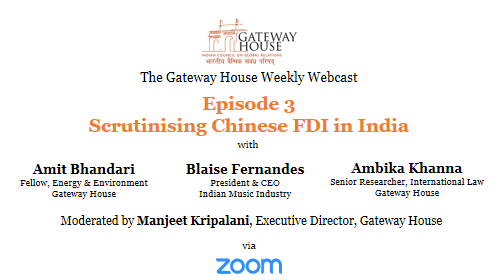
Amit Bhandari, Energy & Environment Fellow, Gateway House; Blaise Fernandes, President, Indian Music Industry Association; Ambika Khanna, Senior Researcher, International Law Programme, Gateway House discuss the reaction to China’s increased investment in HDFC, the depth and motive for China's investments in India, and the new FDI rules put in place by the government to protect strategic investments in the country.
 Courtesy: MEA/Flickr
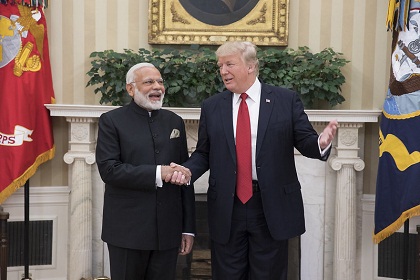
In the run-up to President Trump’s visit to India on 24-25 February 2020, Ambassador Neelam Deo, Director and Co-founder of Gateway House, discusses in this interview how he has made balanced trade a global issue, but given substance to the India-U.S. defence bilateral, sharpening the concept of the Indo-Pacific and the Quad’s profile
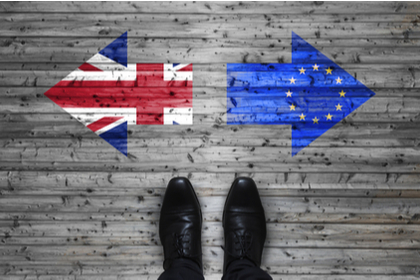
Britain left the European Union on 31 January 2020. There will be no immediate outcome, but the intention of all the European leaders is to make it an amicable departure over the course of the year. Ambassador Neelam Deo, Director and Co-founder of Gateway House, discusses Brexit’s geopolitical implications and its impact on India’s relations with the EU and UK
Don Stephenson, former Chief Trade Negotiator, India-Canada Comprehensive Economic Partnership Agreement, discusses how India and Canada can work together on effecting reform in the World Trade Organization
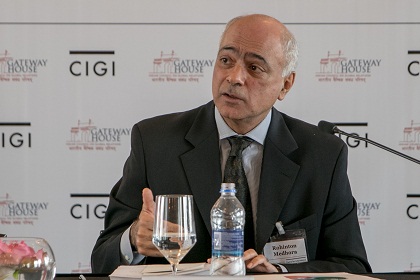
Rohinton Medhora, President, Centre for International Governance Innovation, Canada, who was in Mumbai recently for the T20 conference hosted by Gateway House, spoke on the ways multilateral institutions can include developing countries’ agendas within their own.
The Chinese leadership faces a range of economic problems and not very palatable solutions, says Prof Heribert Dieter, Visiting Fellow at Gateway House, Mumbai, and Senior Fellow, German Institute for International and Security Affairs, Berlin, in this wide-ranging conversation with Gateway House. He also analyses the European perspective on China, the U.S.-China trade war and the role of global forums, such as G20
Academic and columnist M.D. Nalapat, in this interview with Manjeet Kripalani, speaks of how a tardy bureaucracy has brought about “a too-cautious” policy towards the U.S. and China as opposed to the former Gujarat chief minister’s greater openness in consulting people before handing over policy implementation to the bureaucracy. He also discusses the prime minister’s shrewd approach to South Asia, the dependable warmth of the Japanese and a range of other topics
 Courtesy: MEA/Flickr
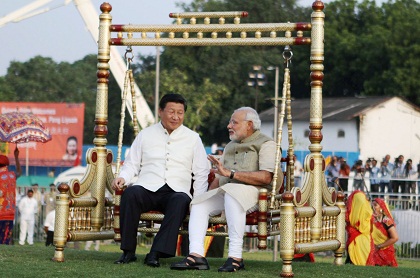
The leaders of India and China have decided not to leave the bilateral relationship to bureaucrats or ministers, but instead handle it themselves at the very top. The April 27-28 meeting promises to be a game-changer as Xi Jinping has accepted the need to improve ties with India as a priority