Carter_final Courtesy: defence.gov
11 December 2014

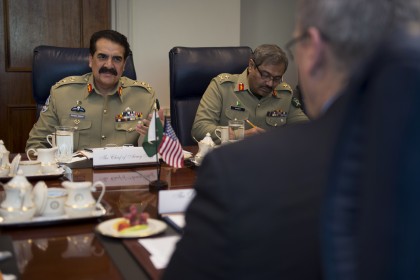
Ashton Carter knows India well

Chuck Hagel’s unremarkable stint as the U.S. Defence Secretary should soon be forgotten if Ashton Carter’s nomination is confirmed. Even though Carter’s nomination bodes well for the India-U.S. bilateral due to his work on furthering the defence partnership he will be faced with more immediate concerns and the onus will then be on India to strategically enhance the relationship

Space station_Nasa Courtesy: nasa.gov
8 December 2014

A divided space again

Space exploration may take a hit as terrestrial politics plays spoilsport with the U.S. government spearheading a sanctions programme against Russia. With China pursuing an independent space programme of its own, Russia’s departure from the effort may mark the beginning of a divided space once again after the Cold War

World Order_1 Courtesy: Allen Lane
5 December 2014

Book review: Writing with an imperialist’s pen

The scope of Kissinger’s book is immense, but it is marred by his prejudices and his arrogant view of non-European cultures. The author’s main premise is that the world is in a state of disorder, but his prescriptions remain unclear

Obama Xi Courtesy: Andy Wong/AP/wired.com
14 November 2014

Challenging the climate change deal

The U.S.-China deal on climate change and clean energy is too little too late. Instead of radical transformation, it is business-as-usual, setting a sub-standard benchmark for others to follow. Will the Indian government play within this framework, or challenge it?

michaelfroman Courtesy: wikimedia
11 November 2014

How fair is America’s ‘fair trade’?

There is a sense in Washington that if the U.S. is not tough with India, it will send a wrong signal to other countries. But the ongoing investigations by the Obama administration into India’s IPR regime and trade practices have become an unpleasant part of doing business with America

US elections Courtesy: wikimedia
5 November 2014

What the U.S. mid-term polls foretell

The Republicans emerged as the clear victors in the U.S. mid-term elections on November 4, taking control of both Houses of Congress. How will this outcome, which has made President Obama’s task more complicated, impact American foreign policy? What are the implications for India? Gateway House analyses the results

mia-main Courtesy: wikimediacommons
31 October 2014

India needs an anti-tapering strategy

India faces heightened geoeconomic risks as the U.S. exits its unconventional monetary policy and the value of the dollar appreciates against major currencies. We can mitigate the risks with a multilateral safety net to provide liquidity, and by attracting FDI through the ‘Make in India’ programme

Ukraine sanctions Courtesy: aitonline.tv
16 October 2014

Sanctions are a negative peace

The imposition of sanctions by Western countries on Russia has conflagrated the Ukrainian crisis with both sides indulging in an asymmetrical sanctions game. The hardening of positions has caused the Russian and the European economies to suffer, with no end in sight for the conflict

UN Courtesy:
1 October 2014

India must push anti-terror compact

With the growth of the Islamic State and of terrorist groups in Africa and other parts of the world, global coordination to combat terrorism is imperative. Prime Minister Narendra Modi has urged the UNGA to adopt the Comprehensive Convention on International Terrorism, but divergent national interests remain a hurdle

kudankulam Courtesy: Wikimedia.org
1 October 2014

Decoding the India-U.S. nuclear deal

Bringing U.S. nuclear technology to India is a goal identified in the countries’ joint vision statement. Although public discourse on the India-U.S. nuclear deal has focussed on the liability clause, the pact’s success also depends on resolving other factors such as local sourcing, technology transfer and project delays