Screenshot 2025-10-13 103335 Courtesy: Körber-Stiftung
13 October 2025

Bandung at 70: Multilateralism in a New Era of Multi-Alignment

The world is facing multiple crises which are shaking the foundations of multilateralism. The West’s structures are faltering, and the need for effective and equitable cooperation is greater than ever. Seventy years after the 1955 Bandung Conference, its principles of sovereignty, territorial integrity, cooperation and solidarity remain vital. This report revisits Bandung’s relevance for today’s reform efforts, urging renewed Global South–Europe collaboration for a sustainable global future.

VOA Courtesy: VOA
2 October 2025

Time to re-burnish Global South credentials

The year 2025 is often compared to the Bandung moment of 1955, and for good reason. With the U.S. reordering traditional relationships, the opportunity for greater emphasis on the Global South is now. It is therefore time for India, Africa and ASEAN among others to re-burnish their Global South credentials and use that identity as a platform to engage each other more deeply.

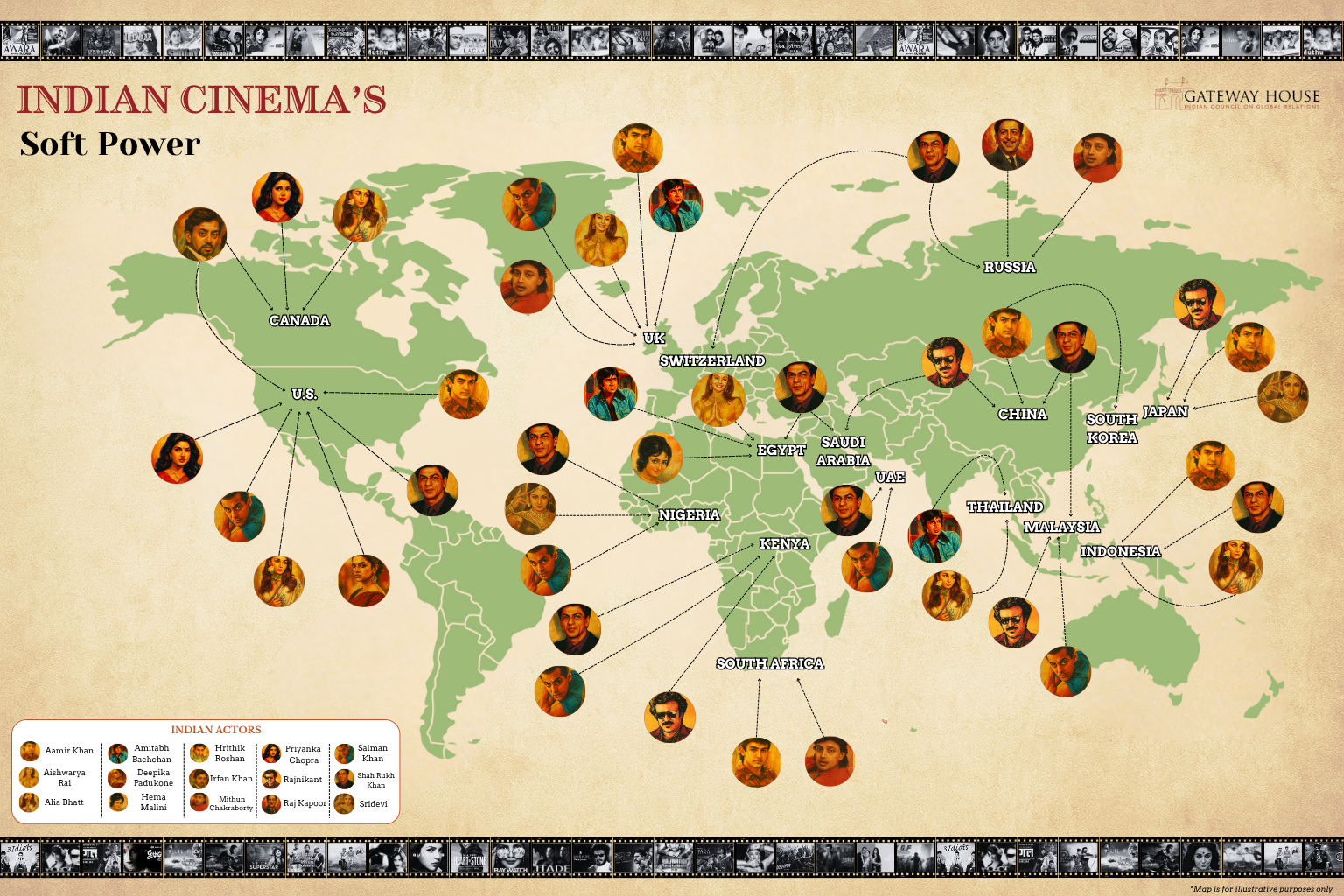
Most popular Indian actors worldwide Courtesy: Gateway House
1 October 2025

Indian Cinema as Economic Catalyst

As India seeks leadership in a multipolar world, cultural credibility is as vital as economic clout. Cinema gives India an edge with vivid storytelling, music, and empowering narratives, fostering understanding in a polarised world. Its popularity correlates with trade, as seen in the U.S., Russia, and Middle East. The more popular the cinema, the bigger the boost to trade.

U.S. Tariffs on Brics+ countries Courtesy: Gateway House
25 September 2025

U.S. Reciprocal Tariffs on BRICS+ countries

Under U.S. President Donald Trump’s reciprocal trade policy, the original five BRICS member countries account for the highest U.S. tariffs globally. India and Brazil are facing the highest tariffs of 50%, while China follows with a tariff of 34%, down from 145% earlier in the year. This infographic details the U.S. reciprocal tariff rates for each BRICS+ member and the sectors that are impacted.

ANI Courtesy: ANI
11 September 2025

India and Indonesia reconnect 

India and Indonesia are two Asian leaders and democracies which are reconnecting after decades, even centuries – in a world rife with new volatility and uncertainty. Both countries can collaborate and learn: Indonesia is an adept trading nation and India is a powerful tech player. The two governments are on a mission to deepen and diversify their relationship, stepping out of their past, and bringing fresh thinking.

G20.Org Courtesy: G20.org
28 August 2025

Appraising Brazil’s G20 Presidency

The G20’s current cycle is unique, with four Global South nations presiding consecutively: Indonesia, India, Brazil, and now South Africa. Brazil’s 2023-24 presidency exhibited both achievements and struggles, prioritising social inclusion, hunger, energy transition, and governance reform. The handover to South Africa marks a significant milestone in G20 history. Will the momentum be followed by the U.S., the next G20 president but also a G20 sceptic?

indo pacific  (2) Courtesy: Getty Images
24 July 2025

India’s footprint in the Indo-Pacific region

India is strategically expanding its influence across the Indo-Pacific region, positioning itself as a key player in regional affairs. Three elements anchor the effort: development aid, trade and the diaspora. The country now has 20 Free Trade Agreement partners in the Indo-Pacific. The 21.8 million-strong Indian diaspora across the region is a significant source of soft power for India.

Gateway House Courtesy: Gateway House
3 July 2025

China Plus One and global supply chains

A slowdown of the Chinese economy, and the shift, particularly by MNCs, from China to other more competitive locations has opened up business opportunities for latecomers to supply chains in the developing world. Evidence suggests that Southeast Asia and some South Asian countries like India, Sri Lanka, Bangladesh, could be beneficiaries of the supply chain shift, particularly in labour-intensive segments.

Getty (1) Courtesy: Gateway House
15 May 2025

The New Geopolitics and South Asia’s Trade Architecture – What Next?

Geopolitics is increasingly intertwined with the economic destiny of South Asia. Even before the U.S. tariffs were rolled out, growing polycrises had hit the global economy, which has been struggling since the pandemic. South Asia seems a relatively bright spark of regional trade and growth. This paper analyses South Asia’s trade architecture in the backdrop of a sluggish world economy in the 2020s, and makes recommendations for closer regional economic integration.

Bandung conference  (3) Courtesy: PTI
24 April 2025

Bandung Principles and the path ahead

Amid polycrises, from pandemics to wars and trade wars, the global order is in flux, with the contours of the new order still unclear. As the world marks the 70th anniversary of the historic Bandung Conference, this article analyses how its Ten Principles still resonate in today's fractured geopolitical landscape and offer a roadmap for equity, inclusivity, and balance.