PM Modi’s five-nation tour
PM Modi's five-nation tour highlights that despite geopolitical conflicts, New Delhi remains confident in its ability to balance relationships with the North and South.
Courtesy: X / PMOIndia
PM Modi's five-nation tour highlights that despite geopolitical conflicts, New Delhi remains confident in its ability to balance relationships with the North and South.
Courtesy: The China-Global South Podcast
In the current era of geopolitical uncertainty, the Middle Power states are deepening engagement with countries of the Global South while reducing their exposure to the U.S. and China. Manjeet Kripalani and Carlos Coelho spoke to Eric and Cobus from The China-Global South Podcast, on how countries like India and Brazil are navigating this increasingly contested world.
Courtesy: Abhijit Chavda Podcast
The rules-based world, perceived to be functional till last year, seems broken, giving way to an increasingly multipolar order. Manjeet Kripalani, Executive Director, Gateway House discusses in the Abhijit Chavda podcast, how emerging middle powers like India, Brazil, and Indonesia to name a few, have the heft to rewrite the rules of global trade and reform, away from U.S. and China.
Courtesy: The Diplomatist
The traditional label of ‘middle power’ fails to capture India’s growing status. The country’s ability to shape the international discourse is no longer in question. India sees itself as a key player the global order.
Courtesy: Körber-Stiftung
The world is undergoing profound transformations that are not being driven only by the United States, China or Russia. Small and medium-sized States are carving out a legitimate place for themselves in the emerging new order. This second edition of our annual Emerging Middle Powers Report is a reminder that the signs of the times are showing a new momentum for middle powers.
Courtesy: X
Prime Minister Narendra Modi’s state visit to Mauritius reinforced the strategic partnership between the two nations amid growing geopolitical competition in the Indian Ocean. The visit introduced the Mahasagar vision for regional security and growth while advancing cooperation in trade, defence, digital infrastructure, and people-to-people ties. With the shared historical, cultural, and economic ties, Mauritius remains pivotal to India’s Indo-Pacific strategy.
Courtesy: Institute for Global Dialogue
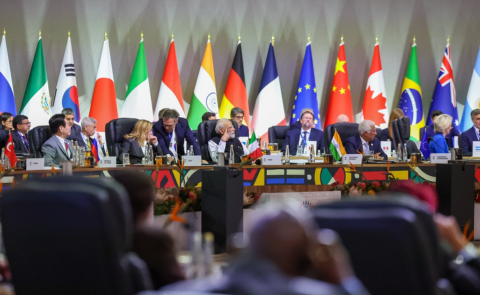
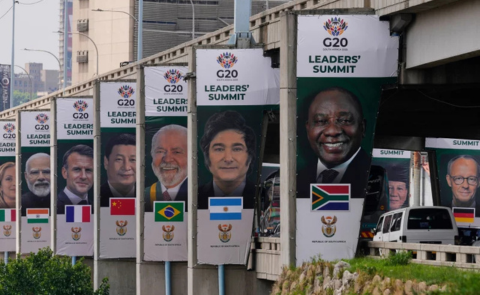
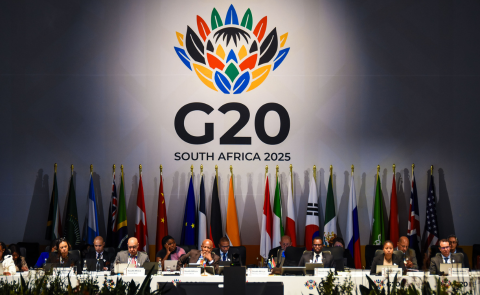
The G20 and South Africa - its presiding nation - will both face a difficult year. The U.S., one of the G20’s most vital members has not yet participated, notable by its absence from two important ministerial meetings. The U.S.’ changed foreign policy stance will be a tough challenge for G20; the Global South members will have to step up and become proactive.
Courtesy:
African National Congress (ANC) lost its long-held majority in the recent national elections in South Africa. While President Ramaphosa continues to be a pivotal actor in the new landscape, the political stakes have become higher as the new government sets about solving the dire economic issues that ordinary citizens face.
Courtesy:
South Africa goes to the polls this week, and there is much to watch: a new electoral system, the fate of the African National Congress, a potential coalition, the promise of economic renewal, and a foreign policy agenda. The winner will have to get to work at once to tackle these simultaneous challenges and ambitions.
Courtesy:
South Africa has just celebrated the 30th anniversary of its epic elections in 1994 which marked the end of apartheid rule. President de Klerk and Nelson Mandela avoided the expected bloodbath but, since then, the ruling African National Congress has not done well. Because the very qualities which make insurgent groups and liberation movements successful, are not the ones that make effective national governments.