

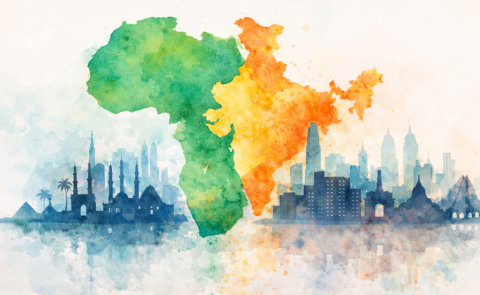
During the first two decades of the 21st century, Africa and the Indo-Pacific region drew huge international attention, as viewed from the Indian capital. International discourse was dominated by the emergence of the Indo-Pacific as a region of great strategic significance, as well as Africa, where a special kind of international competition unfolded among the great and middle powers.
But this began to change dramatically in this century’s third decade. Although the pressing challenges of the Indo-Pacific and Africa did not vanish, the mainstream discourse shifted to other geographies, such as Europe and West Asia.
Africa: Then and Now
It could be argued that in the diplomatic and academic discussions on global affairs, Africa has been sidelined by the shifting dynamics of geopolitics during the “Age of Polycrisis,” which began to unfold in the third decade of the 21st Century.
A rare combination of developments, such as the COVID-19 pandemic, the India–China border clash in Galwan, the Ukraine War, the Gaza conflict, the multiple forms of violence across West Asia, the persisting U.S.–China rivalry across the world, many manifestations of Trumpism, and the India–Pakistan and Pakistan–Afghanistan hostilities, has pushed Africa (and the Indo-Pacific) off the global radar. India is no exception.
The first two decades of the present century were qualitatively different. It appeared then that Africa had “arrived” on the global scene. The replacement of the Organisation of African Unity (OAU) by the African Union (AU) in July 2002 was a defining moment in the post-Cold War era. The new period was gradually marked by increasing multipolarity. Reform of African institutions and a fundamental shift in Africa’s mindset were brought about by a new generation of African leaders, led by South African President Thabo Mbeki and others. The African Renaissance had begun.
China launched its Forum on China–Africa Cooperation (FOCAC) in 2000 for economic diplomacy, which has seen billions of dollars pour into Africa’s economic development. This unleashed a real global competition in which nations, ranging from the EU, U.S., and Russia to those stretching from Türkiye to Indonesia and Australia, began re-engineering their policies on Africa. Only Japan was present beforehand, having initiated the Tokyo International Conference on African Development (TICAD) in 1993.
India, content until then with plodding on its bilateral track, joined the fray in a remarkable burst of imagination, energy, and generosity. It organised three unprecedented India– Africa Forum Summits (IAFSs) in 2008, 2011, and 2015, allocating substantial funds for credit, aid, and investments to African partners. The third summit, hosted by the Narendra Modi government in New Delhi, was particularly remarkable as all African states, rather than just a select few, were invited. Their constructive participation in the New Delhi summit and the joint declaration of an ambitious programme of cooperation took optimism about India–Africa relations to a new level. The process has since stalled.
India’s Policy Approach
Over the past decade, from 2015 to 2025, India’s policy has continued to be pro-Africa. In the absence of regular summits at the Pan-African level, New Delhi focused its attention on the bilateral track again. Prime Minister Narendra Modi and other leaders have visited various parts of the continent, imparting fresh momentum to relations between the host countries and India. The latest two countries he visited in July 2025 were Ghana and Namibia, where he created a positive impact.
At least five other actions by India need to be considered here:
One, India was at the forefront in extending assistance to Africa to battle COVID-19 through a generous supply of vaccines, medicines, and medical equipment, when many Western countries were found wanting.
Two, during its G20 presidency (2022–2023), India took up the long-pending request by Africa to grant the AU full membership in the G20. Indian leaders pushed it hard to the point where resistance crumbled, resulting in the AU’s welcome entry into the world’s premier economic steering group.
Three, India utilised its G20 presidency creatively to advance the Global South agenda, which was strengthened by the collective endeavours of previous and subsequent presidencies of Indonesia, Brazil, and South Africa.
Four, India supported the expansion of Brazil, Russia, India, China, South Africa (BRICS) to bring in two African countries, Egypt and Ethiopia, as full members. In addition, Nigeria, Algeria, and Uganda were accepted as new dialogue partners, with the active support of New Delhi. Within BRICS, India and South Africa in particular worked together on many issues to ensure internal balance.
Five, regular efforts to promote trade and economic relations between India and African nations continued to gain success. In this context, a brief review of the relevant data may be warranted.
India–Africa trade shows a pattern of fluctuation. From the total value of $70 billion in 2015–2016, it rose to $98 billion in 2022–2023, only to decrease to $82 billion in 2024–2025. It is now estimated to be $103 billion for the fiscal year 2025. Of this, Indian exports to Africa amounted to $45 billion and imports to $58 billion, thus giving Africa the benefit of a favourable trade balance.
Investments from India into Africa are now valued at $80 billion. Recently, the Indian government has set a target to double bilateral trade, aiming to reach $200 billion by 2030, within the next five years. The question is: what strategy do the two sides need for attaining this ambitious goal? And beyond trade, what are the other goals the two sides must identify and cooperate on? Perhaps there is justification for India and Africa to consider a slew of ideas and devise a new joint strategy. Some experts feel that the arbitrary tariffs imposed by the U.S. administration create fresh opportunities to increase Africa–India trade exchanges. Besides, there is a massive potential for education, training, and capacity building for African youth by increasing the use of facilities offered by India.
There is a compelling need to inject fresh political capital into the task of deepening and diversifying the India–Africa partnership. All its critical dimensions—strategic and diplomatic, defence and security, economic and people-to-people—need to be addressed in a comprehensive and integrated manner.
India should accord priority and focus on crafting and adding a regional facet to its Africa policy by connecting with the Regional Economic Communities (RECs) in Western–Central and Eastern Africa, which account for a substantial segment of India–Africa trade.
Roadmap 2030, prepared by the Africa Expert Group of the reputed think tank, the Vivekananda International Foundation (VIF), in 2023, remains relevant. Its recommendations should be reconsidered and implemented meticulously. More than ever before, there is a need for the proposed Annual Strategic Dialogue between the chairperson of the EU Commission and India’s external affairs minister. This must start as soon as possible.
On trade, economic and development cooperation, the Confederation of Indian Industry (CII) produced a valuable paper entitled “India–Africa Momentum: Purpose-Driven Partnership” in August 2025. It presents a robust picture of Africa’s growth, projecting that the continent’s business capital could grow with AfCFTA, potentially adding $560 billion in exports and $450 billion in income by 2035. CII’s recommendations, with their focus on 10 specific sectors including agriculture, healthcare, green economy, digital development, defence and space, and Micro, Small, and Medium Enterprises (MSMEs), warrant favourable consideration.
Finally, AUDA-NEPAD should consider establishing a creative platform for regular and in-depth dialogue with India’s top Africanists, to be held annually alternating between Addis Ababa and New Delhi. Without adequate intellectual capital and engagement, the Africa–India partnership will not be able to muster the kind of ballast it needs from the fountain of creative public diplomacy.
India has consistently demonstrated a wealth of goodwill and positive intentions towards Africa. But India needs to invest more in Africa’s development. Africa has consistently demonstrated friendship and respect for the people of India; however, this perception has not been reflected in the AU’s approach lately. This must change.
The lessons from President Donald Trump’s presidency are clear: Africa must look to Asia, especially India, as a key development partner, while India must urgently diversify its external trade by shifting exports from the U.S. towards Africa and Latin America. However, export growth must be accompanied by increased Indian investments in African nations, as well as more concessional assistance and grants for development projects that benefit the African people. Finally, India and Africa must unite to refine and promote the implementation of the agenda of the Global South.
Rajiv Bhatia is the Distinguished Fellow for Foreign Policy Studies and a former ambassador.
This article was first published as ‘Africa’s Marginalisation: How India Must Respond’ in the The Africa–India Blueprint for Growth Report by Centre for Social and Economic Progress (CSEP) and the AUDA-NEPAD Africa Policy Bridge Tank (APBT).