


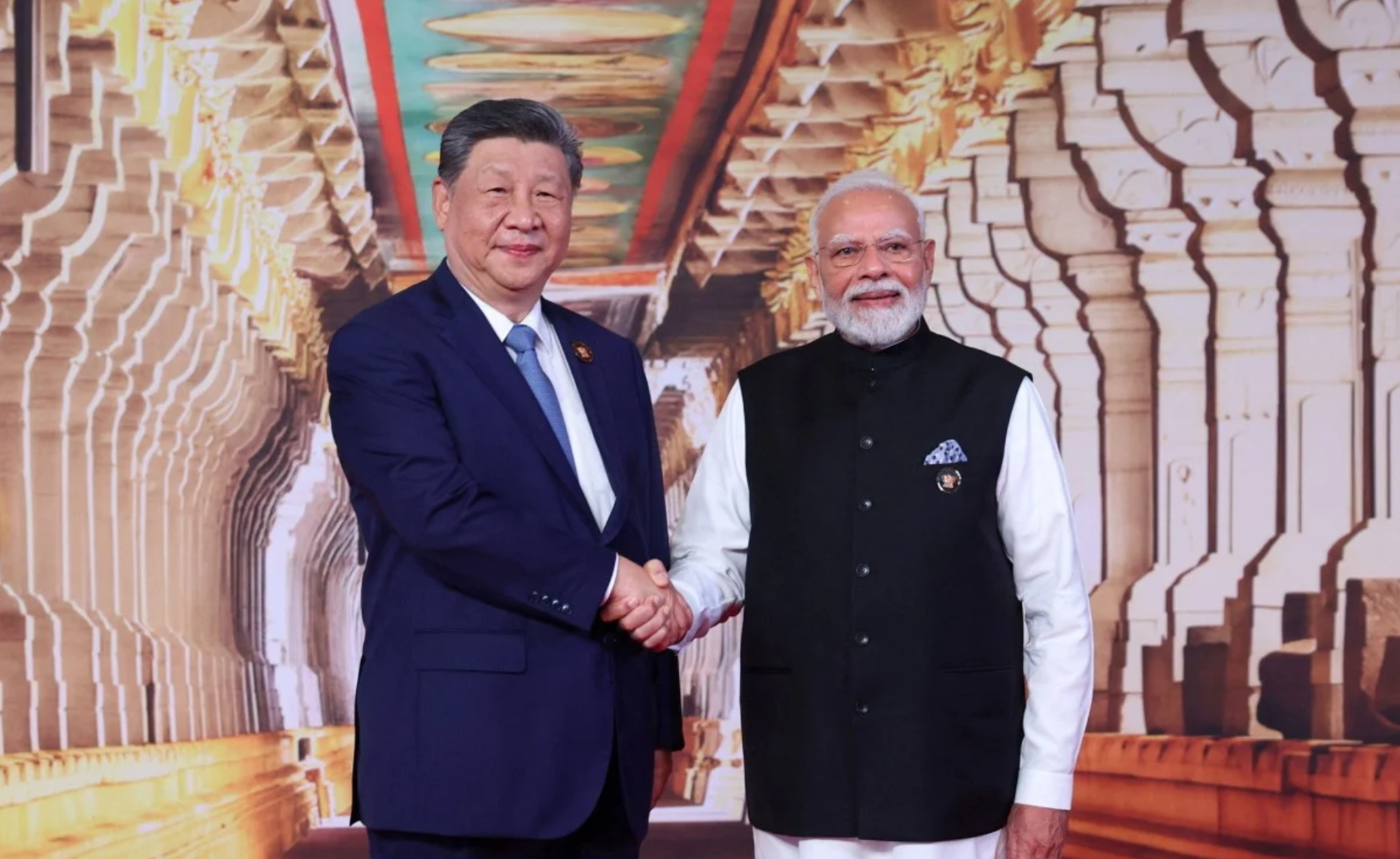
After much suspense over the impending visit to India, Chinese President Xi Jinping finally arrived in New Delhi on Saturday, September 12, after a gap of seven years. He last visited India in October 2019 for an informal bilateral summit. Although that visit was only for 24 hours, it sent a strong signal that despite a deeply adversarial relationship, New Delhi and Beijing were keeping all channels of communication open to discuss the contentious issue of a disputed border. The 2026 visit comes almost a year after PM Modi’s visit to Tianjin, China, in August 2025.
The visit by Xi to attend the 18th BRICS Summit in New Delhi, as well as a bilateral meeting with Modi, can be called a success. Both sides reiterated the basic foundation of the relationship: to maintain peace and tranquillity on the border. Bringing about a solution to the dispute will be a long and arduous process, but the fact that both sides continue to stand, although shakily, on the same ground on maintaining peace in the border region can be considered a success. This is especially crucial now after both countries fought a major border clash in April 2020 in the Galwan region of the eastern Ladakh sector of the Line of Actual Control (LAC) and suspended aviation links, thereby severely restricting cross-border travel. They also disagree on the issue of the succession of the Dalai Lama.
Today, India and China are now discussing an “early and substantial harvest” under an eight-point outcome and consensus[1] which emerged from the dialogue between the Special Representatives of India and China on the boundary question. The SRs for India and China are, respectively, National Security Advisor Ajit Doval and Wang Yi, Special Representative of China, Member of the Political Bureau of the Communist Party of China (CPC) Central Committee and Director of the Office of the Central Commission for Foreign Affairs.
Simultaneously, during his talks with President Xi in New Delhi on the sidelines of the BRICS Summit on September 12, PM Modi asked China to “observe existing agreements and understandings on border-related issues.” He was ostensibly referring to the 2005 India-China border agreement titled ‘Agreement on the Political Parameters and Guiding Principles for the Settlement of the India-China Boundary Question.’ The agreement, signed during Chinese Premier Wen Jiabao’s visit to India in April 2005, continues to serve as the foundational roadmap for political negotiations. It provided a three-step resolution process: first agreeing on guiding principles, then establishing a structural framework, and finally delineating and demarcating the border on maps and on the ground. The agreement was signed between then Foreign Secretary Shyam Saran and Dai Bingguo, Chinese Special Representative.
Just days before the September 12 bilateral, on September 6-7, both sides held a historic and first-of-its-kind Corps Commander-level flag meeting. This was enabled by the brief August 31 meeting between Modi and Xi in Bishkek, Kyrgyzstan, on the sidelines of the Shanghai Cooperation Organisation (SCO) meeting. For the first time ever, the Corps Commander-level talks, usually held in the Ladakh (Western) sector, were held in the Eastern Sector (Arunachal Pradesh). A two-day session took place across the Line of Actual Control (LAC). The first session was at Wacha (Indian side) on September 6, and the second, on September 7, was at Damai (Chinese side).
The discussions were primarily aimed at managing recent operational sensitivities and localised tensions in the Taksing area of Arunachal Pradesh’s Upper Subansiri district. But it can also be seen as the first step towards an early harvest agreement.
The process to normalise ties began in 2024 when people-to-people links began easing, with journalists, think-tankers, scholars and tourists travelling from India to China. In March this year, India partially relaxed Press Note 3 for foreign direct investment from all countries that share a land border with India – most significantly China.
In October 2024, India and China reached patrolling and disengagement agreements for flashpoints like Depsang and Demchok, and created no-patrol zones in some areas, known as de-militarised zones.
The holy Kailash Mansarovar Yatra pilgrimage route was officially revived, border trade via designated Himalayan passes like Nathu La in Sikkim was reopened, and China resumed sharing crucial hydrological flood data for the Brahmaputra and Sutlej rivers.
According to the annual report from the Indian Ministry of Defence released in September 2026, there was a notable decrease in the deployment of China’s People’s Liberation Army forces along India’s northern border in 2025. Nevertheless, the Indian Army maintains that the border situation remains “stable yet sensitive”. The number of troops on the frontlines has diminished. Both nations have spent the past six years building permanent infrastructure, including roads and airfields. This development ensures that heavy reinforcements can be quickly mobilised if tensions escalate once more.
Under the early harvest concept that China had been pushing for years, Beijing has proposed that instead of seeking a solution for the entire 3,488-kilometre-long de facto border, both sides can resolve one sector at a time of the Line of Actual Control. The 2005 pact, on the other hand, which India had been unrelenting on, stands on the premise that nothing will be deemed resolved unless the entire border issue is resolved.
The key compromise now is whether India will agree to settle the boundary dispute as a package deal, as laid out in the 2005 pact, or whether it will agree to the formulation that China is pushing for. Can the current détente between India and China pave the way for a long-term modus vivendi?
Nayanima Basu is the Adjunct Fellow at Gateway House and an author.
This article was exclusively written for Gateway House: Indian Council on Global Relations. You can read more exclusive content here.
For permission to republish, please contact outreach@gatewayhouse.in.
Support our work here.
© Copyright 2026 Gateway House: Indian Council on Global Relations. All rights reserved. Any unauthorised copying or reproduction is strictly prohibited.
References:
[1] Ministry of External Affairs, Government of India, “Eight Points of Outcomes and Consensus for the 25th Round of Talks between Special Representatives of India and China on the Boundary Question,” press release, August 26, 2026, https://www.mea.gov.in/press-releases?dtl/41700/Eight_Points_of_Outcomes_and_Consensus_for_the_25th_round_of_Talks_between_Special_Representatives_of_India_and_China_on_the_Boundary_Question.
[2] “Agreement between the Government of the Republic of India and the Government of the People’s Republic of China on the Political Parameters and Guiding Principles for the Settlement of the India-China Boundary Question,” India–China, April 11, 2005, Ministry of External Affairs, Government of India, https://www.mea.gov.in/bilateral-documents?dtl/6534/Agreement+between+the+Government+of+the+Republic+of+India+and+the+Government+of+the+Peoples+Republic+of+China+on+the+Political+Parameters+and+Guiding+Principles+for+the+Settlement+of+the+IndiaChina+Boundary+Question.
[3] Zhonghua Renmin Gongheguo Waijiaobu [Ministry of Foreign Affairs of the People’s Republic of China], “Xi Jinping huijian Yindu zongli Modi” [Xi Jinping Meets with Indian Prime Minister Modi], September 12, 2026, https://www.fmprc.gov.cn/zyxw/202609/t20260912_12021195.shtml