


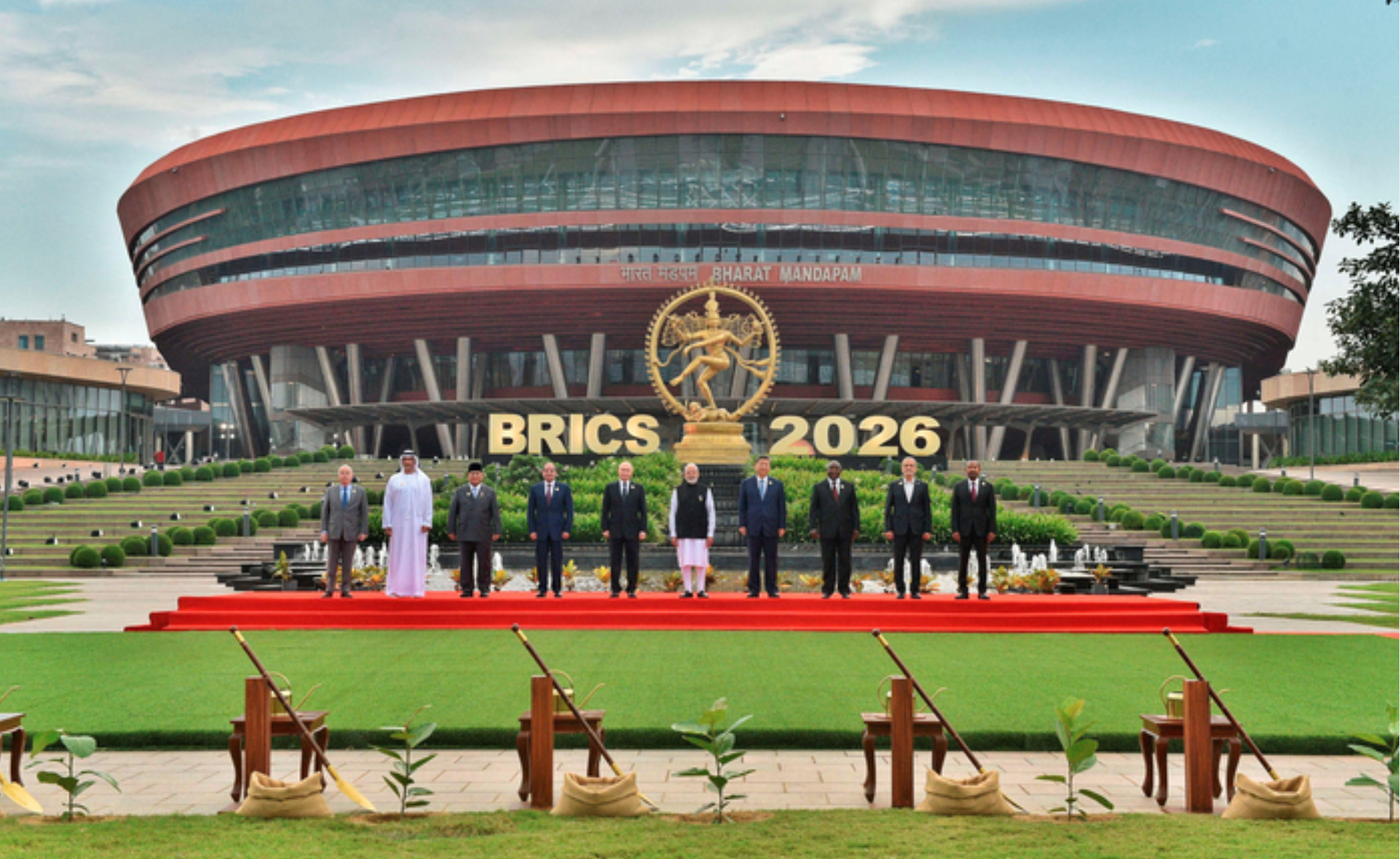
Through the prism of accepted parameters, the 18th Summit of BRICS, held in New Delhi on September 12-13, has been a notable success. The leaders’ attendance was at the highest level. Their participation was proactive and constructive. Protocol and logistics were excellent. Above all, the New Delhi Declaration is a comprehensive outcome document adopted unanimously on Day 1, and India’s Chairship has been praised by the BRICS family.
The question now is, where does the BRICS go from here? How does it ensure that its decisions and announcements of plans are implemented to the extent possible, and how can seamless continuity be ensured as the leadership baton is passed on to China at the year’s end?
For this, it is necessary to examine the New Delhi Declaration closely. Comprising 140 paragraphs, it is the longest when compared to the declarations of the previous three summits – Johannesburg (2023), Kazan (2024), and Rio de Janeiro (2025). The increased length is understandable, given the expansion in the grouping’s members and partners and their concerns, and the fact that the New Delhi Summit was the only annual conference of BRICS that took place when two major wars involving four BRICS members were ongoing, with disastrous consequences for the world. It has tried to insulate the grouping, its members, and the rest from its terrible costs.
The leaders were clear that they were addressing key issues that affect the entire developing world or the Global South. They kept this broader perspective in mind as they set about defining and projecting the current perspective of the Emerging Markets and Developing Countries (EMDCs) on critical challenges facing the international community, of which the grouping together makes up 49 per cent.
The leaders were particularly conscious of balancing the geopolitics right and keeping the focus on expanding, deepening and diversifying intra-BRICS cooperation. Following detailed consultations at the diplomatic and political levels, they reached the conclusion that the key to addressing the conflicts in the Gulf was to express deep concern over its adverse impact, urge maximum restraint, refrain from naming countries responsible for violence, and urge dialogue and diplomacy as the only viable route to a solution. Paragraph 28 of the declaration presented a balanced formulation acceptable to Iran and the UAE (and Saudi Arabia by implication). Consensus on this difficult issue paved the way for the summit’s success. The paragraphs on the Gaza conflict and the Palestinian issue helped matters. Surprisingly, the leaders avoided any pronouncement on the Russia-Ukraine war, thereby opening themselves to serious questioning by the media.
On the original mandate of BRICS with regard to reform of global governance, both of the UN and the international financial architecture, as well as sustainable development, priorities and concerns of developing countries and especially of the Least Developed Countries (LDCs), the declaration sets out its position clearly. This plurilateral grouping, adopting a global orientation, came out as the principal spokesperson for the Global South. However, its key task that remains to be addressed in the future is this: how will it create a global consensus that encompasses the Global North? And how will the grouping then generate the requisite political will collectively so that the international community – South and North – can move from lofty pronouncements to a step-by-step execution of the decisions taken and pronounced with great fanfare?
An important element was Para 116, which presents the BRICS’ view on the G20 and its key role as the premier global forum for international economic cooperation. It yearns for the G20 of the pre-2026 era, praising the legacy of the previous four presidencies held by Indonesia, India, Brazil, and South Africa, recalling the admission of the African Union (AU), and belatedly supporting South Africa’s indispensable place in the G20 as a founding member – a position which cannot be altered, except through consensus.
With the complexities of geopolitics out of the way, it was a relatively smooth run for India, as the Chair, to steer BRICS in the direction of practical cooperation, driven by the ‘Humanity First’ approach. “The strength of BRICS,” observed PM Narendra Modi, “lies in our diversity and cooperation.”
Four verticals were identified by the Chair right at the beginning of the year. Under resilience and security, there was an unqualified condemnation of cross-border terrorism and a focus on disaster resistance and robust public health frameworks. Innovation related to the deployment of digital public infrastructure sharing models, a network on digital agriculture, and scaling AI-driven decision-support systems. Economic and financial cooperation encompasses faster action on cross-border payment systems, the launch of an MSME cooperation portal, and further strengthening of the New Development Bank (NDB). Sustainability covers, inter alia, advances in smart grids, energy storage, sustainable urban mobility, and collaboration to secure critical mineral supply chains.
Adequate attention was also paid to the traditional three pillars of BRICS involving political and security, financial and economic, and cultural and people-to-people operations. On the latter, a long series of discussions were arranged in various fora consisting of representatives of business, think tanks, civil society, youth and women. India’s Sherpa Sudhakar Dalela underlined that “our endeavour has been to make BRICS cooperation more practical, forward-looking and responsive to the priorities of the people.” The over 350 pre-summit activities reflected, he added, “a whole-of-India, a whole-of-nation’s efforts.”
Two additional points to note.
First, the declaration is highly critical of U.S. policy, especially of its “unilateral measures” such as sanctions against Russia and others. Likewise, American unilateral trade tariffs came under criticism. Even on the Gulf conflict, while the language is couched in neutral terms, the indictment of Washington is clear. Yet, care was taken not to overly annoy the U.S. Interestingly, there has been no official reaction by the U.S. government to the summit declaration. Observers consider it surprising, considering that harsh anti-BRICS rhetoric had emerged from top U.S. leaders in the preceding months.
Second, recalling the differences within BRICS over the grouping’s expansion, the leaders agreed to portray their decisions on this issue as reflecting “the influence, credibility and appeal” of BRICS and to stress the need for enhanced coordination in the future. But the apprehension in Delhi is that China, as the next Chair, may be keen to drive the group to admit more members. Surely, each of the 10 partner states will first want to be elevated to the status of full members. How the grouping handles this intricate issue will be watched with interest.
At the intellectual and policy plane, BRICS is a conclave of new concepts and ideas for redefining the contours of its internal cooperation. For example, PM Modi offered several ideas for his fellow leaders’ consideration, particularly the crafting of a BRICS Reform Roadmap by the next summit. President Xi Jinping, on the other hand, proposed a five-point initiative aimed at strengthening cooperation in trade, manufacturing, investment and technology, especially AI. These and other proposals presented at the summit will shape its future trajectory.
Facing a highly fractured and polarised geopolitical situation with its direct impact on intra-BRICS dynamics, this consequential grouping gave a promising account of its collective determination, at the New Delhi summit, to move forward in a constructive manner. If its diversity continues to fold into positive collaboration, BRICS may surprise the horde of its critics and sceptics who have been throwing bricks at it as a matter of professional pleasure, camouflaged as political or ideological conviction.
Rajiv Bhatia is the Distinguished Fellow for Foreign Policy Studies and a former diplomat who served in Jakarta as DCM and in Yangon as Ambassador.
This article was exclusively written for Gateway House: Indian Council on Global Relations. You can read more exclusive content here.
For permission to republish, please contact outreach@gatewayhouse.in.
Support our work here.
© Copyright 2026 Gateway House: Indian Council on Global Relations. All rights reserved. Any unauthorised copying or reproduction is strictly prohibited.