interns research (6) Courtesy: Gateway House
25 June 2026

Dual Citizenships: fine or fraught?

President Trump’s January 2025 executive order ending birthright citizenship has reignited the global debate over citizenship and migration. Dual citizenship has become increasingly popular since the Second World War, but it is now viewed with growing anxiety over migration and national identity, prompting some countries to tighten restrictions. This infographic maps which countries permit, restrict, or prohibit dual citizenship.

revised design Courtesy: Gateway House
27 November 2025

Rise of the Davos Competitor

U.S. health secretary Robert Kennedy Jr. called the World Economic Forum a “billionaires’ boys club” imposing totalitarian controls. Indeed, since 1971, the elite platform shaped geopolitics. But its Western-centricism kept out the concerns of the rest. This gave rise to alternative forums, which look beyond financial agendas to the perspectives shaping the Global South. Here are 45 of biggest, half of which began just two decades ago.

Most popular Indian actors worldwide Courtesy: Gateway House
1 October 2025

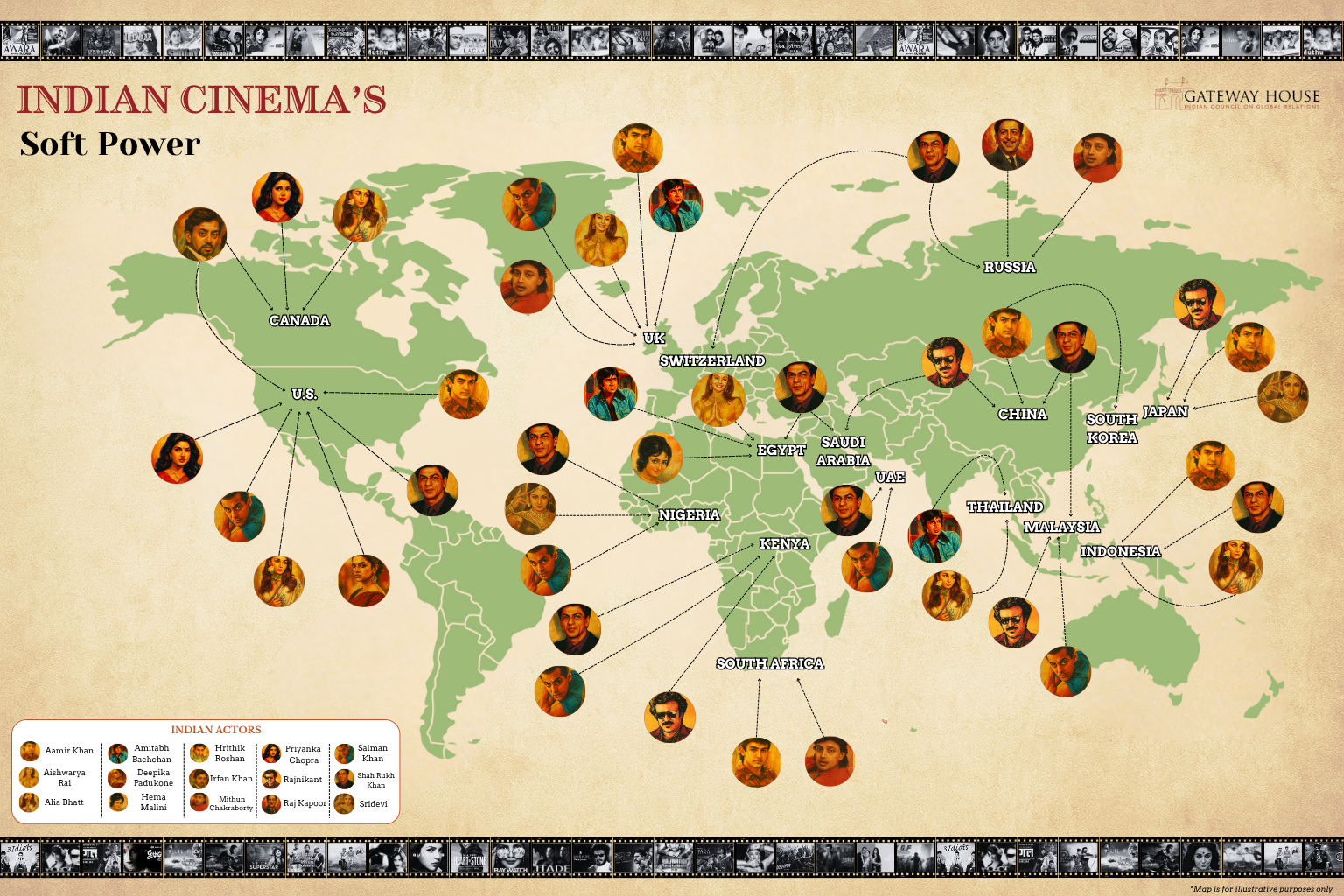
Indian Cinema as Economic Catalyst

As India seeks leadership in a multipolar world, cultural credibility is as vital as economic clout. Cinema gives India an edge with vivid storytelling, music, and empowering narratives, fostering understanding in a polarised world. Its popularity correlates with trade, as seen in the U.S., Russia, and Middle East. The more popular the cinema, the bigger the boost to trade.

U.S. Tariffs on Brics+ countries Courtesy: Gateway House
25 September 2025

U.S. Reciprocal Tariffs on BRICS+ countries

Under U.S. President Donald Trump’s reciprocal trade policy, the original five BRICS member countries account for the highest U.S. tariffs globally. India and Brazil are facing the highest tariffs of 50%, while China follows with a tariff of 34%, down from 145% earlier in the year. This infographic details the U.S. reciprocal tariff rates for each BRICS+ member and the sectors that are impacted.

indo pacific  (2) Courtesy: Getty Images
24 July 2025

India’s footprint in the Indo-Pacific region

India is strategically expanding its influence across the Indo-Pacific region, positioning itself as a key player in regional affairs. Three elements anchor the effort: development aid, trade and the diaspora. The country now has 20 Free Trade Agreement partners in the Indo-Pacific. The 21.8 million-strong Indian diaspora across the region is a significant source of soft power for India.

Website articles  (12) Courtesy: Gateway House
15 May 2025

U.S., global emperor of sanctions

Over two centuries, the U.S. has amassed vast economic powers across the globe during and after the two World Wars , and sanctions slowly became an effective tool it used to achieve its foreign policy goals, becoming the global emperor of sanctions.

Banner_Final Courtesy:
31 October 2024

India-Myanmar: Borderland Dynamics

The timeline records the daily instances and ongoing cross-border dynamics between India and Myanmar since the February 2021 military coup in Myanmar. It tracks the events taking place in the eight states along the Indo-Myanmar border—four states in India (Arunachal Pradesh, Nagaland, Mizoram, and Manipur) and four in Myanmar (Kachin, Sagaing, Chin, and Rakhine), revealing their social, political and economic interconnectedness.

0014 Courtesy: Gateway House
17 February 2022

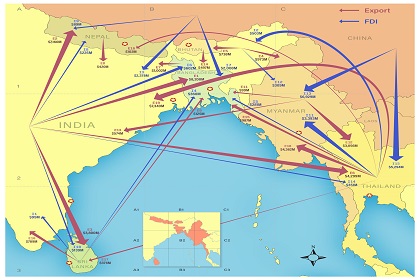
Financial connectivity in the Bay of Bengal

Multilateral funding can aid regional financial connectivity between the Bay of Bengal states, where financial networks are scarce. India's successful fintech can be mobilised to create a local ecosystem of startups with better access to funds and strong ties to the Indian market.

bcim corridor Courtesy: Institute of Peace and Conflict Studies
9 November 2021

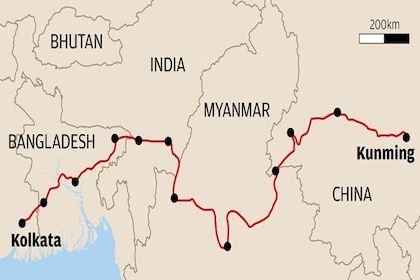
Physical connectivity in the Bay of Bengal

China is a clear winner in the physical connectivity stakes in the Bay of Bengal, and there's a reason a why: Its projects are connected to one another, from rail to road to port. While India also has some successful cross-border road and rail infrastructure projects, they are often an extension of an existing railway line or highway, not specific to the connectivity needs of the region. India can win by focussing instead on building infrastructure to maximise the vast maritime potential of the Bay of Bengal, especially the Andaman and Nicobar Islands that give India access to critical sea channels and trade routes.

Chinese Port invesments Courtesy: The Maritime Executive
19 August 2021

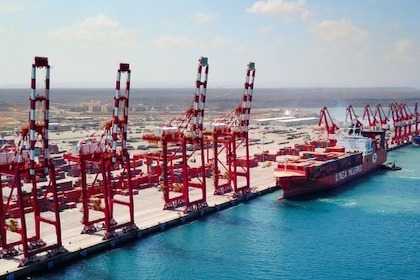
China’s ports in the Indian Ocean

China is rapidly expanding its influence in the Indian Ocean Region, as its massive investment in ports starts to materialise. From smaller investments of $78 million in Djibouti to large ones like $1.6 billion in Gwadar, these are funded largely by Chinese state-owned enterprises. This infographic shows the 17 ports being built by China, which are now important strategic, economic and political outposts for the country.