Nina (1) Courtesy: Gateway House
3 December 2025

Strengthening ties: U.S.–India academic exchange

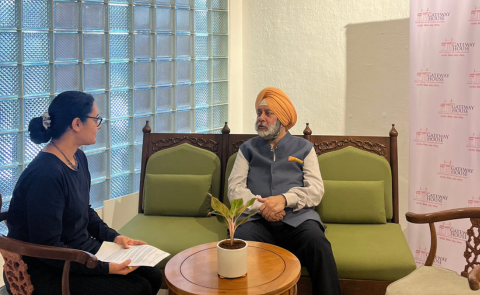
India and the U.S. share a comprehensive global strategic partnership across trade, technology, defence, and education, yet high school exchanges remain overlooked. The ecosystem depends on two U.S. government-backed programmes, which have recently faced budget cuts of 90% and have both been paused, putting their future at risk. Nina Robinson, CFR International Affairs Fellow, explains why these exchanges matter and how their loss would limit opportunities for young students.

Founding India’s  Gateway House Courtesy: Gateway House
26 November 2025

Founding India’s Gateway House

A former diplomat and a journalist came together in 2009 to build what would become Mumbai’s first foreign policy think tank – Gateway House. It is India’s first women-founded think tank, and among the few globally established by two women. In this conversation with Akshobh Giridharadas of USISPF, co-founders Manjeet Kripalani and Neelam Deo reflect on Gateway House’s origins and the epiphany that India needed to shape global conversations with its own perspective, one that extended beyond New Delhi.

IMG_3632 Courtesy: Gateway House
12 November 2025

Unfolding Geopolitics Episode 24 | Has Xi Jinping’s grip on China slackened?

There’s growing speculation about a power struggle in China and whether President Xi Jinping is losing control. Amid reported internal rifts within the Communist Party of China, Xi has launched a military purge, removing several top officials, while Chinese companies face mounting internal issues. Lt Gen S. L. Narasimhan, Adjunct Distinguished at Gateway House, analyses these rumours and reveals China’s internal dynamics.

Ivan Courtesy: Gateway House
8 October 2025

Unfolding Geopolitics Episode 23 | India renews engagement with Afghanistan

Afghanistan’s Foreign Minister Amir Khan Muttaqi will visit India on October 10, marking the first high-level Taliban visit since the group took over Kabul in 2021. Nayanima Basu discusses the purpose of this visit and the importance of engagement with Afghanistan. She explains the roles of China, which seeks business; Pakistan, which pursues political interests; and the U.S., which has a renewed interest in Bagram Air Base and its return to the country it abandoned.

Business Today (1) Courtesy: Gateway House
26 June 2025

Unfolding Geopolitics Episode 19 | Global gaze on terrorism

As part of India’s diplomatic outreach after Operation Sindoor, Ambassador Manjeev Singh Puri and his delegation visited Spain, Greece, Slovenia, Latvia and Russia. He spoke to Gateway House on how the thinking of countries needs to coalesce so that the global gaze is not just on terrorism but on Pakistan, which should be pressured to understand that the price for terrorism is far beyond what it can afford.

bdesh Courtesy:
8 August 2024

Strategic implications of Bangladesh’s regime change

Bangladesh Prime Minister Sheikh Hasina's forced resignation on August 5 came amidst prolonged and violent anti-government protests. Lt Gel S L Narasimhan, the Adjunct Distinguished Fellow for China and National Security Studies, Gateway House, analyzes the role of the army and external actors, and the strategic and security implications for India.

Countering unmanned systems Courtesy: Presidency of Defence Industries, Turkey
30 September 2021

Countering unmanned systems

The use of unmanned systems has increased in the 21st century, employed by great powers, medium powers and non-state actors alike. Zachary Kallenborn, Research Affiliate, Unconventional Weapons and Technology Division of the National Consortium for the Study of Terrorism and Responses to Terrorism (START) explains the growing proliferation of unmanned systems and ensuing threats on a state and global level.

Demystifying Maritime Lawfare Courtesy: Shutterstock
2 September 2021

Demystifying Maritime Lawfare

A new maritime law in China allows it to supervise all foreign vessels which appear in the country's "territorial waters" - many parts of which are internationally disputed. Nationalistic maritime actions such as China’s aggression in the South China Sea and Russia’s actions in the Black Sea, has revived international focus on maritime law. In this podcast, Dr Stefan Talmon, professor and co-director at the Institute of International Law, University of Bonn, interprets maritime law in the two hotly contested seas.

jpg Courtesy: The Times of India
12 August 2021

Deep dive: The Quad

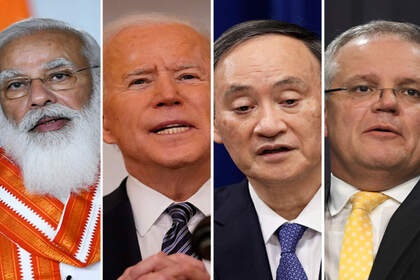
In an interview with Garrison Moratto of The New Diplomatist, Amb. Rajiv Bhatia, Distinguished Fellow, Foreign Policy Studies, counters China's claims that the Quad is an "Asian NATO." He highlights how the India-U.S.-Japan-Australia Quadrilateral initiative aims to increase cooperation in the Indo-Pacific on international law and security. This podcast delves into the history of the Quad's formation, current strategic characteristics, and future geopolitics, ahead of the fall in-person Leaders' Summit in the U.S.

attributing cyber-attacks Courtesy: Shutterstock
15 July 2021

Attributing cyber-attacks

A ransomware attack recently targeted Kaseya, a software services company in the U.S., for $70 million, incapacitating hundreds of its clients globally. There is an increasing incidence of such attacks, with perpetrators targeting government agencies and high-tech companies, leading to considerable economic losses. How can governments mitigate these threats and attribute responsibility to those accountable?