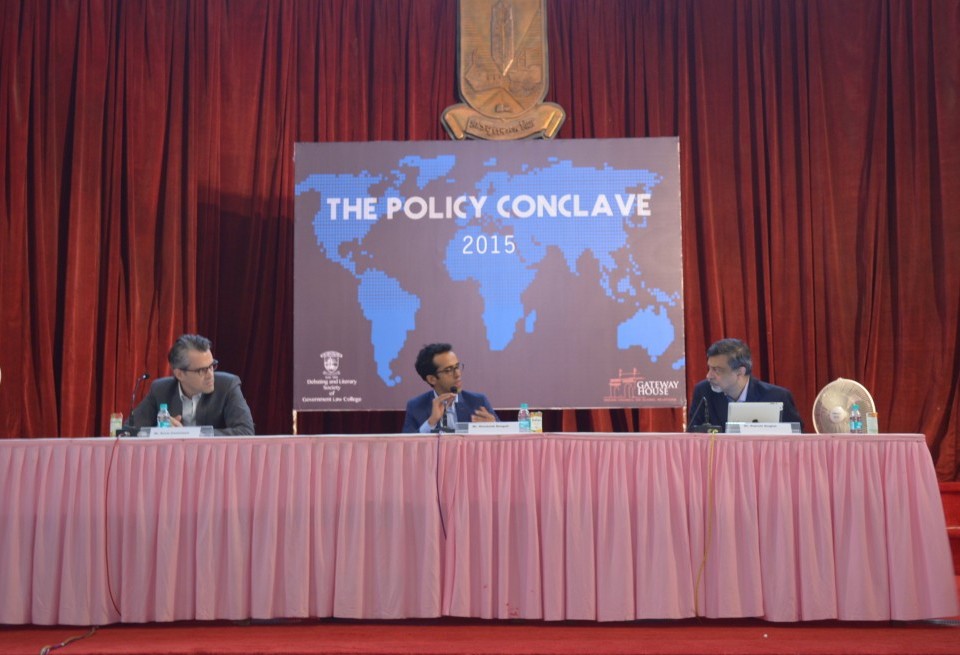
GLC Policy Conclave Session 1: The New Financial World Order Shashank Bengali (SB): So, Rajrishi, can you tell us basically what the circumstances were that led to the development of these new multilateral institutions? How did we get here? Read more
If, after nine years, BRICS remains a disparate grouping, and its trade and investment flows remain dismal, it is time to explore new avenues of cooperation to consolidate the alliance—and culture and education can provide the necessary cementing factor when combined with the New Development Bank
The New Development Bank initiated by BRICS countries can reform and democratise global economic governance. But to reach this goal, in this critical period when the bank is preparing to operationalise, it must formulate an innovative institutional design. This article outlines four guiding principles for such a structure
The imposition of sanctions by Western countries on Russia has conflagrated the Ukrainian crisis with both sides indulging in an asymmetrical sanctions game. The hardening of positions has caused the Russian and the European economies to suffer, with no end in sight for the conflict
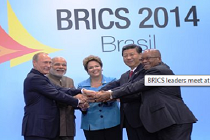
Looking back at the 2008 financial crisis, when governments had to resort to bail-outs to keep economies afloat, the BRICS member countries have decided to set up a New Development Bank which will provide for a contingency fund. This initiative aims at building an alternate financial structure in terms of trade among the member states as well as creating a safety net
The launch of the BRICS bank can now give the member countries confidence to experiment with other geoeconomic ambitions. Incubating a non-dollar financial architecture can be the next goal. There are existing models to build upon but India will need smart economic diplomacy to secure its interests
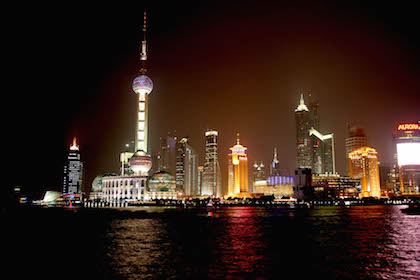
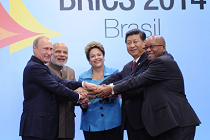
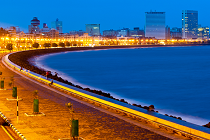
The New Development Bank was formalised at the just concluded meeting of the leaders of the BRICS nations in Fortaleza in Brazil this week. The location is to be Shanghai. The more appropriate and natural choice for locating the bank would have been Mumbai. There are several reasons why
Neelam Deo, Director, Gateway House, talks about the potential economic impact of the ongoing crisis in the Ukraine. In this interview, she also examines the aid packages offered to Ukraine by Russia and the West, and assesses how the situation will affect India’s trade relations
Courtesy: Systemman, Erin A. Kirk-Cuomo/Wikimedia Commons
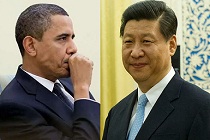
The U.S. government shutdown and President Obama’s absence gave China immense diplomatic and political space at the APEC and East Asia Summit meetings. China’s declaration of a “de-Americanised” world may be premature but the crumbling old order is doing little to dispel this notion
At the 5th BRICS Summit that begins in South Africa today, the heads of state of Brazil, Russia, India, China and South Africa are expected to ratify the creation of the BRICS Bank. After discussion and study for over a year by the respective governments, the bank will be launched with seed money estimated at between $50 billion to $100 billion, and most likely an equal share of voting rights for the management of the bank. What remains