President of Russia Courtesy: President of Russia
2 October 2025

Valdai frames Russia’s global doctrine

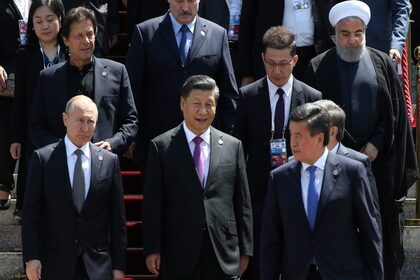
Each autumn, Russia convenes its flagship Annual Summit — a gathering of global leaders, business elites and intellectuals. Often compared in scale to Davos or Shangri-La, what sets Valdai apart is President Vladimir Putin’s extended, unscripted dialogue with the audience. Over the years, India has moved to the centre of this dialogue, reflecting its strategic weight and offering rare insight into Moscow’s evolving worldview.

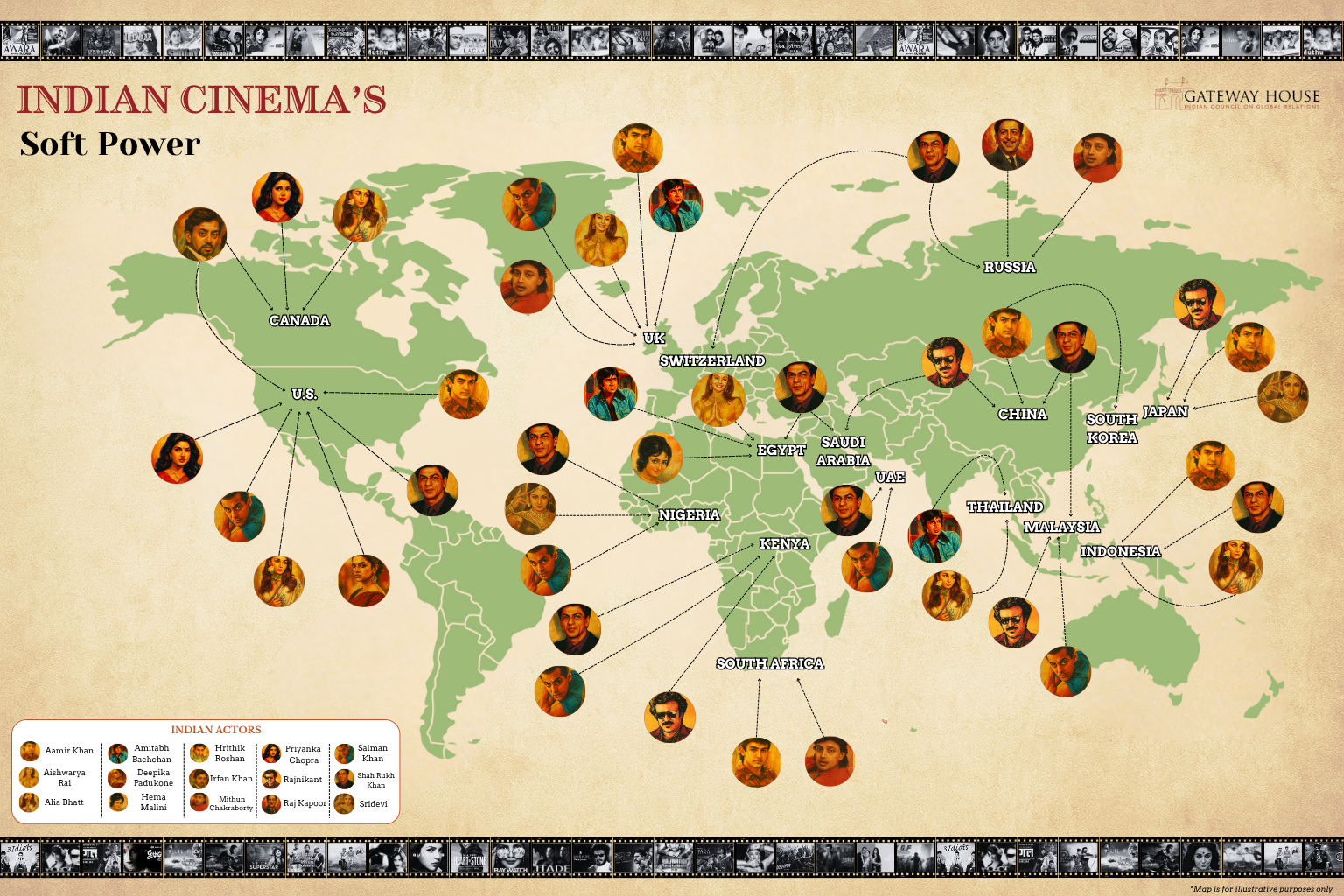
Most popular Indian actors worldwide Courtesy: Gateway House
1 October 2025

Indian Cinema as Economic Catalyst

As India seeks leadership in a multipolar world, cultural credibility is as vital as economic clout. Cinema gives India an edge with vivid storytelling, music, and empowering narratives, fostering understanding in a polarised world. Its popularity correlates with trade, as seen in the U.S., Russia, and Middle East. The more popular the cinema, the bigger the boost to trade.

task force cover 420 Courtesy: Gateway House
16 February 2023

G20 Energy Transitions and Climate Finance Task Force Report

Significant progress has been made globally in adopting green energy. Technological advances, easier availability of capital and regulatory measures have helped. But progress is likely to slow due to the shocks caused by Covid-19 and the Ukraine crisis. How to continue the green transition whilst ensuring that lower-income countries have access to affordable energy? This Task Force offers recommendations for India’s G20 Presidency.

TDB_car_151021 Courtesy: TDB
24 February 2022

Enhancing Regional Financial Intermediation in the Indo-Pacific

Financial intermediaries are critical lubricants for business, growth and development. The Indo-Pacific countries are industrializing, but smaller nations lag behind economically. The Quad countries can aid the advancement of the financial architecture in the Indo-Pacific by helping to develop an ecosystem, modelled on the examples of Japan and India.

G20 Rome summit, marching ahead Courtesy: G20
4 November 2021

G20 Rome summit, marching ahead

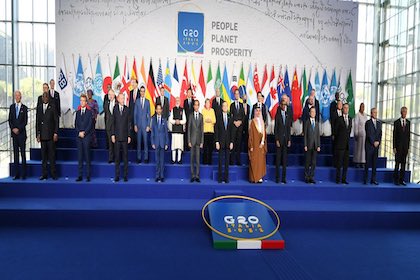
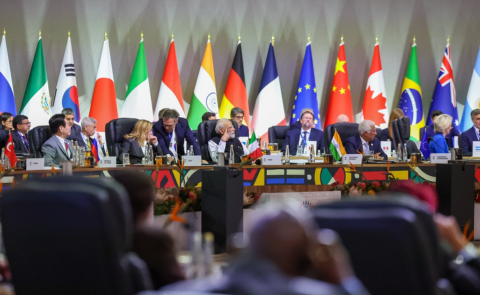
The Oct 30-31 G20 Leaders’ Summit in Rome took several important steps to accelerate economic recovery and health security. In the absence of several Eurasian leaders, India played a significant role especially on climate and energy. The G20 will now acquire greater salience in India's foreign policy, as it readies to lead the grouping in 2023.

2019-06-14T000000Z_1951021920_RC-2 Courtesy: SCO, Russia (2020)
22 July 2021

China’s quad?

A potential anti-Quad formation of China, Russia, Iran and Pakistan is in the making, and can pose risks to the Quadrilateral Security Dialogue. However, a close analysis of China's bilateral relationship with each country shows that this is a flawed grouping, formed on limited common interests and rivalries.

Securing India's energy needs Courtesy: Shutterstock
8 July 2021

Securing India’s energy needs

India’s oil consumption and imports are likely to resume their upward trajectory as the economy opens up, after a temporary drop due to the pandemic. To secure its energy needs, the country should shift course from investing in oil and gas assets of emerging economies to those of developed nations. The oil-rich Organisation for Economic Co-operation and Development (OECD) countries, such as Canada, Norway, and the U.S. can be given special consideration.

amit paper cover Courtesy: Gateway House
21 December 2020

India’s energy investments: A fresh approach

India’s investments in energy thus far have concentrated on buying stakes in oilfields in developing countries often at the risk of political unpredictability. With oil prices, and therefore oil company values, falling – India should revise this strategy and aim for better value and lower risk by making investments in companies in the developed world. This paper recommends investing in oil and gas assets in energy-rich developed countries like the U.S., Canada and Australia, to reduce India's vulnerability to future increases in energy prices. These should be made via a sovereign wealth fund (SWF), not the national oil companies. The SWF will be best served by acting as a financial investor, acquiring, only minority stakes, rather than aiming for management control.