Warfare is changing its character, and drones are playing a big role in it. Technology that was first extensively used in the Vietnam war is a current conflict staple. With the increasing use of artificial intelligence, drones are becoming more powerful and useful.
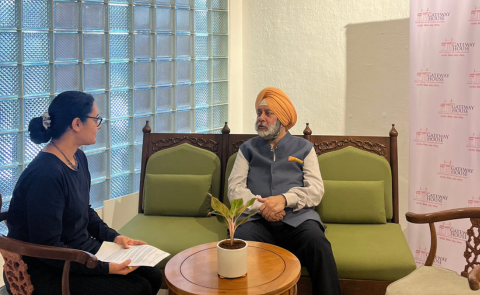
As part of India’s diplomatic outreach after Operation Sindoor, Ambassador Manjeev Singh Puri and his delegation visited Spain, Greece, Slovenia, Latvia and Russia. He spoke to Gateway House on how the thinking of countries needs to coalesce so that the global gaze is not just on terrorism but on Pakistan, which should be pressured to understand that the price for terrorism is far beyond what it can afford.
In the current era of geopolitical uncertainty, the Middle Power states are deepening engagement with countries of the Global South while reducing their exposure to the U.S. and China. Manjeet Kripalani and Carlos Coelho spoke to Eric and Cobus from The China-Global South Podcast, on how countries like India and Brazil are navigating this increasingly contested world.
Presidential visits abroad are high-level instruments of statecraft and, more often than not, signals of geopolitical priorities. The recent visit of U.S. President Donald Trump to the United Arab Emirates, Saudi Arabia, and Qatar, exemplified this, indicating the administration's policy orientation.
The rules-based world, perceived to be functional till last year, seems broken, giving way to an increasingly multipolar order. Manjeet Kripalani, Executive Director, Gateway House discusses in the Abhijit Chavda podcast, how emerging middle powers like India, Brazil, and Indonesia to name a few, have the heft to rewrite the rules of global trade and reform, away from U.S. and China.
Geopolitics is increasingly intertwined with the economic destiny of South Asia. Even before the U.S. tariffs were rolled out, growing polycrises had hit the global economy, which has been struggling since the pandemic. South Asia seems a relatively bright spark of regional trade and growth. This paper analyses South Asia’s trade architecture in the backdrop of a sluggish world economy in the 2020s, and makes recommendations for closer regional economic integration.
Over two centuries, the U.S. has amassed vast economic powers across the globe during and after the two World Wars , and sanctions slowly became an effective tool it used to achieve its foreign policy goals, becoming the global emperor of sanctions.
The victory of Mark Carney and the Liberals in the Canadian elections is a turnaround from the party's diminished position just four months ago. The former banker's campaign ran on a strong, independent Canada able to stand up to the new U.S. administration’s tariff provocations. Now come the challenges. The Carney government has much work to do in rebuilding ties abroad and bridging Canada's internal divisions.
Amid polycrises, from pandemics to wars and trade wars, the global order is in flux, with the contours of the new order still unclear. As the world marks the 70th anniversary of the historic Bandung Conference, this article analyses how its Ten Principles still resonate in today's fractured geopolitical landscape and offer a roadmap for equity, inclusivity, and balance.
The world is undergoing profound transformations that are not being driven only by the United States, China or Russia. Small and medium-sized States are carving out a legitimate place for themselves in the emerging new order. This second edition of our annual Emerging Middle Powers Report is a reminder that the signs of the times are showing a new momentum for middle powers.