Getty (1) Courtesy: Gateway House
15 May 2025

The New Geopolitics and South Asia’s Trade Architecture – What Next?

Geopolitics is increasingly intertwined with the economic destiny of South Asia. Even before the U.S. tariffs were rolled out, growing polycrises had hit the global economy, which has been struggling since the pandemic. South Asia seems a relatively bright spark of regional trade and growth. This paper analyses South Asia’s trade architecture in the backdrop of a sluggish world economy in the 2020s, and makes recommendations for closer regional economic integration.

Bandung conference  (3) Courtesy: PTI
24 April 2025

Bandung Principles and the path ahead

Amid polycrises, from pandemics to wars and trade wars, the global order is in flux, with the contours of the new order still unclear. As the world marks the 70th anniversary of the historic Bandung Conference, this article analyses how its Ten Principles still resonate in today's fractured geopolitical landscape and offer a roadmap for equity, inclusivity, and balance.

BERNAMA Courtesy: BERNAMA
13 February 2025

High expectations of Malaysia as ASEAN chair

Malaysia’s chairmanship of ASEAN in 2025 is pivotal. It will have to steer ASEAN toward regional peace, stability, and prosperity while reinforcing its centrality. All this during a time of heightened geostrategic rivalry, economic deglobalisation, rising protectionism, and nationalist trends.

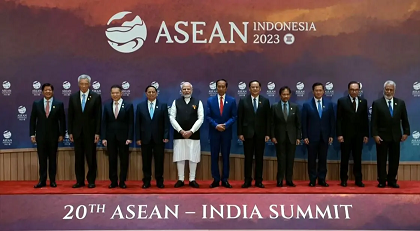
ASEAN summit Courtesy: ANI
22 September 2023

ASEAN’s uphill diplomatic challenge

The recent ASEAN Summit and East Asia Summits stressed the region's centrality and unity while also revealing its principal challenge: managing strategic contestation between the U.S. and China. The outcomes of both summits are reflective of ASEAN's diplomatic and strategic dilemmas in Southeast Asia and the Indo-Pacific.

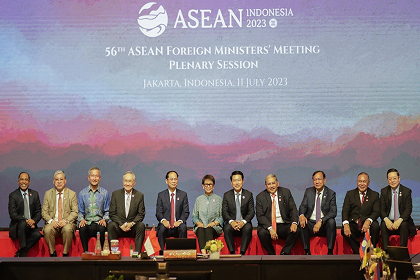
ASEAN Website Courtesy: Kuwait Times
25 July 2023

ASEAN on a trodden path

The 56th ASEAN Foreign Ministers Meeting in Jakarta reflected the grouping’s resilience amidst transformative geopolitical changes in the Indo-Pacific. Striving for unity and centrality, ASEAN tackled challenges posed by COVID-19, economic slowdown, climate change, and U.S.-China competition. However, internal differences on sensitive issues like Myanmar have tested its credibility.

carousel-ocean-indian Courtesy: United Nations Economic Commission for Africa
2 March 2023

Perceptions of Africa’s Role in the Western Indo-Pacific: An Indian Perspective

The Indo-Pacific is viewed by powers within and outside the region as both a strategy and policy to interpret the changing geopolitical dynamics in Asia and beyond. But the question of its geographical and geopolitical definition has varied. Opinions among governments and academics have traditionally differed, but over the years, a viable consensus for a wider definition of the concept seems to have emerged.

Indonesia Trade Courtesy: Shutterstock//Creativa Images
26 September 2022

Trade ties support Indonesia’s G20 year

Indonesia has managed its G20 Presidency year by understanding the importance of not going it alone. This trading nation has used its deep regional and multilateral cooperative processes which provided trusted back-up and support at every step, and was book-ended by strong linkages and investment partnerships with Japan and Australia. In this, it has laid the groundwork for India’s 2023 presidency.

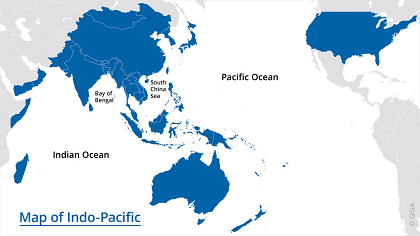
GIGA_map_of_Indo-Pacific_Kontur_resize Courtesy: Science Po
28 July 2022

India’s blue economy and the Indo-Pacific’s future

The Indo-Pacific region envisages the Indian and Pacific Oceans as a continuum and stands on two central pillars – maritime security and economic development. The public discussions, however, are focused on maritime security, strategy and geopolitics, while economic development has received less attention. This imbalance can be corrected by creating an awareness on how to harness the potential of the region's Blue Economy and its vast resources and opportunities.

twitterCPR Courtesy: Juggernaut
20 July 2022

How China Sees India and the World

In his new book, former Foreign Secretary Shyam Saran demystifies China's imagined belief of itself as the Middle Kingdom. Contemporary China's propensity to cut and paste history has resulted in China's resentment of India based on a limited understanding of Indian history and of China's past recognition of India as an advanced civilisation which impacted Chinese culture. Today the West recognises India's potential to match China, with depth and skills, over the long term.

srinagar1 Courtesy: iStock Images
5 July 2022

G20 positioning from Srinagar?

Holding one of the G20 meetings in Jammu and Kashmir is a bold, audacious and timely move. It is possible because of the ceasefire along the Line of Control which has been holding since February 25, 2021. The new geopolitical setting offers India an opportunity to diplomatically disdain the Chinese, camping not too far away in the un-demarcated border areas with India.