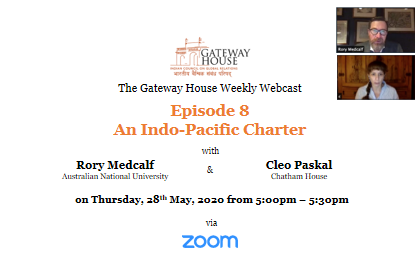
Indo-Pacific: New Geostrategic Reality
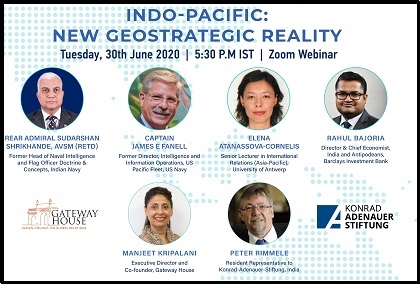
On 30th June, 2020 Gateway House in association with Konrad-Adeneur-Stiftung (KAS) co-hosted a webinar on Indo-Pacific: New Geo strategic reality.

 Courtesy: Gateway House
On 30th June, 2020 Gateway House in association with Konrad-Adeneur-Stiftung (KAS) co-hosted a webinar on Indo-Pacific: New Geo strategic reality.
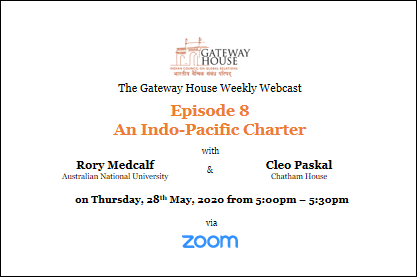
Manjeet Kriplani, Executive Director, Gateway House, in discussion with Prof. Rory Medcalf, Head, National Security College, Australian National University, and author of Indo-Pacific Empire: China, America and the Contest for the World's Pivotal Region; and Cleo Paskal, Associate Fellow, Energy, Environment and Resources, and Asia-Pacific, Chatham House; on the possibility of an Indo-Pacific Charter for the region.
 Courtesy: Gateway House
Manjeet Kripalani, Executive Director, Gateway House, in discussion with Prof. Rory Medcalf, Head, National Security College, Australian National University, and author of Indo-Pacific Empire: China, America and the Contest for the World's Pivotal Region; and Cleo Paskal, Associate Fellow, Energy, Environment and Resources, and Asia-Pacific, Chatham House; on the possibility of an Indo-Pacific Charter for the region.
 Courtesy: Gateway House
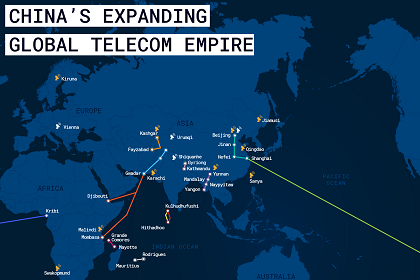
This version of the Gateway House Map on China’s Expanding Global Telecom Empire identifies some more telecommunication assets -- optic-fibre and satellite ground stations -- that Beijing is working on in South and Central America, Africa, Myanmar, the Indian Ocean Region and mainland China besides the existing ones, such as the Pakistan East Africa Cable Express (PEACE). It shows the direction China’s investment is taking, its diplomatic overtures and the larger geopolitical implications of its growing telecom empire
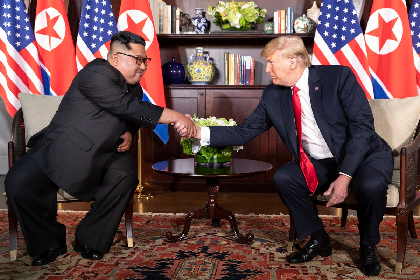 Courtesy: Wikimedia
The June 12 summit was characterised by give-and-take as opposed to the one-way approach practised by earlier U.S. administrations. All countries welcomed the agreement and there is hope that this realism will enable the United States to address other contentious issues too
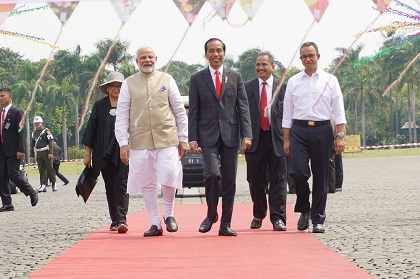 Courtesy: MEA Flickr
Prime Minister Modi’s visits to South East Asia last week were major steps in furthering the goals of India’s Act East Policy even as major power rivalries unfolded in the region. Most significant was the visit to Indonesia, a low key Asian power but one that India can partner to enhance its regional stature.
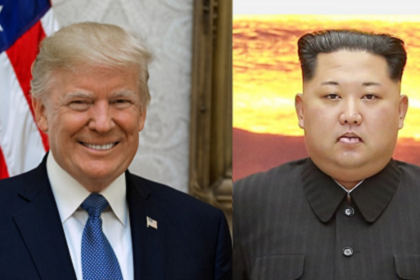 Courtesy: Wikipedia
A historic summit is scheduled to take place on June 12. Three participants—the two Koreas and the U.S.—were involved in effecting the rapprochement that has preceded it. And for once, China is playing catch-up. Here is how it came about
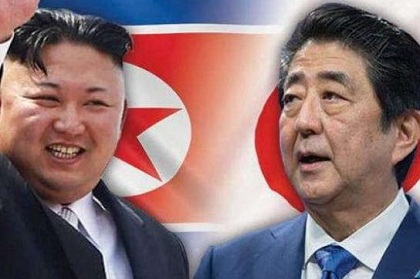 Courtesy: View.mn
North Korea's overtures to its immediate strategic neighbours through a series of summits have excluded Japan, which has long regarded Pyongyang's nuclear weapons and missile development programmes a direct threat. It is reacting by reaching out to the U.S., North Korea and China
 Courtesy: India Strategic
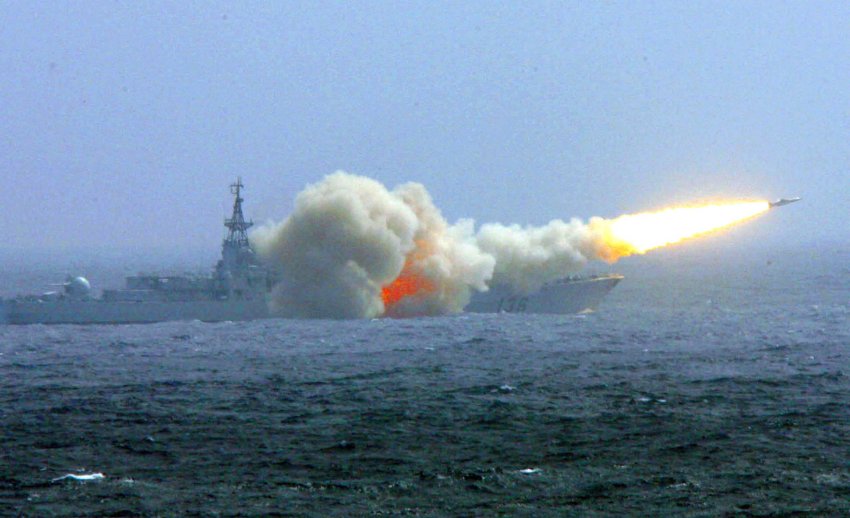
The recent re-evaluation by the US, China, Japan, and Russia of their military strategies reflects new geopolitical equations in which the Asia Pacific is a major strategic intersection. Turmoil in this region can impact India’s trade and security interests, and to avoid this India must craft a balance between its relations with all the countries involved
 Courtesy: Gateway House
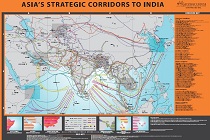
The map – Asia’s Strategic Corridors to India – has emerged from Gateway House’s study of India’s strategic links with other parts of Asia. It highlights the progress India has made in forging multiple links with six strategic regions – Central Asia, West Asia, East Africa, South-East Asia, East Asia, and our immediate neighbourhood