Mid-East: Belligerence vs. evolution
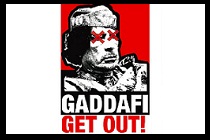
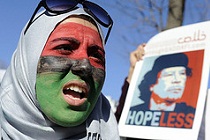
As the young protesters in Libya struggle to rewrite the contract between the people and their rulers to make them more accountable, the world is reacting in predictable ways.

 Courtesy: Feb17.info
As the young protesters in Libya struggle to rewrite the contract between the people and their rulers to make them more accountable, the world is reacting in predictable ways.
 Courtesy: CrethiPlethi/Flickr
As the Arab world reinvents itself in real time, the rest of the world must begin to understand the region as something more than a source for oil and a market for armaments and consumer goods.
In the last few months, South Asia has gone from being just a global security headache, to a region with new possibilities. Teresita C. Schaffer, former US ambassador to Sri Lanka, and Howard Schaffer, former US ambassador to Pakistan and Bangladesh, discuss the major challenges that confront the US in South Asia.
 Courtesy: NinaAldinThune/Wikimedia
There are more than Western interests at play in Egypt. The other catalysts for the unrest are a combination of Iranian adventures, hypocritical policies of West Asian regimes and resurgent commodity speculation in western markets, triggering a rise in prices of basic items in emerging markets
 Courtesy: SamanthaAppleton/WhiteHouse
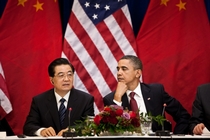
Indo-US business dealings and the US Federal Reserve’s money-printing initiative may have saved Chinese President Hu Jintao the headache of explaining – to his American counterpart – China’s stealth fighter shocker, undervalued currency and giant trade surplus.
 Courtesy: ChuckKennedy/WhiteHouse
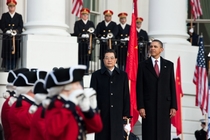
Chinese President Hu Jintao’s visit to the US comes at a time when the geopolitical situation in Asia and the Asia-Pacific region is fluid - consequent to the US deciding to re-energise relations with countries in the region - and when Sino-US relations have been under some strain.
 Courtesy: PeteSouza/WhiteHouse
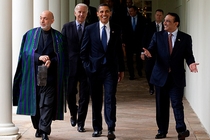
A week after Salman Taseer's murder, US Vice President Joseph Biden flew to Pakistan to "gauge priorities" in the Af-Pak region. India, Ambassador Neelam Deo says, must not allow itself to become a victim of American imperatives and Pakistani maneuvers.
 Courtesy:
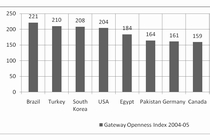
Over the past decade, emerging markets that have liberalized are far more open to foreign banks in their markets than are developed economies. A Gateway House study of financial services in 11 countries: four BRIC countries, one emerging market, four developed economies and two developing markets.
 Courtesy: PeteSouza/WhiteHouse
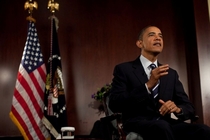
For a moment, President Obama’s Asia tour served as a diversion from the abysmal results of the US midterm election. By the end of the tour, the Obama administration was swept up in the backlash of currency crisis. Can Barack Obama be the president America needs?
 Courtesy: MogensEngelund/WikiCommons
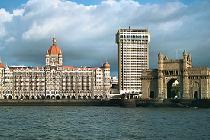
By coming to Mumbai first, President Obama has ushered in a new phase in bilateral relations. Mumbai and all it represents is now firmly a part of Indian foreign policy. This is a game changer for the future, and is arguably the most significant outcome of the Barack Obama visit.