PM Modi’s five-nation tour
PM Modi's five-nation tour highlights that despite geopolitical conflicts, New Delhi remains confident in its ability to balance relationships with the North and South.

 Courtesy: X / PMOIndia
PM Modi's five-nation tour highlights that despite geopolitical conflicts, New Delhi remains confident in its ability to balance relationships with the North and South.
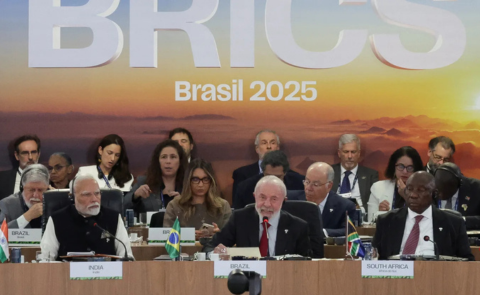 Courtesy: Ricardo Moraes / Reuters
While BRICS does have a wise agenda, backed by considerable unity, it is not in a strong position to garner the world’s support for it. The fissures within the G7, the tensions between the U.S. and Europe, and the unilateralism of Washington leave little room for BRICS to develop an international consensus on the issues agreed at the recent Rio Summit.
 Courtesy: X / narendramodi
BRICS is undergoing a major transformation—expanding its membership, redefining its global role, and navigating geopolitical tensions. As the group prepares for the Rio Summit in July 2025, key challenges include integrating new members, reforming multilateral institutions, and balancing economic ambitions with strategic unity. With India set to chair in 2026, the bloc’s evolving identity will shape its global influence.
 Courtesy: X / PMOIndia
PM Modi's multi-country visit from 15-19 June to Cyprus, Canada, and Croatia demonstrated India's expertise in nurturing ties with great powers, middle powers and state powers. The common thread was twofold: to represent India at the still-important summit of the Group of Seven in Alberta, and to push India’s strategic partnership with the EU, by forging closer ties with the countries of eastern and central Europe.
 Courtesy: Adem Altan/AFP via Getty Images
Iranian foreign policy must move toward strategic autonomy and internal concord. As witnessed after the 1988 ceasefire with Iraq, such moments can mark an inflexion point - one that prioritises national reconstruction, resilience, and welfare; strategic recalibration, strengthening of confidence, and finding a geopolitical identity. Iran has been there before, and can apply those experiences again.
 Courtesy: Defense News
Warfare is changing its character, and drones are playing a big role in it. Technology that was first extensively used in the Vietnam war is a current conflict staple. With the increasing use of artificial intelligence, drones are becoming more powerful and useful.
 Courtesy: U.S. Embassy & Consulates in India
The July 2 meeting of the QUAD foreign ministers in Washington, D.C., restated all the commitments of the grouping, including a condemnation of the April 22 terrorist attacks on Pahalgam. Yet, none of the QUAD countries actually came to the aid of India, despite China being a present player in the fight, in full support of its partner Pakistan.
 Courtesy: Times Now
India and the U.S. are now on the verge of establishing a comprehensive trade agreement, overcoming a long history of bilateral trade challenges. This is a pivotal moment that could lead to mutual benefits and a deeper partnership. It will also illumine the path for other modern trade agreements that India is currently negotiating with multiple countries.
 Courtesy: Reuters photo
Presidential visits abroad are high-level instruments of statecraft and, more often than not, signals of geopolitical priorities. The recent visit of U.S. President Donald Trump to the United Arab Emirates, Saudi Arabia, and Qatar, exemplified this, indicating the administration's policy orientation.
 Courtesy: Reuters
The India-UK Free Trade Agreement comes amidst increasing economic uncertainty caused by the Trump administration’s reciprocal tariff policies. The FTA has revitalised previously lethargic discussions for India to conclude FTAs between like-minded countries. An India-EU FTA, along with the India-UK FTA, may reform global rule-making on international trade and perhaps even revive the WTO.