Indo-Pacific: New Geostrategic Reality
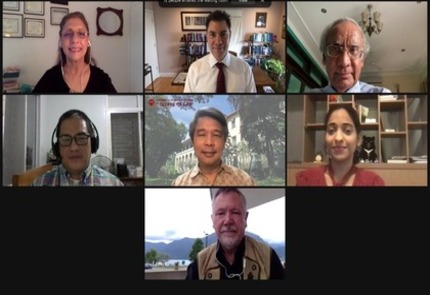
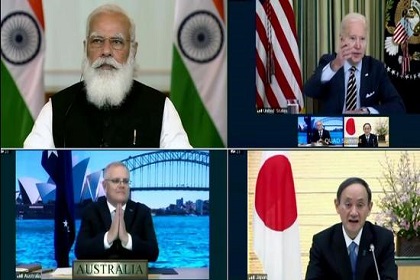
On 30th June, 2020 Gateway House in association with Konrad-Adeneur-Stiftung (KAS) co-hosted a webinar on Indo-Pacific: New Geo strategic reality.
Courtesy: Gateway House
On 30th June, 2020 Gateway House in association with Konrad-Adeneur-Stiftung (KAS) co-hosted a webinar on Indo-Pacific: New Geo strategic reality.
Courtesy: Shutterstock
The shifting geopolitics of the COVID-19 crisis might be an opportune time for India to consider new strategies for managing and curtailing Pakistan’s military aggression for the future. One policy tool used effectively by other countries is the imposition of economic sanctions. This podcast discusses the possibility of India imposing sanctions on Pakistan.
Courtesy: Gateway House
In this webcast, we discuss India's Diplomacy during the COVID-19 pandemic with David Rasquinha, Managing Director, Exim Bank, Amb. Rajiv Bhatia, Distinguished Fellow, Foreign Policy Studies Programme, Gateway House and Nayanima Basu, ThePrint.
Courtesy: Gateway House
Amit Bhandari, Energy & Environment Fellow, Gateway House; Blaise Fernandes, President, Indian Music Industry Association; Ambika Khanna, Senior Researcher, International Law Programme, Gateway House discuss the reaction to China’s increased investment in HDFC, the depth and motive for China's investments in India, and the new FDI rules put in place by the government to protect strategic investments in the country.
Courtesy: Shutterstock
India should stop looking at Afghanistan through the Pakistan prism and be a major contributor in the development of peace and prosperity in the country
Courtesy: Shutterstock
The signing of an agreement between the U.S. and the Taliban on February 29 may result in the withdrawal of U.S. troops from Afghanistan, which is contingent upon the Taliban’s adherence to certain conditions. The end of the West’s 19-year-long Afghan campaign – if Pakistan does not turn spoiler – is of vital interest to India
Courtesy: MEA/Flickr
The outcome of the U.S. presidential elections could have a significant impact on the deepening Indo-U.S. bilateral. The partnership has grown substantially in the last two decades resulting in a deepening of economic and strategic relations. Defence dominates the strategic partnership and also stimulates the economic engagement. The newly signed BECA agreement is a testament to this. The next U.S. administration's policies will be critical for India, given repeated Chinese incursions into Indian territory on the Line of Actual Control at the border, the U.S.-China rivalry and China's ambitions to dominate Asia. Gateway House has an extensive repository of primary research, analysis and reporting on the Indo-U.S. bilateral, addressing issues such as trade, technology exchange and defence cooperation.
Courtesy: MEA/Flickr
In the run-up to President Trump’s visit to India on 24-25 February 2020, Ambassador Neelam Deo, Director and Co-founder of Gateway House, discusses in this interview how he has made balanced trade a global issue, but given substance to the India-U.S. defence bilateral, sharpening the concept of the Indo-Pacific and the Quad’s profile
Courtesy: MEA/Flickr
U.S. President Donald Trump’s first presidential visit to India later this month bodes well for bilateral relations. It is a continuing foreign policy success story for the two countries extending through four U.S. administrations and three Indian ones. A curtain raiser on what to expect.
Courtesy: Shutterstock
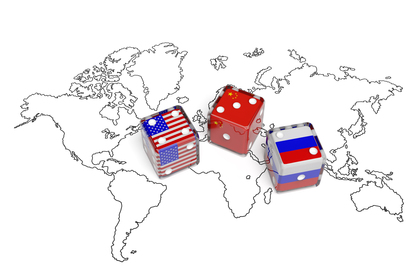
The U.S.-China Trade Agreement, concluded on 15 January 2020, was the result of a trade war. It is limited to agriculture, mainly, and select service sectors of American interest, with provisions designed to prevent imbalances and distortions