Countering China's Maritime Greyzone activities Courtesy:
22 July 2021

Countering China’s Maritime Grey Zone Activities

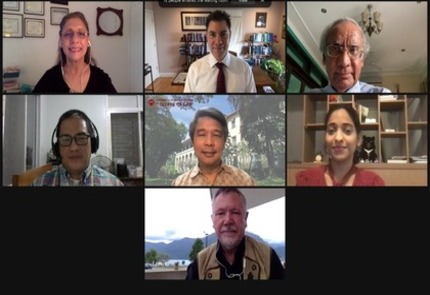
On 15 July, Gateway House co-hosted a webcast with Konrad-Adenauer-Stiftung (KAS) on 'Countering China’s Maritime Grey Zone Activities'. The panel discussed the potential strategies that smaller nations in the region can adopt to overcome the challenges of Chinese maritime grey zone activities, and the role of regional maritime powers in capability-building of maritime law enforcement agencies.

sanctions and counter-sanctions Courtesy: Shutterstock
15 July 2021

Sanctions and counter-sanctions

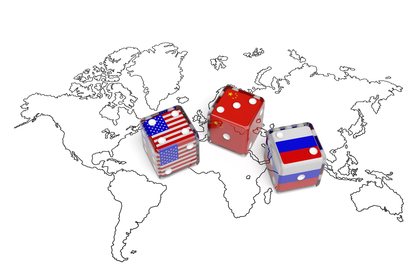
For years, Western countries have used sanctions as a means of economic warfare against their adversaries. Now, China and Russia are utilising the same tactic against the West. The United Nations Security Council is paralysed by differences between the five permanent members, leaving the tools of unilateral sanctions and counter-sanctions to proliferate at the cost of UN-approved multilateral sanctions.

Source: Shutterstock Courtesy: Shutterstock
3 June 2021

The Quad hits its stride

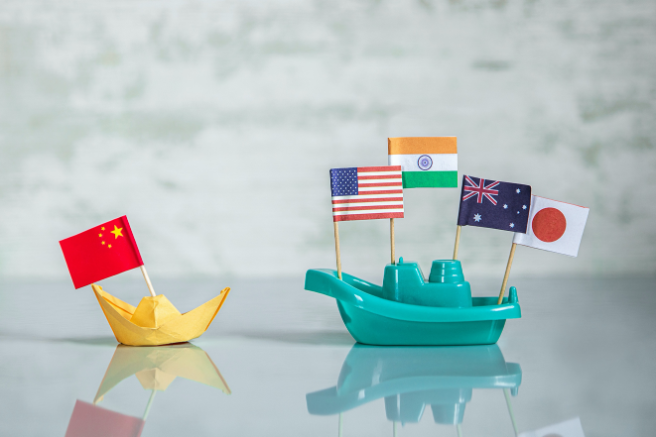
As China’s global competitive edge is sharpening across the military, economic, diplomatic, and technological domains, it is clear that the extent to which the Quad countries (Australia, India, Japan, and the United States) can collaborate across all four domains will be an important factor in determining whether China’s hegemonic designs on the Indo-Pacific will succeed.

P051085-560456 Courtesy: European Commission
13 May 2021

India-EU: Everything is in place

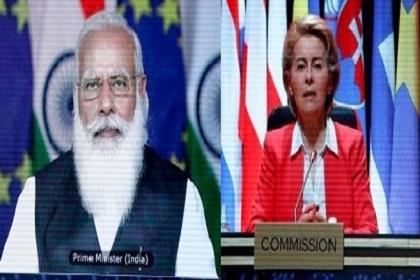
This India-EU summit was different from the ones past, and India is a significant gainer. A trade agreement and connectivity partnership aside, the EU has stepped up to help India during this emergency, viewing it not as a weak state but as a partner in distress. The geopolitical indicators for an enhanced engagement are now also in place.

WhatsApp Image 2021-05-06 at 14.00.05 (1) Courtesy: Gateway House
6 May 2021

The New Age of Globalisation – Digital manufacturing opportunities for India

Digital Manufacturing in India can bring in a new age globalisation of manufacturing, and developing resilient, transparent and trusted supply chains. With the help of MNCs, start-ups and government in accelerating digital adoption, and India must become part of the emerging global trading system, using the COVID-19 pandemic to accelerate digitisation.

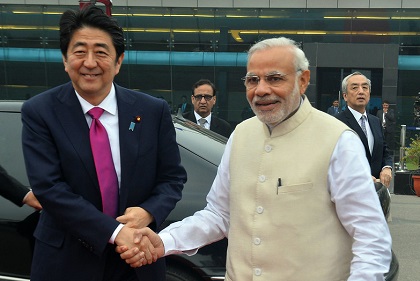
Rajiv Bhatia_Image Courtesy: Gateway House
12 November 2020

India-SCO: New Platform, Common Ground

India will host the 19th meeting of the Council of Heads of Government on 30 November 2020. This will be the first meeting of the grouping’s second highest organ, hosted by India. The significance of the event lies in the timing – India’s relations with two fellow memberstates, China and Pakistan, are at an exceptionally low ebb; yet the clear message from the SCO Secretariat and other member-states is: India’s presence in the SCO is highly beneficial to the latter and should be fully leveraged to strengthen it as an important and upcoming intergovernmental organisation. This necessitates a fresh appraisal of options for India.

shutterstock_1752673730 Courtesy: Shutterstock
30 July 2020

A New World for India and the United States

The recent rush of U.S. capital into India’s digital future, and India’s recent structural reforms, is the impetus for an attractive collaboration between the U.S. and India. To really succeed, the U.S. will have to support India with the same kind of technical assistance and best practices in areas like regulation, distribution, and innovation, that it gave China. The alternative is for India to follow Europe’s regulatory model, which places less of an emphasis on job growth and innovation.

Webcast 3 - website Courtesy: Gateway House
30 April 2020

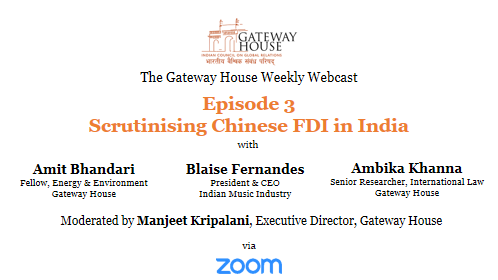
Gateway House Webcast: Scrutinising Chinese FDI in India

Amit Bhandari, Energy & Environment Fellow, Gateway House; Blaise Fernandes, President, Indian Music Industry Association; Ambika Khanna, Senior Researcher, International Law Programme, Gateway House discuss the reaction to China’s increased investment in HDFC, the depth and motive for China's investments in India, and the new FDI rules put in place by the government to protect strategic investments in the country.