Demystifying Maritime Lawfare Courtesy: Shutterstock
2 September 2021

Demystifying Maritime Lawfare

A new maritime law in China allows it to supervise all foreign vessels which appear in the country's "territorial waters" - many parts of which are internationally disputed. Nationalistic maritime actions such as China’s aggression in the South China Sea and Russia’s actions in the Black Sea, has revived international focus on maritime law. In this podcast, Dr Stefan Talmon, professor and co-director at the Institute of International Law, University of Bonn, interprets maritime law in the two hotly contested seas.

four dimensions of the quad Courtesy: Shutterstock
10 June 2021

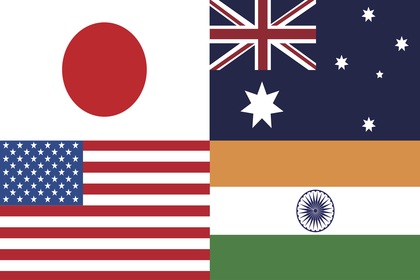
Four dimensions of the Quad

The Quad countries are preparing for an autumn summit in Washington, which will provide an opportunity to discuss multilateral cooperation in various sectors. Four dimensions which merit closer attention and are crucial to the group's future are the Indo-Pacific strategies of European countries and the EU, partnerships with ASEAN and its members, closer India-U.S. ties and maritime security issues in the Pacific.

46658837911_46b856f8ef_o Courtesy: MEA Flickr
10 January 2019

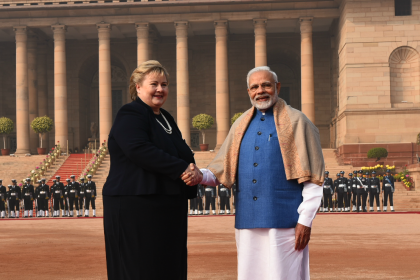
India, Norway and the Blue Economy

Norwegian prime minister Erna Solberg’s visit to India earlier this week had a central focus: strengthening economic and technological cooperation in the Blue Economy. This is an area in which her country has considerable expertise and with which Indian business needs to collaborate in managing industries, such as oil, shipping, fisheries and aquaculture in a ‘green’ way

2-8-18 CableMap-02 - Copy Courtesy: Gateway House
2 August 2018

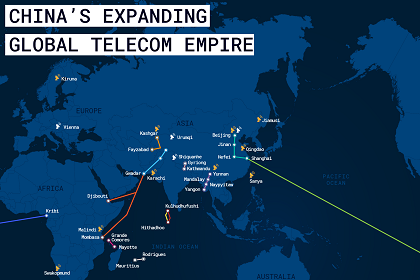
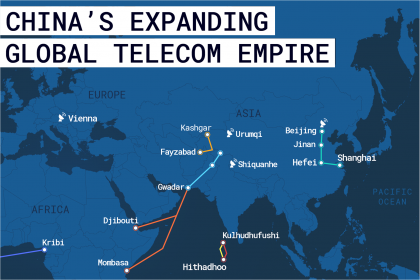
Version 2: Mapping China’s global telecom empire

This version of the Gateway House Map on China’s Expanding Global Telecom Empire identifies some more telecommunication assets -- optic-fibre and satellite ground stations -- that Beijing is working on in South and Central America, Africa, Myanmar, the Indian Ocean Region and mainland China besides the existing ones, such as the Pakistan East Africa Cable Express (PEACE). It shows the direction China’s investment is taking, its diplomatic overtures and the larger geopolitical implications of its growing telecom empire

CableMap-web Courtesy: Gateway House
5 April 2018

Version 1: China’s strategic edge in covert communications

China is steadily deploying state-of-the-art communications systems to connect its strategic and economic assets in Asia. It is then linkingthe Asian mainland to Africa, and Africa to South America. The investment spree is rapidly making Beijing a major player in global telecommunications – and ‘informationisation warfare’.

28912263963_0b75893744_h Courtesy: MEA/ Flickr
14 February 2017

Indo-Pacific: a scenario of possibilities

The Indo-Pacific region is home to some of the largest and most rapidly growing economies as also powerful military forces. Nuclear threats, international terrorism and climate change are some of the issues that define the region. Uncertainty dogs relations among the four nations in the top league—U.S., China, India and Japan—but what is emerging is a hawkish, policy stance from the U.S. as opposed to an isolationist outlook apprehended earlier

Maritime Cover Courtesy: Wikipedia
22 December 2016

India-EU: maritime security cooperation

With common objectives in the Indo-Pacific, the maritime sphere is a good opportunity for India and the EU to deepen cooperation. They must focus on preventing outbreak of an inter-state armed conflict; addressing maritime piracy; adhering to the UNCLOS; and developing maritime infrastructure and the blue economy in the region

southblock Courtesy: rajkumari1220/Flickr
18 April 2014

Circles & Corridors of Economic Diplomacy

India’s political and economic future will be determined over the next few weeks. Gateway House recommends a priority diplomacy agenda for the next government – one which puts economics at the heart of our foreign policy

ind jap Courtesy: generalising/Flickr
6 November 2013

The new Indo-Pacific core

The India-Japan alliance needs to be viewed through a prism broader than that of "containing" China, and by treating the Indian and Pacific oceans as a single entity. Such an alliance has the potential to strengthen the geopolitical security of India and Japan, along with that of all their allies and associates