AUKUS spurs EU's Indo-Pacific ambitions Courtesy: EuroNews
25 November 2021

AUKUS spurs EU’s Indo-Pacific ambitions

The news of the EU's much-awaited Indo-Pacific strategy was overshadowed by the Australia-UK-U.S. military alliance, AUKUS. Eight weeks later, tempers are cooling off as the U.S and EU signed agreements at COP26. So, are transatlantic good times back on track? Has AUKUS put a permanent spanner in the wheel of the EU’s Indo-Pacific outreach?

Europe - IP Courtesy: Club of Three
18 November 2021

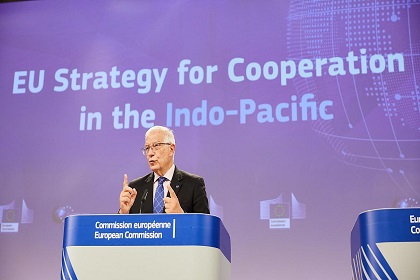
Indo-Pacific through the European prism

The EU's Indo-Pacific strategy, released in September, set the tone for a renewed focus on the region. Europe's Asia connect is rich, strong and multi-layered, laying the foundation for an advantageous position for the EU in the Indo-Pacific. This can be achieved if the EU is more candid with itself, more assertive with China, and more cooperative with India.

Demystifying Maritime Lawfare Courtesy: Shutterstock
2 September 2021

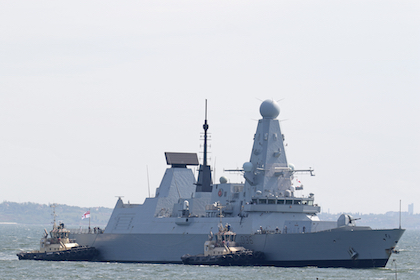
Demystifying Maritime Lawfare

A new maritime law in China allows it to supervise all foreign vessels which appear in the country's "territorial waters" - many parts of which are internationally disputed. Nationalistic maritime actions such as China’s aggression in the South China Sea and Russia’s actions in the Black Sea, has revived international focus on maritime law. In this podcast, Dr Stefan Talmon, professor and co-director at the Institute of International Law, University of Bonn, interprets maritime law in the two hotly contested seas.

Countering China's Maritime Greyzone activities Courtesy:
22 July 2021

Countering China’s Maritime Grey Zone Activities

On 15 July, Gateway House co-hosted a webcast with Konrad-Adenauer-Stiftung (KAS) on 'Countering China’s Maritime Grey Zone Activities'. The panel discussed the potential strategies that smaller nations in the region can adopt to overcome the challenges of Chinese maritime grey zone activities, and the role of regional maritime powers in capability-building of maritime law enforcement agencies.

four dimensions of the quad Courtesy: Shutterstock
10 June 2021

Four dimensions of the Quad

The Quad countries are preparing for an autumn summit in Washington, which will provide an opportunity to discuss multilateral cooperation in various sectors. Four dimensions which merit closer attention and are crucial to the group's future are the Indo-Pacific strategies of European countries and the EU, partnerships with ASEAN and its members, closer India-U.S. ties and maritime security issues in the Pacific.

shutterstock_1091235845 Courtesy: Shutterstock
15 October 2020

UN: Necessary but reformed

The UN turned 75 this year but instead of grand celebrations, the world witnessed an empty UNGA with world leaders addressing it via video screening because of the pandemic. The UN is under unprecedented stress and being shown up for its inability to tackle the challenges of today like the pandemics, climate change, terrorism or global peace and security. The institution's key governing structures, especially the UN Security Council, are inadequate and demand reform. India must now use gritty resolve to ensure its place in these governing structures.

shutterstock_1049895998 Courtesy: Shutterstock
10 September 2020

India and Asean in a VUCA world

Ambassador Rajiv Bhatia, Distinguished Fellow, Foreign Policy Studies Programme, Gateway House delivered the opening remarks at the 2020 Asia Economic and Entrepreneurship Summit, in the lead-up to the session, - The Future of Asia Pacific Economic Cooperation in a Sustainable VUCA World – What to Expect? What Next? The Summit was jointly organised by the KSI Strategic Institute for Asia Pacific (KSI), The Pacific Basin Economic Council (PBEC) and China Daily Asia Pacific (CD), Kuala Lumpur, 8 September 2020.

2-8-18 CableMap-02 - Copy Courtesy: Gateway House
2 August 2018

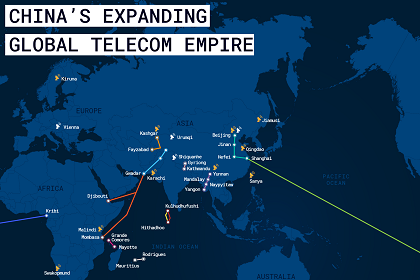
Version 2: Mapping China’s global telecom empire

This version of the Gateway House Map on China’s Expanding Global Telecom Empire identifies some more telecommunication assets -- optic-fibre and satellite ground stations -- that Beijing is working on in South and Central America, Africa, Myanmar, the Indian Ocean Region and mainland China besides the existing ones, such as the Pakistan East Africa Cable Express (PEACE). It shows the direction China’s investment is taking, its diplomatic overtures and the larger geopolitical implications of its growing telecom empire